

Taiwanese civic groups and Taiwan-based Hong Kongers in Taipei yesterday voiced support for Hong Kong pro-democracy activist Joshua Wong (黃之鋒), calling on the Hong Kong government to drop the charges against him and immediately and unconditionally release Wong and other Hong Kong political prisoners.
Wong, the former secretary-general of pro-democracy group Demosisto, is imprisoned in Hong Kong’s Stanley Prison for his conviction for “subversion of state power.”
While serving his sentence, he was charged again by Hong Kong police. Prosecutors alleged that between July and November 2020, Wong conspired with former lawmaker Nathan Law (羅冠聰) and others to call on foreign governments and organizations to impose sanctions, a blockade or other hostile actions against Hong Kong and China.
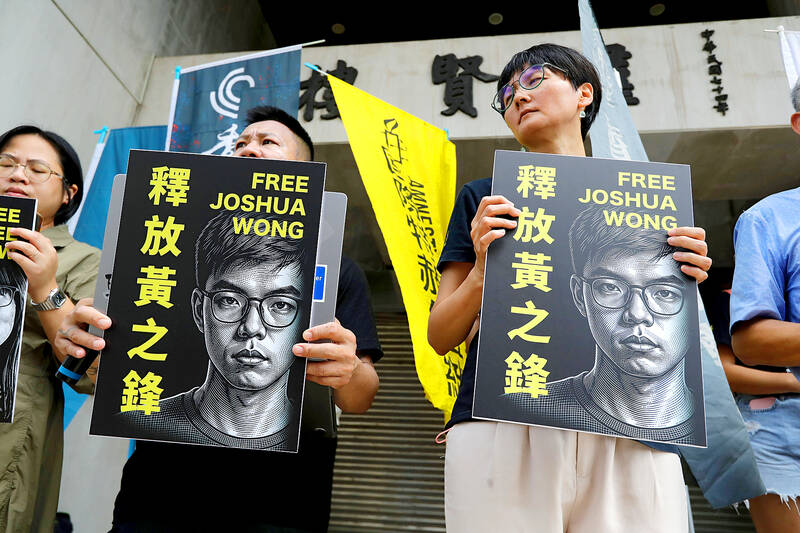
Photo: AP
This is the second time Wong has been prosecuted under the Hong Kong National Security Law. Under the law, the offense generally carries a prison sentence of three to 10 years. If the offense is deemed “serious,” the sentence can be increased to 10 years or more, up to life imprisonment.
Wong yesterday pleaded guilty to foreign collusion in a second national security trial against him that could see him jailed for life.
At the Taipei rally in front of the Legislative Yuan, Hong Kong Outlanders secretary-general Sky Fung (馮紹天) said that Hong Kong’s national security laws were being used to suppress dissidents and restrict Hong Kongers’ freedoms.
The groups put forward four demands.
The first is for all charges against Wong to be dropped and for him to be released immediately and unconditionally.
The second is for the Hong Kong government to stop using the Hong Kong National Security Law and the Safeguarding National Security Ordinance to suppress peaceful advocacy, freedom of expression, freedom of association and international human rights efforts.
Third is the immediate release of all Hong Kong political prisoners jailed for exercising their rights to freedom of expression, association and peaceful assembly.
Fourth, they called on the Taiwanese government to publicly voice its support and work with the international community to monitor Wong’s case, his treatment in prison and the plight of Hong Kong political prisoners.
Hong Kong Human Rights Front founder Henry Tong (湯偉雄) said that many Hong Kongers have been imprisoned for exercising their rights to freedom of expression, association and peaceful assembly since the anti-extradition protests.
Shih Yi-hsiang (施逸翔), a senior researcher at the Taiwan Association for Human Rights, said the Hong Kong government had signed the International Covenant on Civil and Political Rights (ICCPR), yet has deprived Wong of his liberty for more than 2,100 days.
In its 2022 concluding observations, the UN Human Rights Committee directly criticized the Hong Kong government for applying the National Security Law in an overly broad and arbitrary manner, criminalizing legitimate cross-border advocacy and using it to suppress freedom of expression and the right to participate in public affairs, Shih said.
New School for Democracy Association secretary-general Kung Chin-lung (龔欽龍) said the National Security Law had helped silence criticism in Hong Kong and abroad by creating fear of imprisonment.
Taiwanese human rights activist Lee Ming-che (李明哲) said that regardless of the outcome of Wong’s trial, the case would go down as one of the most shameful episodes in human history, adding that it reflected the corruption of the Chinese government.
“Taiwan should learn from Hong Kong’s experience and reject the Chinese government’s attempts to exert influence over Taiwan,” he said. “Taiwan must refuse to become the next Hong Kong.”
Additional reporting by AFP

A Straits Exchange Foundation official today warned that yielding to political pressure in exchange for access to China’s entertainment industry rarely ends well, amid rumors that China is seeking to lure Taiwanese K-pop star Chou Tzu-yu (周子瑜). Chou, more commonly known as Tzuyu, is the only Taiwanese member of the girl group Twice. Her contract with JYP Entertainment is set to expire at the end of this year, and there have been widespread reports that she would not renew it. She is reportedly planning to pursue solo activities under her parents’ agency, Yu Hai Entertainment (瑜海娛樂), although China has also reportedly offered
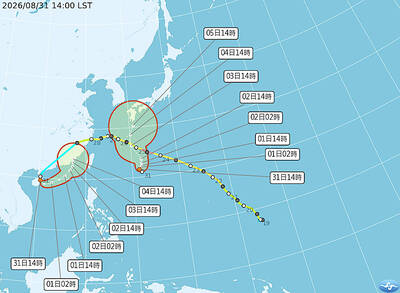
A tropical depression near Hainan that was once Typhoon Saudel may once again strengthen into a tropical storm, the Central Weather Administration (CWA) said yesterday, but a sea warning for waters around Taiwan is unlikely. CWA forecaster Huang En-hung (黃恩鴻) said that Saudel would return to being a weak tropical storm by late yesterday or early this morning. However, as the storm is to gradually weaken again and would head toward China’s Guangdong Province away from Taiwan, the chances that it would affect Taiwan enough for the CWA to issue a sea warning are relatively low,

Yielding to political pressure in exchange for access to China’s entertainment industry rarely ends well, a Straits Exchange Foundation official said yesterday amid rumors that China is seeking to lure Taiwanese K-pop star Chou Tzu-yu (周子瑜). Chou, who goes by Tzuyu, is the only Taiwanese member of the girl group Twice. Her contract with JYP Entertainment is set to expire at the end of this year, and there have been widespread rumors that she would not renew it. She is reportedly planning to pursue a solo career under her parents’ agency, Yu Hai Entertainment, although China has also reportedly offered to help Tzuyu
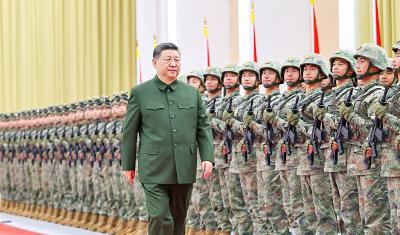
China has revised its National Defense Mobilization Law to prepare for a rapid transition to wartime, with an official today saying the measures are aimed at helping Chinese President Xi Jinping (習近平) fulfill his “historic mission of national unification.” The revised version of the mobilization law is to take effect on Oct. 1, marking the first major revision since the law was enacted in 2010. The amendments define national defense mobilization as measures taken in response to threats to national sovereignty, unification, territorial integrity, security and development interests, including efforts to ensure rapid transition between peacetime and wartime and convert economic and


 RSS
RSS