


Civic groups yesterday urged the government to establish a formal asylum system to create a haven for human rights after China’s Ethnic Unity and Progress Promotion Law took effect on July 1.
The law prohibits “acts that undermine ethnic unity and create ethnic division,” and states that any organization or person within or outside the People’s Republic of China that commits such acts would be held legally responsible.
At a news conference in Taipei, representatives of civic groups tore up red pieces of paper bearing the national emblem of the People’s Republic of China and the name of the law.

Photo: Wang Yi-sung, Taipei Times
Article 21 of the law requires Chinese authorities to promote cross-strait exchanges that would “enhance Taiwanese compatriots’ sense of belonging, identification and pride in the Chinese people,” thereby unilaterally imposing a national identity on Taiwanese, Judicial Reform Foundation executive committee member and lawyer Chang Ching-Ju (張靜如) said.
Article 10 effectively imposes an obligation on Taiwanese to uphold China’s goal of unification, while Article 63 allows Chinese authorities to hold overseas organization or people legally accountable for acts directed at the People’s Republic of China that authorities deem to undermine “ethnic unity,” she said.
The Judicial Reform Foundation is conducting preliminary research into whether Taiwan’s existing laws can protect the public from extraterritorial jurisdiction or cross-border law enforcement and would consider proposing amendments, Chang said.
The group aims to complete the report by the end of the year, she added.
Taiwan has long lacked an asylum system and instead handles asylum requests case by case, Chang said.
The need for a legally codified system is even more urgent considering the current circumstances, she said.
New School for Democracy secretary-general Cecil Kung (龔欽龍) said the government should establish a high-level, interagency coordination mechanism to oversee responses to transnational legal and security issues arising from China’s new law.
Chinese Nationalist Party (KMT) caucus secretary-general Lin Pei-hsiang (林沛祥) has said that people should not assume that the Chinese Communist Party (CCP) would apply the law to people overseas.
Taiwan Association for Human Rights senior researcher Shih Yi-hsiang (施逸翔) called Lin’s comments an endorsement of the CCP’s authoritarian rule and a tacit acceptance of China’s human rights violations.
“We strongly condemn the KMT for not only failing to denounce the law, but intentionally seeking to defend it,” Shih said.
It is not a law, but rather a tool through which the CCP seeks to suppress people under authoritarian rule and extend the long arm of the law beyond its borders, he added.
Under the law, anyone who criticizes the CCP or is deemed to undermine “ethnic unity” could be subject to human rights abuses, whether they are Chinese living overseas, Taiwanese, Hong Kongers or nationals of any other country, Shih said.
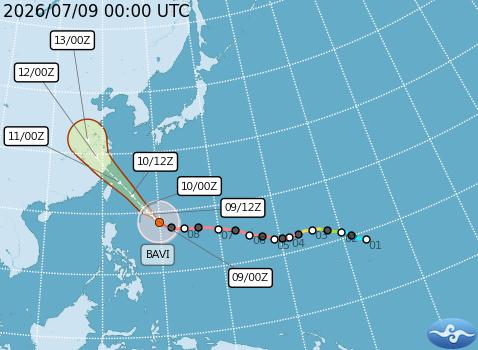
Typhoon Bavi today churned southeast of Taiwan in the Pacific Ocean, its winds easing overnight to just shy of 200kph, as authorities urged residents to stock up on supplies and brace for what could be the most powerful typhoon since 2024. Bavi is set to be the largest storm by size to hit Taiwan since 1987, Central Weather Administration forecaster Jason Chang said, adding that storms of similar size have been "fairly rare in recent years." President William Lai (賴清德) wrote on Facebook that people should prepare supplies from food to torches and shared a video teaching people how to put together
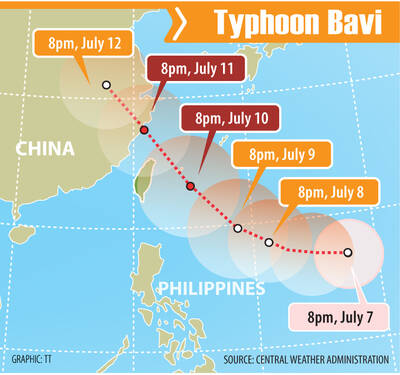
TORRENTIAL: People should be on alert for heavy rain, the CWA said, as Typhoon Bavi is forecast to bring more than 1m of rain to Taiwan Torrential rain brought by Typhoon Bavi is forecast to affect Taiwan most severely on Friday and Saturday, prompting authorities to urge local governments to clear drainage ditches, while nearly 29,000 troops were placed on disaster-prevention standby. As of 2pm yesterday, the typhoon’s center was approximately 1,930km east-southeast of Oluanpi (鵝鑾鼻), Taiwan proper’s southernmost tip, moving west-northwest at 25kph, the Central Weather Administration (CWA) said. Bavi is showing signs of weakening as it approaches Taiwan, although it is still expected to have the intensity of a typhoon, CWA forecaster Lee Meng-hsuan (李孟軒) said. The typhoon has a 350km storm radius, Lee said,
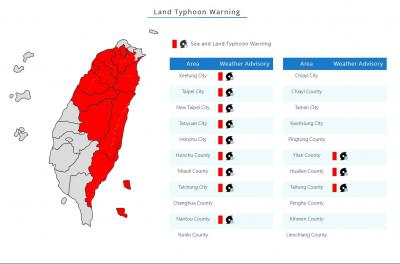
The Central Weather Administration at 5:30am today issued a land warning for Typhoon Bavi, which is expected to have its greatest impact on Taiwan from this evening through tomorrow. As of 8am, the eye of Bavi was about 700km east of Oluanpi (鵝鑾鼻), Taiwan's southernmost point, and was moving northwest at 25kph, the CWA said. The storm was packing maximum sustained winds of 162kph, with gusts of up to 198kph, the weather agency said, adding that Bavi had a storm radius of about 380km. Rainfall is expected to increase in mountainous areas of northern, central and southern Taiwan later today, with the heaviest

Taiwan yesterday stepped up preparations for Typhoon Bavi, suspending ferry services to outlying islands, closing tourist attractions, preparing traffic restrictions and offering flexible airline ticket changes. As of 2pm yesterday, Bavi was about 1,380km east-southeast of Oluanpi (鵝鑾鼻), Taiwan’s southernmost point, moving west-northwest at 17kph to 21kph, the Central Weather Administration (CWA) said. All ferry services in eastern Taiwan were suspended yesterday afternoon, the Maritime and Port Bureau said. Services could resume on Sunday, if the weather permits, it added. The Keelung-Matsu route is also to be suspended from today through Saturday, while routes linking Kaohsiung and Budai (布袋) with Penghu, as well as


 RSS