

The Supreme Court yesterday upheld guilty sentences for three military service members accused of spying for China, but ordered retrials for three other defendants.
The guilty verdicts are final.
The case involved an espionage ring allegedly headed by Ding Xiaohu (丁小琥), a Chinese national who targeted active duty and retired Taiwanese military personnel for recruitment, resulting in secret information being passed to Beijing.
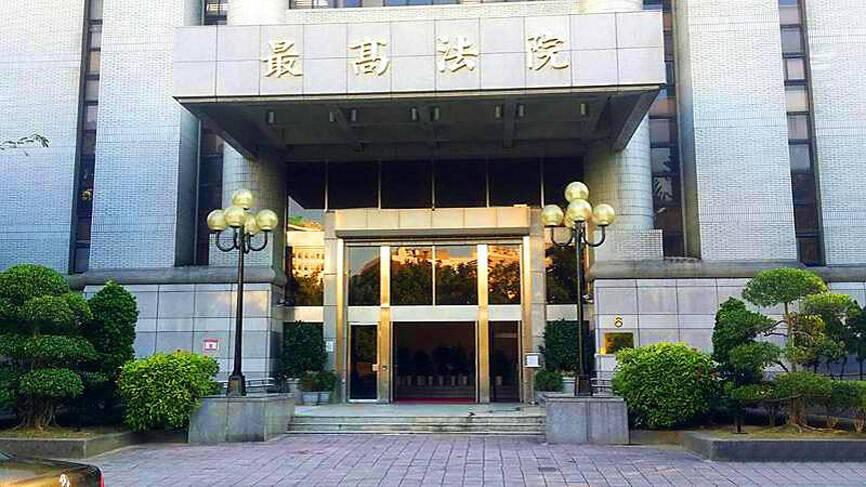
Photo: Wu Cheng-feng, Taipei Times
Last year, the High Prosecutors’ Office indicted Ding and six former and active military personnel over contraventions of the National Security Act (國家安全法) and Criminal Code of the Armed Forces (陸海空軍刑法).
Ding died of an illness in February and his case was dismissed.
Two Taiwanese implicated in the case, Chang Chih-wei (張志煒) and Ho Sheng-ying (何聖影), had died earlier during the investigation.
The Supreme Court upheld the guilty verdict and seven-year prison sentence of retired lieutenant colonel Wang Wen-hao (王文豪), who served in the Army Combat Readiness and Training Division.
It also upheld the guilty verdict and seven-year-and-two-month prison sentence of retired lieutenant colonel Tan Chun-ming (譚俊明), who served in the Air Force Air Defense and Missile Command.
It upheld the guilty verdict and six-year prison sentence of Sergeant Major Lu Fang-chi (呂芳契), who served in the Army Armored Training Command.
It vacated the convictions of Major Colonel Yang Po-chih (楊博智), a staff officer at the Army Northern Region Combined Testing Center, his sister Second Lieutanent Yang Chien-hui (楊千慧), who is a human resources officer at the Air Force Air Defense and Missile Command, and her husband, Major Chiu Han-lin (邱翰林), who serves at the same command as an air defense control officer.
The Supreme Court said that prosecutors must prove the factual basis of the allegations against the three defendants in a retrial at the High Court.
Ding, ostensibly an overseas Chinese and ethnic affairs official at the Changsha municipal government, was with the Nannin branch of the Chinese Central Military Commission Political Work Department’s Liaison Bureau, the prosecutors’ office said in the indictment.
Ding, registered as a resident of Hong Kong, visited Taiwan multiple times under the cover of cross-strait religious exchange activities revolving around Matsu worship, business and tourism, it said.
Ding had access to funds estimated at NT$11.12 million (US$348,480), which he used to bribe service members in exchange for intelligence and other potential informants, the office said.
He paid assets by the quality of the information they provided, using unregistered financial operations to launder the money, it said
Military service members on Ding’s payroll were instructed to convince their comrades to offer no resistance to the Chinese People’s Liberation Army, should Taiwan and China go to war, the office said.
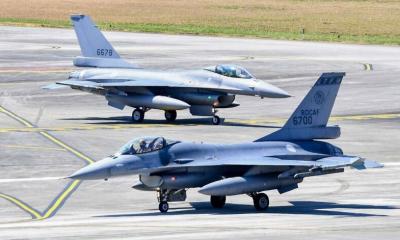
The first two F-16V Block 70 jets Taiwan purchased from the US were spotted unexpectedly turning back after departing from Hawaii yesterday, potentially further delaying delivery of the aircraft. Taiwan has purchased 66 of the F-16 C/D Block 70 jets to be deployed at Chihhang Air Base (志航基地) in Taitung County and operated by the air force's 7th Tactical Fighter Wing to defend Taiwan’s eastern region. Two single-seat jets, bearing serial No. 6727 and 6728, were spotted taking off from Hickam Field in Hawaii yesterday, observers said. Based on the precedent set during the delivery of Taiwan's older F-16 Block 20s, the new

Taiwan’s growing defense preparations might be sending a stronger signal to the US than to Beijing, highlighting the need for Taipei to tailor its deterrence efforts to different audiences, a US security academic said yesterday. Stanford University Freeman Spogli Institute for International Studies fellow Oriana Skylar Mastro made the comment during a Taipei Security Dialogue panel examining lessons Taiwan could draw from the wars in Ukraine and the Middle East. Mastro said she was impressed by Taiwan’s increased defense spending, emphasis on asymmetric capabilities and efforts to prepare society for conflict, but questioned whom those initiatives were influencing. She said when she asked
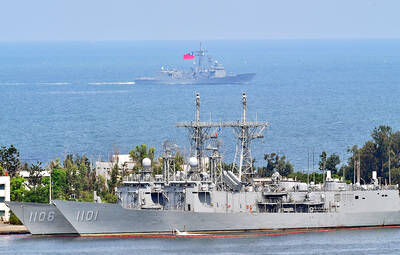
SIZE MATTERS: Large ships are politically attractive as visible symbols of national defense, but small surface combatants are more likely to survive an initial strike Taiwan needs to restructure its naval fleet from focusing on large warships, which are “sitting ducks” for China’s advanced tracking technology, to smaller, stealthy corvettes that are harder to detect but retain sufficient firepower to deter a Chinese invasion, a Taiwanese academic and a former US military commander said in an article published on Friday in the journal Foreign Affairs. Taiwan does not need a fleet capable of competing with the Chinese navy for traditional control of the Taiwan Strait, but rather “sea denial” capabilities that would prevent China from freely using the waterway, Taiwanese aerospace and security expert Holmes Liao
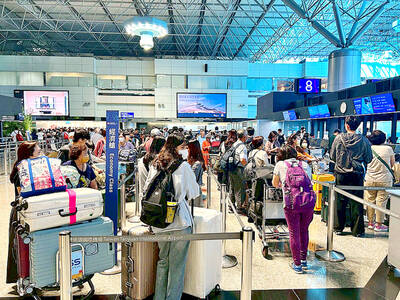
EVA Airways Corp is to raise excess baggage fees and revise other international baggage charges beginning on Sept. 29, citing higher fuel prices and rising global operating costs amid economic and geopolitical pressures. The changes would apply to international flights with travel dates on or after Sept. 29, the Taiwanese carrier said in a statement on its Web site. The revised baggage policy covers excess baggage, prepaid excess baggage, overweight and oversized baggage fees. It also covers updated pricing rules, and fees for transporting pets and sports equipment. Under the new rates, excess baggage fees would increase by between US$20 and US$90 per


 RSS
RSS