


Taiwan's maritime sovereignty “cannot be violated” by Chinese efforts to create a false impression of jurisdiction, the Coast Guard Administration (CGA) said after China ended a patrol off the nation’s eastern shores.
China, which claims Taiwan as its own and has never renounced the use of force to annex it, was angered after Japan and the Philippines last month said they would begin formal talks on their maritime boundaries, viewing that as involving waters off Taiwan.
Late on Saturday, Chinese state media reported that ships had been sent to carry out a "special maritime traffic law-enforcement operation" and inspect shipping in waters east of Taiwan, in response to the Japanese and Philippine announcement.
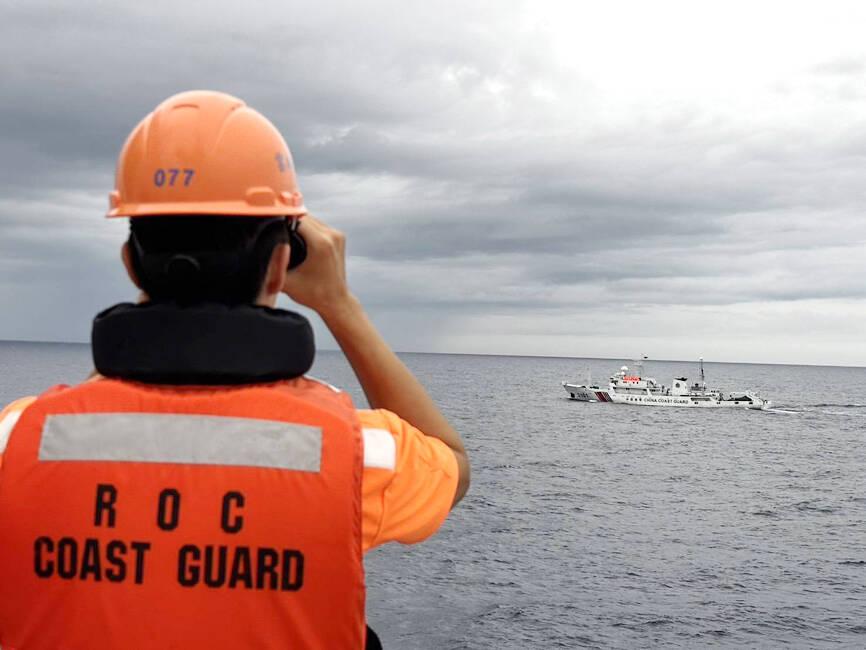
Photo courtesy of the Coast Guard Administration
Late yesterday, Chinese state media said that the patrol had ended, after it had "inspected 198 passing vessels and rectified violations involving three ships," carried out a hydrographic survey and patrolled areas where undersea cables are located.
Beijing has no jurisdiction in those waters, and whenever Chinese ships appear, Taiwan's vessels would "forcefully drive them away, and maintain the freedom and safety of navigation," the CGA said in a statement.
"Our nation's maritime sovereignty cannot be violated," the CGA said. "Any country that asserts jurisdiction will be expelled without exception."

UPGRADE: The Kang Ding-class frigate is replacing its Chaparall missiles with Tien Chien II and Hua Yang VLS, which would provide it with long-range, 360° air defense Taiwan plans to produce 1,200 to 1,376 Hai Chien II missiles (海劍二, Sea Sword II) — also known as TC-2N — to serve as the standard air defense system of the navy’s surface combatant fleet, a source said yesterday. Last week, the Hai Chien II, the naval version of the Tien Kung II missile (天劍二, Sky Sword II), completed a live-fire test in waters off the National Chungshan Institute of Science and Technology’s Jiupeng facility (九鵬) in Pingtung County’s Manjhou Township (滿州). The MIM72 Chaparral and other dated air defense missiles that currently arm Taiwanese ships have inadequate range to combat Chinese
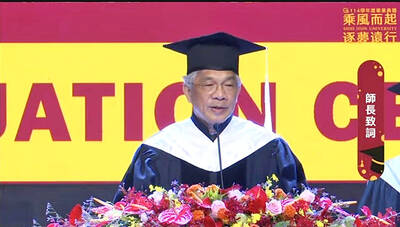
Shih Hsin University President Chen Ching-he (陳清河) yesterday issued a public apology for comments made in his commencement speech last week, stating that he has asked the school to suspend his duties and halt his wages for two months as a show of contrition. At the commencement ceremony on May 30, Chen said, “If you don’t manage your time well, or your own emotions, or your health, then I am telling every one of you — put a quick end to ‘you,’ because the world has no need for ‘you.’” The comments have sparked significant controversy online, and Chen through an open
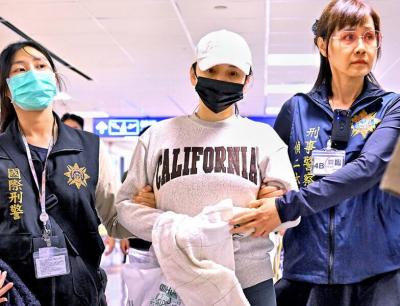
Johanne Liou (劉喬安), a Taiwanese woman who shot to unwanted fame during the Sunflower movement protests in 2014, returned to Taiwan last night after being deported from the US. She is to stand trial in Taiwan for charges involving embezzlement, fraud and drug crimes. The Criminal Investigation Bureau (CIB) said it took her into custody at Taiwan Taoyuan International Airport and would first question her before transferring her to the New Taipei District Prosecutors’ Office. She was arrested upon disembarking a flight from San Francisco that landed shortly before 7pm. Liou absconded to the US in 2019 after jumping bail

In a historic first, Taiwanese officials participated in this year’s Riga Strategic Communications Dialogue in Latvia from Wednesday to Friday last week, which debuted a breakout session focused on Taiwan The event organizer, the NATO Strategic Communications Center of Excellence, displayed Taiwan’s national flag and the officials’ formal titles on their Web site. Taiwanese attendees included National Security Council (NSC) Deputy Secretary-General Lin Fei-fan (林飛帆) and deputy head of the Taipei Representative Office in the UK, Chiang Ya-chi (江雅綺). In addition to the session discussing Taiwan titled “Taiwan: Navigating Strategic Communication in a Tense Environment,” the dialogue also included sessions


 RSS
RSS