


The National Institute of Cyber Security (NICS) and Microsoft Corp yesterday signed a memorandum of understanding (MOU) to jointly address cybersecurity threats, use artificial intelligence to buttress the resilience of critical infrastructure and promote the adoption of a “Zero Trust” cybersecurity framework.
The agreement was signed by the institute’s president Lin Ying-dar (林盈達) and Microsoft’s Asia Regional Director for Government Affairs and Public Policy Marcus Bartley Jones in Taipei yesterday.
Lin said that the institute has continued to invest in the development of technologies such as threat hunting and anomalous behavior detection, while promoting the deployment and validation of related defense frameworks across government agencies.
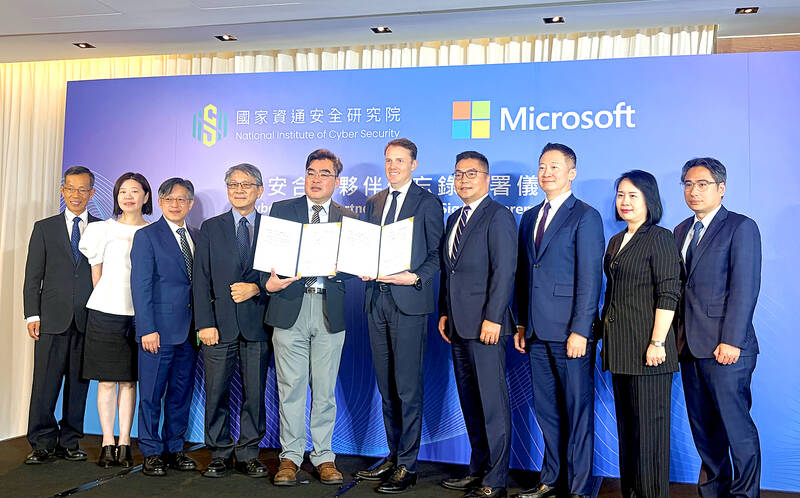
Photo: Chiu Chiao-chen, Taipei Times
Through collaboration with Microsoft, Taiwan can leverage one of the world’s most advanced cybersecurity intelligence networks, strengthening its ability to detect, prevent and respond to cyber threats while enhancing the resilience of its cybersecurity infrastructure, Lin said.
The organizations aim to develop a more precise cybersecurity defense mechanism to gauge the readiness of crucial infrastructure operators against cyber threats, including whether they have well-rounded backup plans or the ability to recover from damages, Lin said.
Jones said that cybersecurity can only be effective if it is handled collectively, and collaboration is even more important in the age of AI.
“We are very focused on the way in which AI is creating new threats and challenges. We are also focused, through this partnership, on how we can work together and use AI to detect vulnerabilities faster and defend in a more effective and efficient way against cybersecurity,” he said.
Johns said the partnership would help integrate key cybersecurity intelligence and data contributed by the NISC and Microsoft. Microsoft processes 100 trillion cybersecurity signals per day, while the institute can access information dealing with national security, he said.
Microsoft would continue to invest in large-scale scenario simulations and security validation efforts, aiming to strengthen Taiwan’s overall cybersecurity defenses through hands-on exercises and testing experience, while continuously refining related models and mechanisms, he said.
The institute said that both organizations agreed to adopt a pilot-based approach, using a phased and scalable implementation strategy that begins with small-scale validation before expanding to broader applications, it said.
Under the agreement, cyber threat intelligence would be shared between NICS and Microsoft via a trusted, secure and closed mechanism, while relevant government stakeholders would be involved to jointly improve the efficiency of threat detection, response and remediation, the institute said.
Microsoft agreed to support the large-scale adoption of a Zero Trust architecture, including readiness assessments, baseline development and exercises covering cloud and on-premises environments, the institute said.
Meanwhile, AI-enabled cybersecurity capabilities would be leveraged to sharpen threat hunting, anomaly detection, recovery and failover exercises, it added.

UPGRADE: The Kang Ding-class frigate is replacing its Chaparall missiles with Tien Chien II and Hua Yang VLS, which would provide it with long-range, 360° air defense Taiwan plans to produce 1,200 to 1,376 Hai Chien II missiles (海劍二, Sea Sword II) — also known as TC-2N — to serve as the standard air defense system of the navy’s surface combatant fleet, a source said yesterday. Last week, the Hai Chien II, the naval version of the Tien Kung II missile (天劍二, Sky Sword II), completed a live-fire test in waters off the National Chungshan Institute of Science and Technology’s Jiupeng facility (九鵬) in Pingtung County’s Manjhou Township (滿州). The MIM72 Chaparral and other dated air defense missiles that currently arm Taiwanese ships have inadequate range to combat Chinese

REASONS FOR TRAVEL: An assistant professor said that proposed amendments to penalize drivers if they used drugs overseas would not deter people from traveling People who operate a motor vehicle under the influence of marijuana would have their driver’s license revoked, even if they used the substance while overseas, the Ministry of Transportation and Communications said yesterday, citing proposed amendments to the Road Traffic Management and Penalty Act (道路交通管理處罰條例). The amendments would also authorize the government to revoke the licenses of people determined to have used Category 1 or Category 2 narcotics, even if they were not operating a vehicle while under the influence of drugs, as well as ban them from taking the license test for three years, the ministry said. People aged 18 or
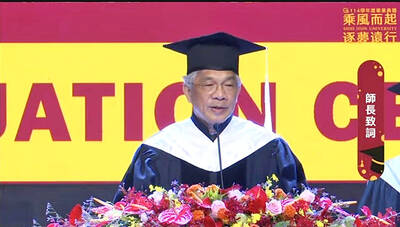
Shih Hsin University President Chen Ching-he (陳清河) yesterday issued a public apology for comments made in his commencement speech last week, stating that he has asked the school to suspend his duties and halt his wages for two months as a show of contrition. At the commencement ceremony on May 30, Chen said, “If you don’t manage your time well, or your own emotions, or your health, then I am telling every one of you — put a quick end to ‘you,’ because the world has no need for ‘you.’” The comments have sparked significant controversy online, and Chen through an open

Johanne Liou (劉喬安), a Taiwanese woman who shot to unwanted fame during the Sunflower movement protests in 2014, returned to Taiwan last night after being deported from the US. She is to stand trial in Taiwan for charges involving embezzlement, fraud and drug crimes. The Criminal Investigation Bureau (CIB) said it took her into custody at Taiwan Taoyuan International Airport and would first question her before transferring her to the New Taipei District Prosecutors’ Office. She was arrested upon disembarking a flight from San Francisco that landed shortly before 7pm. Liou absconded to the US in 2019 after jumping bail


 RSS
RSS