


Banquets held in honor of Chinese Nationalist Party (KMT) Chairwoman Cheng Li-wun (鄭麗文) during her US trip are open only to Taiwanese expatriates, and non-Taiwanese attendees are there at the invitation of Taiwanese expatriates, the party said yesterday.
The KMT released the statement after Taiwan Statebuilding Party Taipei city councilor candidate Wu Hsin-tai (吳欣岱) on Sunday raised questions about a photograph posted on Cheng’s Facebook page showing her in Boston at the same table with Chinese national Gary Yu (俞國梁), who reportedly has recruited people in the US to support China’s “united front” work against Taiwan.
Democratic Progressive Party (DPP) spokesman Justin Wu (吳崢) earlier yesterday said that Cheng, the chairwoman of the nation’s largest opposition party, has stooped so low that she is willing to be a “special envoy” for Chinese President Xi Jing-ping (習近平) and a “mouthpiece” for the Chinese Communist Party (CCP).
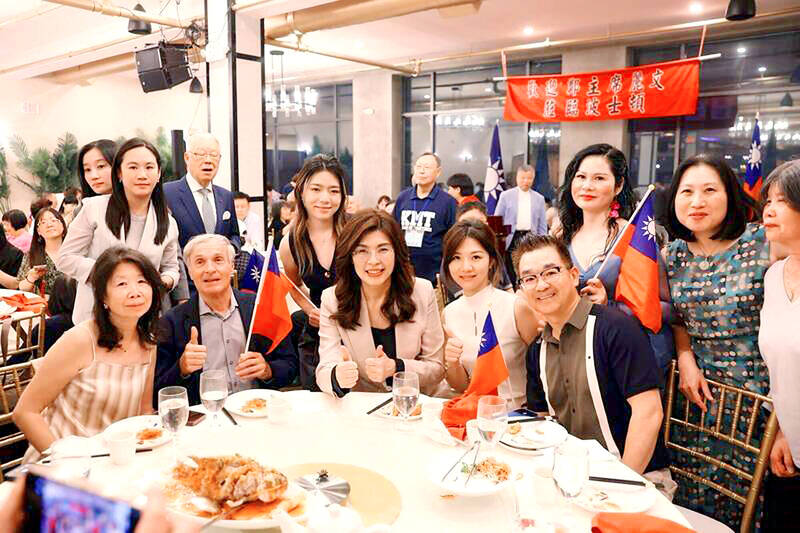
Photo: Screen grab from Chen Li-wun’s Facebook page
The KMT said that Yu was not on the guest list compiled by the party’s Boston chapter, which hosted the banquet. Yu was at the banquet at the invitation of Taiwanese expatriates participating in the banquet, it added.
Cheng did not dine with Yu and only took a group photo with him and other guests when she toasted guests at different tables, it said.
All banquets that are on Cheng’s two-week itinerary are hosted by KMT chapters, and attendance is strictly limited to Taiwanese expatriates and Taiwanese expatriate organizations, the KMT said.
Participants who are not Taiwanese must be invited by Taiwanese expatriates, the party said, adding that it is inappropriate to speculate or make unwarranted associations.
In addressing Taiwanese expatriates in New York on Sunday evening, Cheng praised former president Ma Ying-jeou (馬英九) for contributing to cross-strait peace and prosperity, while accusing the DPP government of poisoning relations with China in the past 10 years and making the Taiwan Strait one of the most dangerous places on Earth.
Cheng said that risks of a cross-strait conflict have risen because of what she described as President William Lai’s (賴清德) new “two-state theory,” adding that the KMT must step up to show the world that peace across the Taiwan Strait is still possible, she said.
The differences between Taiwan and China can be resolved by returning to the so-called “1992 consensus,” opposing Taiwanese independence and recognizing that both sides belong to one China, she said.
The cooperation of the US, China and Taiwan can free Taiwan from potential conflicts and is in the best interest of all parties involved, including East Asian countries, she said.
The “1992 consensus” — a term that former Mainland Affairs Council chairman Su Chi (蘇起) in 2006 admitted making up in 2000 — refers to a tacit understanding between the KMT and the Chinese Communist Party that both sides of the Strait acknowledge there is “one China,” with each side having its own interpretation of what “China” means.

UPGRADE: The Kang Ding-class frigate is replacing its Chaparall missiles with Tien Chien II and Hua Yang VLS, which would provide it with long-range, 360° air defense Taiwan plans to produce 1,200 to 1,376 Hai Chien II missiles (海劍二, Sea Sword II) — also known as TC-2N — to serve as the standard air defense system of the navy’s surface combatant fleet, a source said yesterday. Last week, the Hai Chien II, the naval version of the Tien Kung II missile (天劍二, Sky Sword II), completed a live-fire test in waters off the National Chungshan Institute of Science and Technology’s Jiupeng facility (九鵬) in Pingtung County’s Manjhou Township (滿州). The MIM72 Chaparral and other dated air defense missiles that currently arm Taiwanese ships have inadequate range to combat Chinese

REASONS FOR TRAVEL: An assistant professor said that proposed amendments to penalize drivers if they used drugs overseas would not deter people from traveling People who operate a motor vehicle under the influence of marijuana would have their driver’s license revoked, even if they used the substance while overseas, the Ministry of Transportation and Communications said yesterday, citing proposed amendments to the Road Traffic Management and Penalty Act (道路交通管理處罰條例). The amendments would also authorize the government to revoke the licenses of people determined to have used Category 1 or Category 2 narcotics, even if they were not operating a vehicle while under the influence of drugs, as well as ban them from taking the license test for three years, the ministry said. People aged 18 or
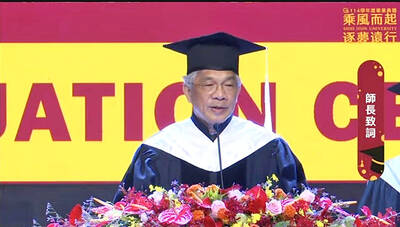
Shih Hsin University President Chen Ching-he (陳清河) yesterday issued a public apology for comments made in his commencement speech last week, stating that he has asked the school to suspend his duties and halt his wages for two months as a show of contrition. At the commencement ceremony on May 30, Chen said, “If you don’t manage your time well, or your own emotions, or your health, then I am telling every one of you — put a quick end to ‘you,’ because the world has no need for ‘you.’” The comments have sparked significant controversy online, and Chen through an open
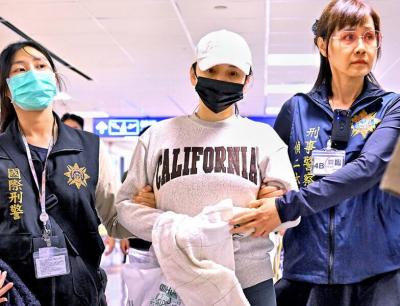
Johanne Liou (劉喬安), a Taiwanese woman who shot to unwanted fame during the Sunflower movement protests in 2014, returned to Taiwan last night after being deported from the US. She is to stand trial in Taiwan for charges involving embezzlement, fraud and drug crimes. The Criminal Investigation Bureau (CIB) said it took her into custody at Taiwan Taoyuan International Airport and would first question her before transferring her to the New Taipei District Prosecutors’ Office. She was arrested upon disembarking a flight from San Francisco that landed shortly before 7pm. Liou absconded to the US in 2019 after jumping bail


 RSS
RSS