


Although exosomes have been described as a “powerful” therapy in regenerative medicine over the past few years, they are not always beneficial, as they are only “messengers” among cells, a research team at National Health Research Institutes (NHRI) said yesterday.
Extracellular vesicles have become a hot topic in regenerative medicine over the past few years, but related products’ active ingredients and how they are distributed are not validated, the research team said.
Exosomes act like “messengers” between cells, transmitting messages and providing coordination, NHRI president Sytwu Huey-kang (司徒惠康) said.
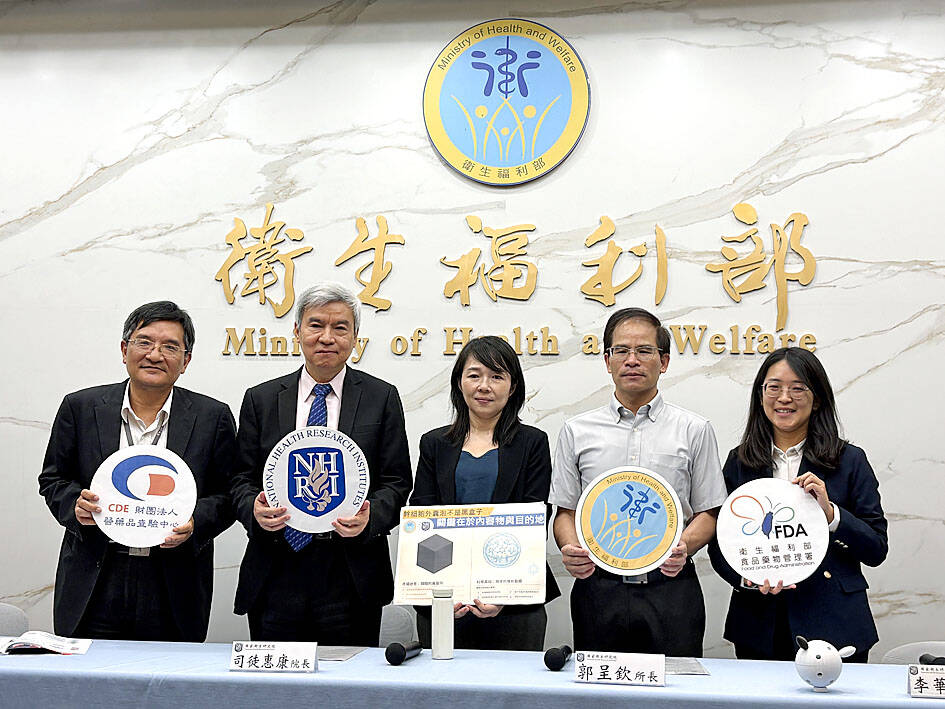
Photo: Lin Chih-yi, Taipei Times
Most commercial exosome products only highlight the source cells, but their efficacy lacks scientific proof, so the team focused on two areas — breast cancer lung metastasis and nerve injury repair — and found that while exosomes have potential as therapeutic tools, they can also exacerbate disease, said Li Hua-jung (李華容), the deputy director of the NHRI’s Institute of Cellular and System Medicine.
The study indicated that exosomes are not always beneficial, as in some situations they might also promote cancer metastasis, inflammatory responses or alter the tumor microenvironment, Li said, adding that it is difficult to confirm the efficacy and safety of exosome products that do not explain their ingredients and mechanisms.
The team also utilized a small-molecule induction strategy to stimulate mesenchymal stem cells into producing “functional extracellular vesicles” with neurorepair potential, she said.
Further studies suggest these vesicles possess neuroprotective and repair capabilities, she said, adding that in vivo experiments showed that they can improve learning and cognitive performance in mice with brain injury.
The therapeutic efficacy and safety of exosomes highly depend on the state of the source cells, the encapsulated active ingredients, the distribution in the body and their ability to precisely target the lesion, she said.
The future of extracellular vesicle therapy should not only focus on “producing extracellular vesicles,” but also on establishing a comprehensive quality standard that is “definable, detectable, traceable and verifiable,” to ensure patient safety and mitigate market irregularities, the research team said.
The team’s studies were published by international academic journals Cancer Research and Journal of Extracellular Vesicles, as well as the domestic Contemporary Pharmaceutical Regulations Monthly (當代醫藥法規月刊) published by the Center for Drug Evaluation, the NHRI said.

NATIONAL SECURITY: Authorities are working to confirm the identities of the military personnel involved and investigating possible illegal conduct and regulatory violations Authorities are probing possible national security implications after Kinmen police and immigration officers on Sunday found a Chinese woman allegedly posing as a tourist while engaging in prostitution involving more than 10 military personnel. The woman, surnamed Chen (陳), has since been deported, authorities said, adding that investigators are still working to confirm the identities of those implicated, as the records only listed code names and aliases. The case stemmed from a report received by the Kinmen District Prosecutors’ Office on Friday last week from the Jinhu Precinct of the Kinmen County Police Bureau. On Sunday, police, along with the National Immigration

GLOBALGIVING: ‘ Caving to external pressure is not acceptable for an organization that has cultivated justice reform and human rights for 30 years,’ one NGO said A slew of non-government organizations (NGOs) have withdrawn from the GlobalGiving fundraising platform after it announced it would use “Chinese Taipei” instead of “Taiwan” from next month. The Taiwan Good Rice Association wrote on Facebook on Friday that it was informed on April 28 via a teleconference call of the change, which was made because the platform wanted to operate in China. Taiwan Good Rice is to terminate all cooperative relationships with GlobalGiving in response to the platform’s “unilateral and non-negotiable” decision to remove references to Taiwan, the NGO said. “Taiwan is in the official name of Taiwan Good Rice Association and the

HEAVY WEATHER: Typhoon Jangmi is due to crash straight into the Ryukyus as airlines look to shift flights to larger aircraft or cancel flights to Okinawa entirely Taiwan’s international air carriers announced flight adjustments over the weekend as Typhoon Jangmi is forecast to hit the Ryukyu Islands today and tomorrow. The Central Weather Administration (CWA) upgraded Jangmi from a tropical storm to a typhoon at 8am yesterday, with the eye located 580km south of Naha city. It was moving north at 19kph. Today, China Airlines’ CI-120, CI-121, CI-122 and CI-123 flights between Taoyuan and Naha, Okinawa, have been canceled as well as CI-132 and CI-133 between Kaohsiung and Naha. EVA Air’s BR-112, BR-113, BR-186 and BR-185 flights between Taoyuan and Naha are also canceled. Low-cost carrier Tigerair Taiwan canceled IT-230,

Chinese Nationalist Party (KMT) Chairwoman Cheng Li-wun (鄭麗文) yesterday briefed her party’s Central Standing Committee regarding her scheduled visit to the US between Monday next week and June 16, saying that her purpose would be to persuade the US that the Republic of China (ROC) Constitution was a “one China” constitution that would foster stable and peaceful cross-strait relations. The ROC Constitution is the most important defense for all Taiwanese citizens, as it upholds our democracy and has contributed to our robust economy, which aligns with international and US interests, she said. “We would not be troublemakers and drag the US under,”


 RSS
RSS