


The Ministry of Transportation and Communications yesterday said that it would propose an amendment to the Road Traffic Management and Penalty Act (道路交通管理處罰條例) that would revoke licenses of drug users, ban drug-impaired drivers from taking the license test for three years and impose penalties on their passengers.
It made the announcement after consulting officials from the Judicial Yuan, the Ministry of Justice, the Ministry of Health and Welfare, and the National Police Agency last month on tackling the rise of drug-impaired cases.
Currently, drug-impaired drivers would have their licenses suspended for one to two years.
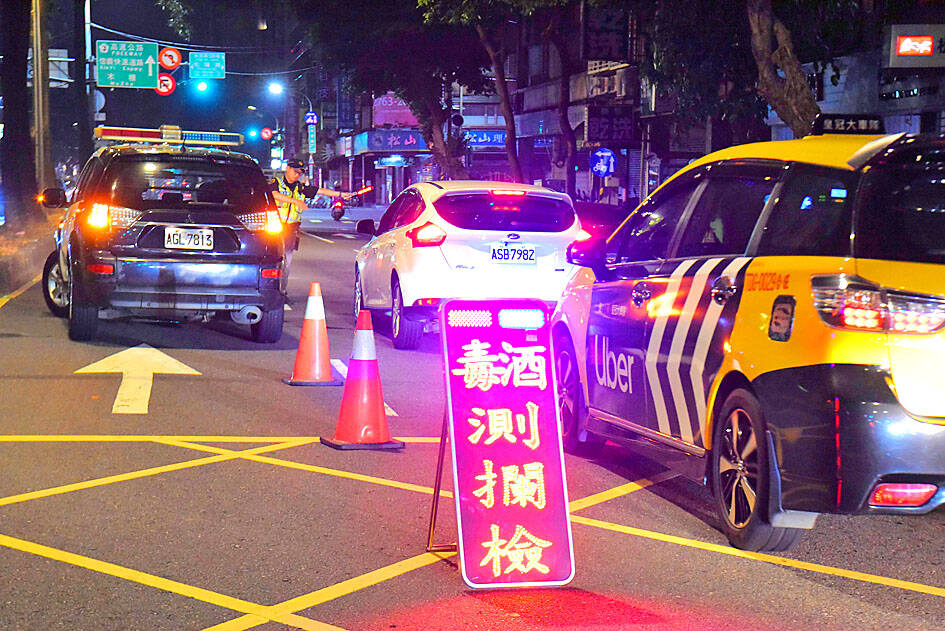
Photo: Wu Liang-yi, Taipei Times
Drug-impaired drivers face administrative and criminal punishment, the transportation ministry said, adding that authorities would prioritize pursuing criminal liability.
Aside from imposing stricter penalties on drug-impaired drivers, the amendment would also stipulate that users of Category 1 and Category 2 narcotics — including heroin, morphine, cocaine, amphetamine, methamphetamine, ecstasy and marijuana — would have their driver’s licenses revoked and be barred from reapplying for a specified period, even if they were not caught driving, the transportation ministry said.
Consumers of Category 3 and Category 4 narcotics, including ketamine, flunitrazepam, zolpidem and alprazolam, would have their driver’s license suspended, it added.
The amendment would also raise fines for first-time drug-impaired driving offenders, while passengers aged 18 or older who knowingly ride with drug-impaired drivers would also be subject to penalties, the ministry said.
Meanwhile, drivers whose licenses were revoked or suspended due to drug-impaired driving would only be allowed to renew their licenses or take the license test again if they undergo drug addiction treatment or drug-hazard courses and do not use drugs for a specified time period, the ministry said.
It said before the amendment to the act is completed, it would revise the Road Traffic Safety Rules (道路交通安全規則), which would require drivers who are confirmed to have used illicit drugs to complete mandatory treatment or educational courses and meet certain requirements for a specified period before being permitted to renew or reapply for a driver’s license. Such a revision does not need legislative approval.
Separately, saliva tests might soon be administered in the nation’s primary, junior-high and high schools starting in the next fall semester to detect etomidate, an anesthetic drug that has been increasingly used in e-cigarette cartridges.
Etomidate, also known as “zombie vapes,” is an emerging illegal drug.
Schools have already administered or scheduled ad hoc urine tests to students who had been found using drugs or had been suspended, Ministry of Education Department of Student Affairs Director-General Tsai Yi-ching (蔡宜靜) said.
“However, some students would dilute the urine test samples or swap them with tea to conceal drug use. Meanwhile, emerging drugs are metabolized relatively quickly in the body. As such, we are considering using saliva tests as an auxiliary screening tool, which helps simplify administrative procedures and enable timely access to counseling resources,” Tsai said.
If a saliva screening yields a positive result, it must be confirmed by a urine test before being reported through the campus safety reporting system, she said.

NATIONAL SECURITY: Authorities are working to confirm the identities of the military personnel involved and investigating possible illegal conduct and regulatory violations Authorities are probing possible national security implications after Kinmen police and immigration officers on Sunday found a Chinese woman allegedly posing as a tourist while engaging in prostitution involving more than 10 military personnel. The woman, surnamed Chen (陳), has since been deported, authorities said, adding that investigators are still working to confirm the identities of those implicated, as the records only listed code names and aliases. The case stemmed from a report received by the Kinmen District Prosecutors’ Office on Friday last week from the Jinhu Precinct of the Kinmen County Police Bureau. On Sunday, police, along with the National Immigration

GLOBALGIVING: ‘ Caving to external pressure is not acceptable for an organization that has cultivated justice reform and human rights for 30 years,’ one NGO said A slew of non-government organizations (NGOs) have withdrawn from the GlobalGiving fundraising platform after it announced it would use “Chinese Taipei” instead of “Taiwan” from next month. The Taiwan Good Rice Association wrote on Facebook on Friday that it was informed on April 28 via a teleconference call of the change, which was made because the platform wanted to operate in China. Taiwan Good Rice is to terminate all cooperative relationships with GlobalGiving in response to the platform’s “unilateral and non-negotiable” decision to remove references to Taiwan, the NGO said. “Taiwan is in the official name of Taiwan Good Rice Association and the

HEAVY WEATHER: Typhoon Jangmi is due to crash straight into the Ryukyus as airlines look to shift flights to larger aircraft or cancel flights to Okinawa entirely Taiwan’s international air carriers announced flight adjustments over the weekend as Typhoon Jangmi is forecast to hit the Ryukyu Islands today and tomorrow. The Central Weather Administration (CWA) upgraded Jangmi from a tropical storm to a typhoon at 8am yesterday, with the eye located 580km south of Naha city. It was moving north at 19kph. Today, China Airlines’ CI-120, CI-121, CI-122 and CI-123 flights between Taoyuan and Naha, Okinawa, have been canceled as well as CI-132 and CI-133 between Kaohsiung and Naha. EVA Air’s BR-112, BR-113, BR-186 and BR-185 flights between Taoyuan and Naha are also canceled. Low-cost carrier Tigerair Taiwan canceled IT-230,

Chinese Nationalist Party (KMT) Chairwoman Cheng Li-wun (鄭麗文) yesterday briefed her party’s Central Standing Committee regarding her scheduled visit to the US between Monday next week and June 16, saying that her purpose would be to persuade the US that the Republic of China (ROC) Constitution was a “one China” constitution that would foster stable and peaceful cross-strait relations. The ROC Constitution is the most important defense for all Taiwanese citizens, as it upholds our democracy and has contributed to our robust economy, which aligns with international and US interests, she said. “We would not be troublemakers and drag the US under,”


 RSS
RSS