


Kaohsiung has over the past few years aggressively leveraged its “concert economy,” hosting more than 100 domestic and international gigs annually to crown itself Taiwan’s undisputed concert capital.
Last year, Kaohsiung rolled out the red carpet for global juggernauts such as South Korean K-pop girl groups Blackpink, Twice and Hong Kong singer Jacky Cheung (張學友), with 109 concerts attracting nearly 1.63 million attendees and generating more than NT$5.2 billion (US$170 million) in tourism-related revenue.
This year, the momentum has grown, with high-profile acts like mega K-pop group BTS, Japanese singer-songwriter Fujii Kaze and US rapper Post Malone driving the projected annual concert count toward 140.
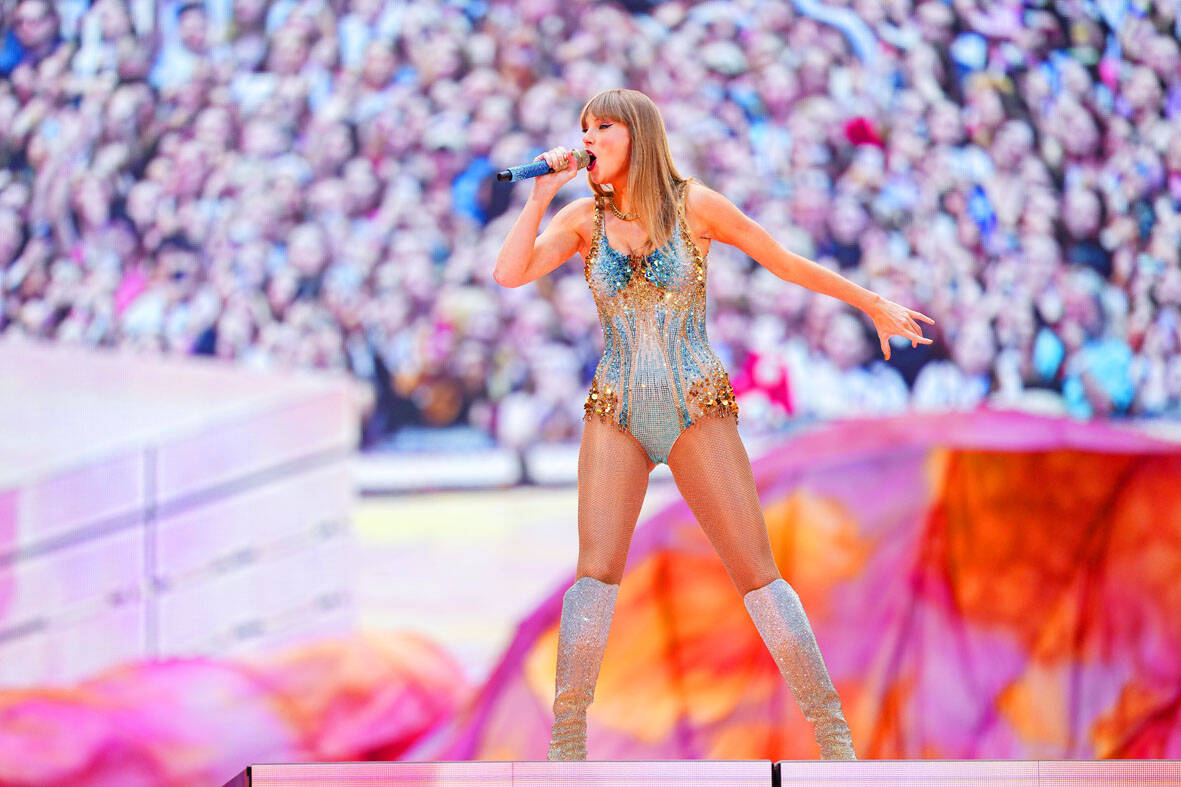
Photo: AP
As Kaohsiung Mayor Chen Chi-mai’s (陳其邁) tenure enters its final six months, one ultimate prize remains frustratingly out of reach for local fans: US singer Taylor Swift.
The economic impact of mega tours has become impossible for governments to ignore. Swift’s Eras Tour generated an estimated US$5.7 billion in economic activity in the US — surpassing the combined GDP of 50 countries — helping popularize the term “Swiftonomics” among economists and policymakers.
Across Asia, governments have increasingly viewed blockbuster concerts as strategic investments in tourism and urban branding. To secure exclusive Southeast Asian rights for Swift’s tour, Singapore offered substantial state subsidies, turning artist recruitment into a state-level investment strategy.
However, landing an act of that magnitude requires more than just wishful thinking. Kaohsiung Deputy Mayor Lee Huai-jen (李懷仁) said that international superstars typically lock in their schedules 12 to 18 months in advance, making a Swift concert during Chen’s remaining six months in office highly unlikely.
While it appears Swift would not arrange a global tour within the next year, the city is still in talks with other major international performers, he said.
With Chen’s term winding down, the dream of bringing the “Swifconomics” phenomenon to southern Taiwan would likely fall to his successor. As the mayoral race heats up, candidates from both major political parties are already pledging to keep the city’s stages star-studded.
Democratic Progressive Party’s Kaohsiung mayoral candidate Lai Jui-lung (賴瑞隆) said Kaohsiung has developed mature capabilities for hosting large-scale international events, from transportation and shuttle systems to hotel networks and interagency coordination.
Lai said he hopes to expand the city’s “concert economy” into a broader industrial strategy linking tourism, transportation, restaurants and cultural industries throughout southern Taiwan.
He pledged to continue seeking more international artists and groups to perform in Kaohsiung.
Chinese Nationalist Party (KMT) Kaohsiung mayoral candidate Ko Chih-en (柯志恩) also expressed support for attracting global acts, saying Kaohsiung National Stadium’s 55,000-seat capacity gives the city a major advantage after years of hosting high-pressure large-scale events.
However, Ko questioned whether Kaohsiung should emulate Singapore’s subsidy-heavy approach, saying that the city should instead rely on efficient administration and strong public-private cooperation to attract organizers.
As the city debates its next move, a major policy shift is under way at its premier venue. The Kaohsiung National Stadium is set to end its long-standing “zero-rent” policy, a move that has sparked some concern over whether international acts would look elsewhere.
Under new regulations submitted to the city council, organizers would pay an administrative service fee of NT$1.1 million per day, while the city would also collect 5 percent of ticket revenue per show, capped at NT$5 million.
Still, the new policy includes flexibility. Organizers deemed beneficial to Kaohsiung’s image or tourism development could receive discounted rates approved by the mayor, allowing use of the venue for NT$2.2 million per event.
Kaohsiung City Councilor Chiu Yu-hsuang (邱于軒) said the change formally marks the end of the city’s free-rental policy and reflects a broader “user pays” principle.
Compared with Taipei Dome’s 10 percent revenue-sharing arrangement, Kaohsiung’s rates remain relatively favorable, she said, urging the city government to continuously review pricing to maintain competitiveness and sustainability.
Asked whether the new fees would deter major acts, Lee said the new policy would not be a dealbreaker to international superstars, as cost and revenue are the main concerns of commercial organizers.
The Kaohsiung National Stadium can accommodate 50,000 to 55,000 fans per night, while Taipei Dome can host roughly 38,000 spectators, meaning a two-night stand can sell up to 110,000 tickets in the former and 76,000 in the latter — a gap of 24,000, he said.
In addition, accommodation in Kaohsiung is cheaper than in Taipei, he said, adding that the stadium offers features such as fireworks displays.
International touring teams evaluate cities based on far more than venue fees, placing greater emphasis on venue quality, administrative efficiency and integrated support services, the Kaohsiung Bureau of Cultural Affairs said.
The city’s one-stop coordination model, which combines transportation, police, firefighting and environmental resources across departments, has helped reduce uncertainty for organizers and improve the fan experience, the bureau said.
It is the artists who choose the cities, not the other way around, said National Sun Yat-sen University professor Chen Yi-heng (陳以亨), who specializes in concert economy.
Public services, venues and convenience all matter, but the most important factor is administrative efficiency, an area in which Kaohsiung has done quite well among other Asian cities, he said.

The Ministry of Finance this afternoon announced the winning numbers for the March-April uniform invoice lottery. The winning number for the NT$10 million (US$318,060) special prize is 19531471, and the winning number for the NT$2 million grand prize is 85941329. Three numbers were drawn for the NT$200,000 first prize: 07225810, 20231230 and 83518781. Those with receipts matching the last seven digits of any of the first-prize numbers will win the NT$40,000 second prize, while those matching the last six digits will win the NT$10,000 third prize. Those whose receipts match the last five digits of the first-prize numbers can claim the NT$4,000 fourth prize,
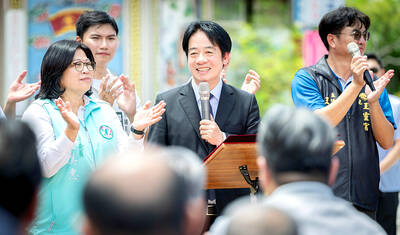
SIX SUBSIDIES: The monthly allowance for older farmers is to increase to NT$10,000, and NT$5,000 is to be given to homemakers under the national pension system, Lai said The government is to implement major welfare policies for disadvantaged groups, including raising the monthly allowance for older farmers to NT$10,000 and providing homemakers with NT$5,000 per month, President William Lai (賴清德) said yesterday. Lai made the remarks during a visit to Wangling Temple in Chiayi County, saying that the planned increases were being introduced amid economic growth and an increase in tax revenue. Touting a policy, in which the government plans to provide a monthly allowance of NT$5,000 for every child under the age of 18 in a bid to address Taiwan’s low birthrate, Lai said that if received for the
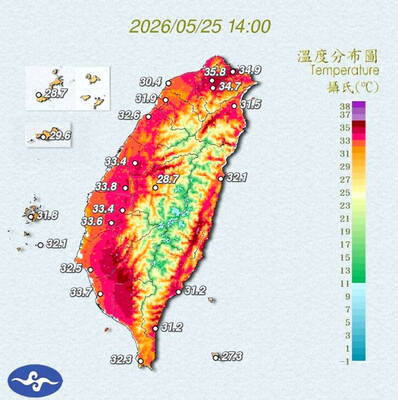
STAY COOL: The HPA recommended that people stay hydrated, use air-conditioning or fans while indoors, wear loose-fitting clothes and walk in the shade while outdoors Employers must implement measures such as installing cooling equipment, and providing drinking water and rest breaks for outdoor workers starting from Monday next week, the Taipei Department of Labor said on Sunday. Employers who fail to comply could face fines of NT$30,000 to NT$300,000 under the Occupational Safety and Health Act (職業安全衛生法), the department said. Businesses in Taipei employing fewer than 100 workers, as well as registered self-employed workers with labor insurance coverage, could receive on-site assessments and guidance from occupational safety consultants to help them apply for central government subsidies to implement or improve heat-protection measures, it said. Under the Ministry of
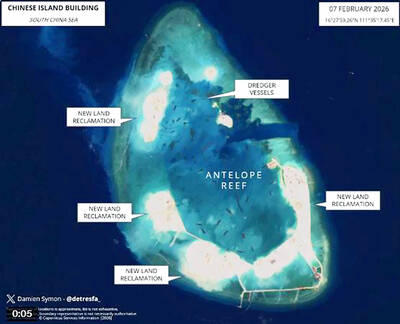
ISOLATION: The outposts would serve as support and backup bases, forcing US forces to either face China head-on or reroute, increasing travel time and operational costs China’s outposts in the South China Sea could be used to delay and constrain foreign forces during a conflict in the Taiwan Strait, giving Beijing a critical window to carry out amphibious landing and blockade operations, a report said. The Chinese Communist Party’s (CCP) forward operating bases on islands and reclaimed features in the South China Sea could delay foreign forces long enough for the Chinese People’s Liberation Army (PLA) to secure a key 48-to-72-hour window in the Taiwan Strait, a report commissioned by the Mainland Affairs Council found. The report, conducted by the Institute for National Defense and Security Research, examined


 RSS
RSS