


In-demand Patriot interceptors and a valuable air defense integration system make up more than half of the US$14 billion weapons deal with Taiwan that has become a flashpoint in broader US-China relations, people familiar with the situation said.
The potential weapons package that US President Donald Trump has yet to approve includes Northrop Grumman Corp’s Integrated Battle Command System and Patriot interceptors, collectively worth US$8.6 billion, according to the people, who requested anonymity to discuss a sensitive matter.
Taiwan, and the potential deal, became a central focus of Trump’s meeting earlier this month in Beijing with Chinese President Xi Jinping (習近平).
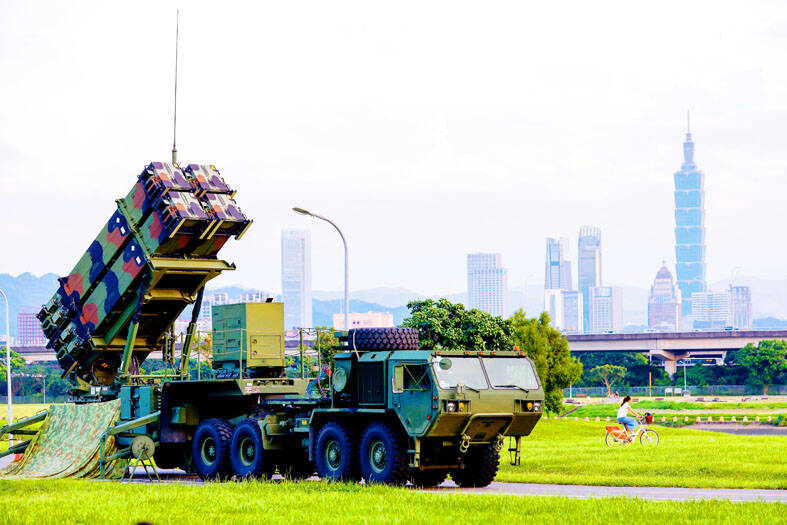
Photo: Ritchie B. Tongo, EPA
The Trump administration has delayed making a decision since the visit, during which Xi warned Trump that mishandling the “Taiwan issue” could lead to “clashes.”
The package also includes approximately US$230 million in counterdrone systems, US$5.3 billion for National Advanced Surface-to-Air Missile System projectiles and launch units and about US$500 million in M4A1 rifles, the people said.
Trump signaled recently that he would speak directly with President William Lai (賴清德) about the deal.
Acting US Secretary of the Navy Hung Cao told US lawmakers this month the Pentagon is “doing a pause” on the weapons sale to ensure that it has sufficient munitions for its war against Iran.
A US administration official declined to comment on the terms of the proposed sale, citing a policy against confirming or commenting on defense sales prior to formal notification to the US Congress.
Ahead of Trump’s visit to Beijing, a group of US senators urged Trump to proceed with the sale, noting that Taiwan’s recently passed special defense budget would cover the cost.
Several US representatives on national security-focused committees sent Trump a similar missive.
For a potential sale to Taiwan to proceed, the US Department of State must formally notify Congress of the proposal, which represents maximum potential quantities and dollar amounts. After a congressional review, negotiations can begin with defense contractors on purchase contracts.
US Secretary of Defense Pete Hegseth yesterday appeared to contradict Cao, saying that there had been “no change” in Washington’s position on Taiwan despite the Middle East war straining US weapons stockpiles.
Hegseth said at the Shangri-La Dialogue, a major security forum, in Singapore that US arms stocks were “in a very good place.”
“Hung Cao is fantastic, but I would not couple the two in any way at all,” he said in apparent reference to the Middle East war and Taiwan’s defense commitments. “I feel good about not only where we are, but where we are in future production rates as well.”
“Any decision about future Taiwan arms sales, as the president [Trump] said, will rest with him ... [but] there’s no change in our status there, just to clarify,” Hegseth said.
Taiwan is not officially represented at the forum, while China, for the second consecutive year, has sent a watered-down delegation that does not include its defense minister.
With a deal between the US and Iran not yet secured, Hegseth said that Washington was “more than capable” of restarting the conflict if it wanted.
“Our stockpiles are more than suited for that, both there and around the globe because of how we balance exquisite and more plentiful munitions,” he said.

The Ministry of Finance this afternoon announced the winning numbers for the March-April uniform invoice lottery. The winning number for the NT$10 million (US$318,060) special prize is 19531471, and the winning number for the NT$2 million grand prize is 85941329. Three numbers were drawn for the NT$200,000 first prize: 07225810, 20231230 and 83518781. Those with receipts matching the last seven digits of any of the first-prize numbers will win the NT$40,000 second prize, while those matching the last six digits will win the NT$10,000 third prize. Those whose receipts match the last five digits of the first-prize numbers can claim the NT$4,000 fourth prize,

SIX SUBSIDIES: The monthly allowance for older farmers is to increase to NT$10,000, and NT$5,000 is to be given to homemakers under the national pension system, Lai said The government is to implement major welfare policies for disadvantaged groups, including raising the monthly allowance for older farmers to NT$10,000 and providing homemakers with NT$5,000 per month, President William Lai (賴清德) said yesterday. Lai made the remarks during a visit to Wangling Temple in Chiayi County, saying that the planned increases were being introduced amid economic growth and an increase in tax revenue. Touting a policy, in which the government plans to provide a monthly allowance of NT$5,000 for every child under the age of 18 in a bid to address Taiwan’s low birthrate, Lai said that if received for the
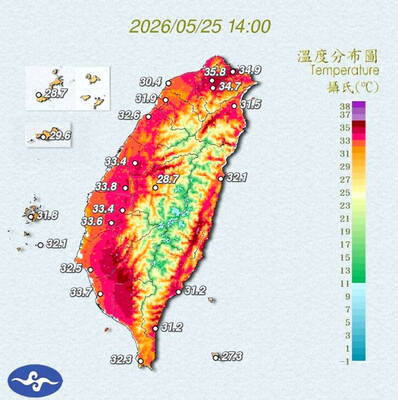
STAY COOL: The HPA recommended that people stay hydrated, use air-conditioning or fans while indoors, wear loose-fitting clothes and walk in the shade while outdoors Employers must implement measures such as installing cooling equipment, and providing drinking water and rest breaks for outdoor workers starting from Monday next week, the Taipei Department of Labor said on Sunday. Employers who fail to comply could face fines of NT$30,000 to NT$300,000 under the Occupational Safety and Health Act (職業安全衛生法), the department said. Businesses in Taipei employing fewer than 100 workers, as well as registered self-employed workers with labor insurance coverage, could receive on-site assessments and guidance from occupational safety consultants to help them apply for central government subsidies to implement or improve heat-protection measures, it said. Under the Ministry of
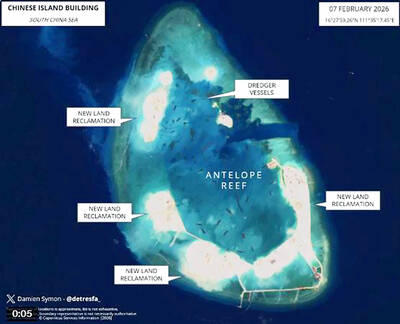
ISOLATION: The outposts would serve as support and backup bases, forcing US forces to either face China head-on or reroute, increasing travel time and operational costs China’s outposts in the South China Sea could be used to delay and constrain foreign forces during a conflict in the Taiwan Strait, giving Beijing a critical window to carry out amphibious landing and blockade operations, a report said. The Chinese Communist Party’s (CCP) forward operating bases on islands and reclaimed features in the South China Sea could delay foreign forces long enough for the Chinese People’s Liberation Army (PLA) to secure a key 48-to-72-hour window in the Taiwan Strait, a report commissioned by the Mainland Affairs Council found. The report, conducted by the Institute for National Defense and Security Research, examined


 RSS
RSS