


Public restrooms that fail to meet standards to combat the use of spy cameras would not be eligible for top rating under proposed regulations, Minister of Environment Peng Chi-ming (彭?明) said yesterday.
The Ministry of Environment has launched a scheme to promote public restrooms with distinct features, with the goal of building 30 such public restrooms nationwide by 2030.
Of the 71 proposals submitted last year under the scheme, 11 were selected by experts as eligible for funding, with the designs unveiled yesterday.
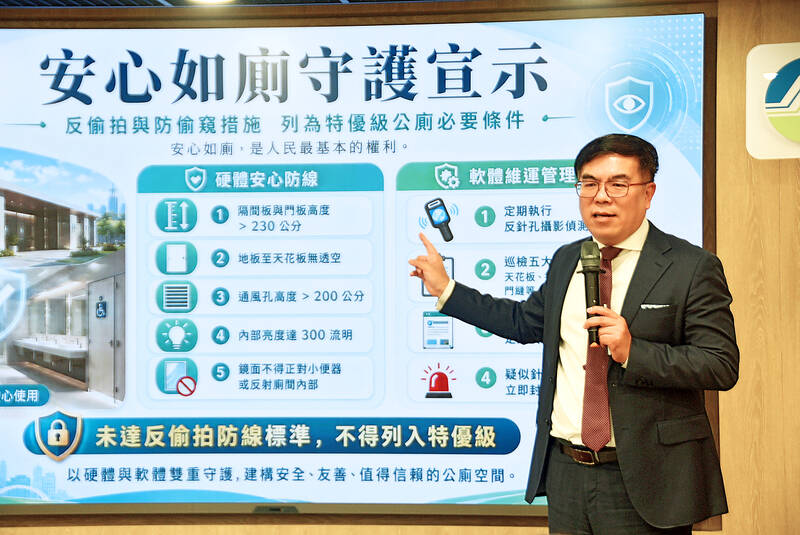
Photo: Wu Po-hsuan, Taipei Times
The distinctive public restrooms are expected to become tourist spots following the examples of Japan’s 17 public restrooms built for the 2020 Tokyo Olympics, Peng said.
He was referring to the Tokyo Toilet initiative, an urban redevelopment project funded by the Tokyo-based Nippon Foundation in which 17 public restrooms in Shibuya District were redesigned by architects such as Tadao Ando and Toyo Ito.
The 11 public restrooms to be built in Taiwan under the ministry’s scheme feature creative designs and compatibility with local environments, Peng said.
For example, one to be built at Kaohsiung’s Singda Harbor (興達港) has a boat-shaped terrace from which the sea view can be enjoyed, he said.
Architect Chao Chien-ming (趙建銘) said that the Singda Harbor restroom would have such good natural ventilation that it would not necessarily need fans to keep it dry and odorless.
Natural ventilation is based primarily on buoyancy-driven ventilation — also known as the stack effect, Chao said.
The top and bottom of the building would have openings that allow temperature differences to generate convection, pushing air through the structure, he said.
The restrooms would be equipped mainly with sitting toilets, which would be more elderly-friendly given Taiwan’s aging population, Peng said.
They would improve environmental aesthetics, and focus on safeguarding safety and privacy, he said.
Public restrooms that fail to meet new anti-spying criteria would not be given “outstanding” ratings, he said.
Lin Yi-fang (林憶芳), section chief of the Environmental Management Administration’s Environmental Sanitation Division, said that the ministry’s regulations on public restroom management would be revised to enhance measures to combat spy cameras.
Vents at toilet stall must be at least 2m above the ground, while stall doors must be more than 2.3m high, Lin said.
Partitions between toilets must extend from the ground to the ceiling without gaps, she said, adding that mirrors in public restrooms must not face toilets.
Electronic sweeps to detect cameras must be conducted at least once a month, while public facilities with high foot traffic should have more frequent sweeps, she said.
QR codes would be displayed at public restrooms for people to promptly report any suspicious activity, she added.

FUKUOKA SITUATION: Japanese media reported that the pathogen is expected to be identified by the summer, while the CDC downplayed the idea that it was hMPV A “mysterious cold-like illness” reported in Japan’s Fukuoka Prefecture does not seem to be a new disease, but Japanese authorities have been asked about the situation, the Centers for Disease Control (CDC) said yesterday. The Fukuoka Prefectural Medical Association on Wednesday told a news conference that a “mystery cold” that has become a hot topic on social media is “highly likely to be caused by some kind of viral infection,” Japan’s KBC News reported. “Many people are experiencing symptoms starting with a sore throat, followed by a runny nose, phlegm and a severe cough,” KBC News reported, citing association officials. Health authorities are

Nvidia Corp CEO Jensen Huang (黃仁勳) arrived in Taiwan yesterday ahead of upcoming AI and technology events, saying he plans to meet with clients and Taiwan Semiconductor Manufacturing Co Chairman C.C. Wei (魏哲家) during his visit. After landing at Taipei Songshan Airport, Huang posed for photos with fans and handed out Yakult drinks to reporters and supporters waiting at the scene, saying he has “a lot to do” during the trip. Asked about reports that Nvidia’s planned headquarters site in Taipei’s Beitou Shilin Technology Park could break ground on May 27, Huang said that if the company holds an event, he would

The Ministry of Finance this afternoon announced the winning numbers for the March-April uniform invoice lottery. The winning number for the NT$10 million (US$318,060) special prize is 19531471, and the winning number for the NT$2 million grand prize is 85941329. Three numbers were drawn for the NT$200,000 first prize: 07225810, 20231230 and 83518781. Those with receipts matching the last seven digits of any of the first-prize numbers will win the NT$40,000 second prize, while those matching the last six digits will win the NT$10,000 third prize. Those whose receipts match the last five digits of the first-prize numbers can claim the NT$4,000 fourth prize,

SIX SUBSIDIES: The monthly allowance for older farmers is to increase to NT$10,000, and NT$5,000 is to be given to homemakers under the national pension system, Lai said The government is to implement major welfare policies for disadvantaged groups, including raising the monthly allowance for older farmers to NT$10,000 and providing homemakers with NT$5,000 per month, President William Lai (賴清德) said yesterday. Lai made the remarks during a visit to Wangling Temple in Chiayi County, saying that the planned increases were being introduced amid economic growth and an increase in tax revenue. Touting a policy, in which the government plans to provide a monthly allowance of NT$5,000 for every child under the age of 18 in a bid to address Taiwan’s low birthrate, Lai said that if received for the


 RSS
RSS