


The number of people with age-related hearing loss has risen 17 percent over the past five years, with experts concerned that many elderly people are reluctant to seek treatment.
As Taiwan has become a super-aged society with people aged 65 or older accounting for more than 20 percent of the population, data from the Ministry of Health and Welfare’s Social and Family Affairs Administration showed that the number of elderly people with hearing impairment has increased to 160,643 people last year from 91,160 in 2021.
Speech-Language-Hearing Association chairperson Yeh Wen-ying (葉文英), an audiologist, said that there might be more than 450,000 people with age-related hearing loss, but not all of them have a disability identification, while many in the early stages of hearing loss failed to take action, meaning their condition deteriorated.
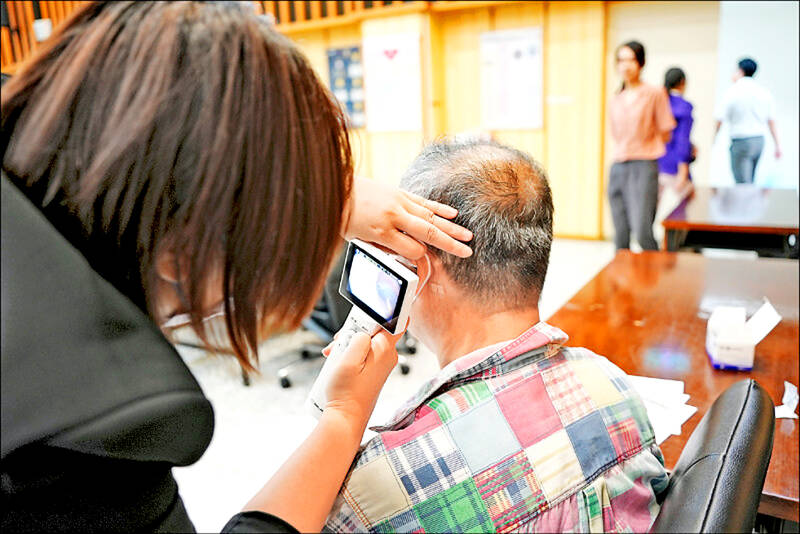
Photo courtesy of the National Taiwan University Hospital’s Yunlin Branch
Regulations on the assessment of people with disabilities say that those aged six or older meet the criteria for hearing impairment if they have at least 45 percent overall hearing loss in both ears, or if one ear has a hearing threshold of 90 decibels (dB) or higher and the other ear has a hearing threshold of 48dB or higher.
The WHO says that hearing loss of 35dB or more for elderly people qualifies as a hearing impairment, but Taiwan’s regulations require a loss of at least 48dB to qualify for a disability identification, meaning there is a significant gap between the two standards, Yeh said.
If the prevalence rate of age-related hearing loss in Western countries of 6 to 10 percent is indicative of the situation in Taiwan, that would mean about 450,000 people face the issue in Taiwan, but public awareness remains low and publicly funded adult health checkups only offer basic hearing screenings, making it difficult to identify potential cases early, Yeh said.
Li Po-hung (力博宏), director of Cheng Hsin General Hospital’s Department of Otolaryngology, said that when elderly people are diagnosed with hearing impairment or even receive a disability identification, some are still unwilling to get treatment or wear hearing aids.
Their reasons for rejecting treatment include unwillingness to spend money on treatment, downplaying the seriousness of their condition or not wanting to be perceived as “getting old,” Li said.
These “subjective issues” might not be solved by revising the criteria for hearing impairment or providing subsidies, as a UK study showed that in areas where full subsidies are provided for hearing aids, people diagnosed with hearing loss still delayed wearing them by seven years, he said.
The study showed that managing hearing loss is not solely about what health professionals suggest should be done, the subjective experience of people with the condition must also be improved through public health education and up-to-date information, he said.
If chronic hearing loss is untreated, it can easily lead to social isolation, depression and an increased risk of dementia, Li said, adding that some elderly people might experience symptoms of “pseudo-dementia,” such as incoherent responses and delayed reactions, simply because they cannot hear clearly.
The Speech-Language-Hearing Association, Taiwan, said hearing impairments can be identified at an early stage through pure-tone audiometry screening, allowing for early intervention to reduce negative impacts and long-term care costs.
The testing method should be part of publicly funded adult health checkups or labor health examinations, it said.
The Health Promotion Administration said that incorporating the test into routine adult health checkups requires careful consideration of evidence-based benefits, cost-effectiveness and service capacity.
Additional reporting by Hou Chia-yu and Lo Bi

FUKUOKA SITUATION: Japanese media reported that the pathogen is expected to be identified by the summer, while the CDC downplayed the idea that it was hMPV A “mysterious cold-like illness” reported in Japan’s Fukuoka Prefecture does not seem to be a new disease, but Japanese authorities have been asked about the situation, the Centers for Disease Control (CDC) said yesterday. The Fukuoka Prefectural Medical Association on Wednesday told a news conference that a “mystery cold” that has become a hot topic on social media is “highly likely to be caused by some kind of viral infection,” Japan’s KBC News reported. “Many people are experiencing symptoms starting with a sore throat, followed by a runny nose, phlegm and a severe cough,” KBC News reported, citing association officials. Health authorities are

Nvidia Corp CEO Jensen Huang (黃仁勳) arrived in Taiwan yesterday ahead of upcoming AI and technology events, saying he plans to meet with clients and Taiwan Semiconductor Manufacturing Co Chairman C.C. Wei (魏哲家) during his visit. After landing at Taipei Songshan Airport, Huang posed for photos with fans and handed out Yakult drinks to reporters and supporters waiting at the scene, saying he has “a lot to do” during the trip. Asked about reports that Nvidia’s planned headquarters site in Taipei’s Beitou Shilin Technology Park could break ground on May 27, Huang said that if the company holds an event, he would

The Ministry of Finance this afternoon announced the winning numbers for the March-April uniform invoice lottery. The winning number for the NT$10 million (US$318,060) special prize is 19531471, and the winning number for the NT$2 million grand prize is 85941329. Three numbers were drawn for the NT$200,000 first prize: 07225810, 20231230 and 83518781. Those with receipts matching the last seven digits of any of the first-prize numbers will win the NT$40,000 second prize, while those matching the last six digits will win the NT$10,000 third prize. Those whose receipts match the last five digits of the first-prize numbers can claim the NT$4,000 fourth prize,

SIX SUBSIDIES: The monthly allowance for older farmers is to increase to NT$10,000, and NT$5,000 is to be given to homemakers under the national pension system, Lai said The government is to implement major welfare policies for disadvantaged groups, including raising the monthly allowance for older farmers to NT$10,000 and providing homemakers with NT$5,000 per month, President William Lai (賴清德) said yesterday. Lai made the remarks during a visit to Wangling Temple in Chiayi County, saying that the planned increases were being introduced amid economic growth and an increase in tax revenue. Touting a policy, in which the government plans to provide a monthly allowance of NT$5,000 for every child under the age of 18 in a bid to address Taiwan’s low birthrate, Lai said that if received for the


 RSS
RSS