


The US on Thursday formally announced preferential tariff treatment for certain Taiwanese exports under Section 232 tariffs, fulfilling a part of a bilateral investment memorandum of understanding (MOU) signed earlier this year.
The measures, published in the Federal Register by the US Department of Commerce and the Office of the US Trade Representative (USTR), cap Section 232 tariffs on Taiwan-made automobile parts, timber, lumber and wood derivative products at 15 percent.
They also exempt certain aircraft components from derivative steel, aluminum and copper tariffs, but they did not make any mention of semiconductors, which the US said were under consideration as part of the Section 232 review.
Photo: Reuters
The changes to the Section 232 tariffs, which are aimed at protecting the US’ national security, are retroactive to May 1.
The US secretary of commerce and trade representative are “taking necessary and appropriate action” to implement the MOU, the notice said.
The announcement follows the signing in January of the Taiwan-US Investment MOU, under which Taiwan became the first economy to secure preferential treatment under US President Donald Trump’s administration’s Section 232 tariff regime.
The tariff concessions lower duties on Taiwanese automobile parts from 26.71 percent to 15 percent, matching the rate applied to competitors such as the EU, Japan and South Korea, which have also received preferential Section 232 tariff rates.
Tariffs on certain wood products have likewise been reduced from 25 percent to 15 percent, while derivative Section 232 duties on some steel, aluminum and copper-based aircraft components, which previously faced combined tariffs of up to 50 percent, have been eliminated.
Riley Walters, a senior fellow at the Hudson Institute specializing in international economics and national security, said the move showed Washington was honoring the MOU.
“The US side is moving ahead with implementing its part of the agreement,” Walters said. “This reflects an expectation that Taiwan will also commit to its part of the agreement once the Section 301 adjustments are made later this year.”
Under the Section 301 provision, economies found to have adopted “unreasonable or discriminatory” measures against the US that “burden or restrict” its commerce could be subject to heavy tariffs.
During his first term, Trump invoked the provision as the basis for imposing a 25 percent tariff on many Chinese imports, on the grounds of forced technology transfers and intellectual property theft.
It is unclear if Taiwan is a target for any Section 301 changes.
The Taiwan-US investment MOU includes commitments to facilitate two-way investment in high-tech sectors and support what officials have described as a “Taiwan model” for helping manufacturers establish supply-chain clusters in the US.
The agreement also envisions up to US$250 billion in additional Taiwanese investment in the US.
In Taipei, Vice Premier Cheng Li-chiun (鄭麗君) on Thursday said that Taiwanese companies had pledged to invest US$250 billion in the US, with some companies already submitting first-phase investment plans.
National Development Council Minister Yeh Chun-hsien (葉俊顯) said the Cabinet had approved a program to support those investments and is expected to sign MOUs with participating banks by the middle of next month, enabling companies to begin applying for financing.

FUKUOKA SITUATION: Japanese media reported that the pathogen is expected to be identified by the summer, while the CDC downplayed the idea that it was hMPV A “mysterious cold-like illness” reported in Japan’s Fukuoka Prefecture does not seem to be a new disease, but Japanese authorities have been asked about the situation, the Centers for Disease Control (CDC) said yesterday. The Fukuoka Prefectural Medical Association on Wednesday told a news conference that a “mystery cold” that has become a hot topic on social media is “highly likely to be caused by some kind of viral infection,” Japan’s KBC News reported. “Many people are experiencing symptoms starting with a sore throat, followed by a runny nose, phlegm and a severe cough,” KBC News reported, citing association officials. Health authorities are

Nvidia Corp CEO Jensen Huang (黃仁勳) arrived in Taiwan yesterday ahead of upcoming AI and technology events, saying he plans to meet with clients and Taiwan Semiconductor Manufacturing Co Chairman C.C. Wei (魏哲家) during his visit. After landing at Taipei Songshan Airport, Huang posed for photos with fans and handed out Yakult drinks to reporters and supporters waiting at the scene, saying he has “a lot to do” during the trip. Asked about reports that Nvidia’s planned headquarters site in Taipei’s Beitou Shilin Technology Park could break ground on May 27, Huang said that if the company holds an event, he would

The Ministry of Finance this afternoon announced the winning numbers for the March-April uniform invoice lottery. The winning number for the NT$10 million (US$318,060) special prize is 19531471, and the winning number for the NT$2 million grand prize is 85941329. Three numbers were drawn for the NT$200,000 first prize: 07225810, 20231230 and 83518781. Those with receipts matching the last seven digits of any of the first-prize numbers will win the NT$40,000 second prize, while those matching the last six digits will win the NT$10,000 third prize. Those whose receipts match the last five digits of the first-prize numbers can claim the NT$4,000 fourth prize,
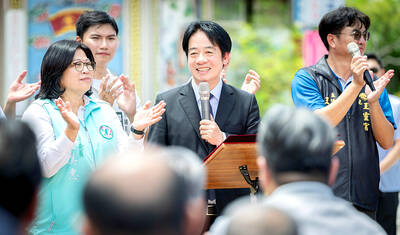
SIX SUBSIDIES: The monthly allowance for older farmers is to increase to NT$10,000, and NT$5,000 is to be given to homemakers under the national pension system, Lai said The government is to implement major welfare policies for disadvantaged groups, including raising the monthly allowance for older farmers to NT$10,000 and providing homemakers with NT$5,000 per month, President William Lai (賴清德) said yesterday. Lai made the remarks during a visit to Wangling Temple in Chiayi County, saying that the planned increases were being introduced amid economic growth and an increase in tax revenue. Touting a policy, in which the government plans to provide a monthly allowance of NT$5,000 for every child under the age of 18 in a bid to address Taiwan’s low birthrate, Lai said that if received for the


 RSS
RSS