


Using a smartphone before going to sleep can prevent the brain from entering a rest state and might harm sleep quality, disrupt autonomic nervous system regulation and cause heart palpitations, chest tightness, irritability and poor concentration, a psychiatrist said on Saturday.
Many people use smartphones as they lie in bed before going to sleep, believing that watching short videos, replying to messages or browsing social media is a way to relax.
However, people often end up staying up late, leaving them even more tired the next morning, psychiatrist Yu Kuan-tang (尤冠棠) said.
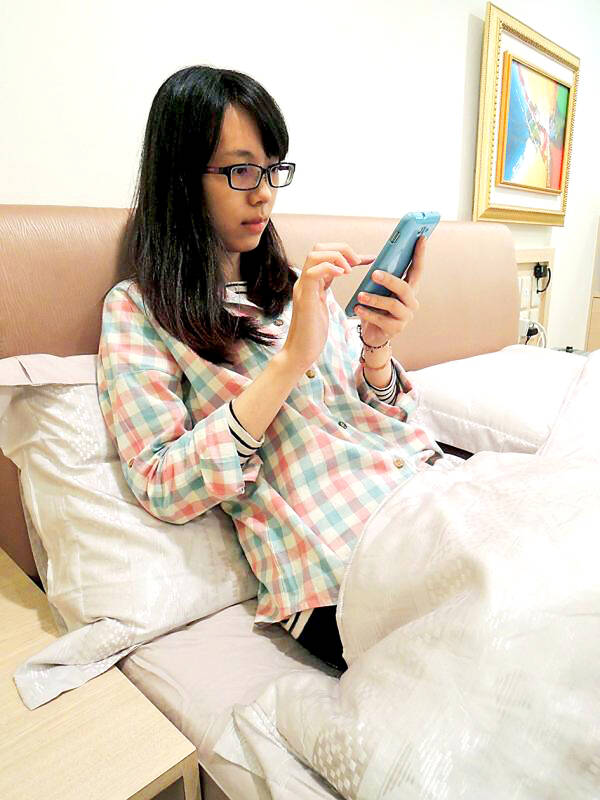
Photo: Tsai Shu-yuan, Taipei Times
The human brain and biological clock are attuned to daylight, with sunlight helping to maintain alertness and focus, while the body begins to release melatonin and transition into a resting state after dark, said Yu, an adjunct physician at Dr Chou’s Mental Health Clinic.
Using electronic devices for long periods at night keeps the brain stimulated, he said.
In particular, the blue light from smartphone screens can suppress melatonin secretion and delay the body’s biological clock, making it difficult to feel sleepy, he said.
The light from smartphones disrupts the brain’s natural rhythm and keeps the brain in an active state, Yu said.
Sleep research has shown that if the brain continues to process information and rapidly switches between topics, it stays in a state of cognitive arousal, making it difficult to transition smoothly into a resting state, he said.
Short videos, social media, messaging apps and news all keep the brain waiting for the next piece of information, preventing the brain’s alert system from shutting down, he added.
Using a phone while lying in bed disrupts sleep more than using a phone at night in general, because it weakens the brain’s association between bed and sleep, Yu said.
When sleep deprivation builds up, the body’s ability to recover declines and the autonomic nervous system becomes harder to regulate, he said.
Sleep-deprived people often experience heart palpitations, chest tightness, neck and shoulder tension, gastrointestinal discomfort, irritability and poor concentration, he said.
Many people mistake these for symptoms of stress when they are actually linked to chronic sleep deprivation, he added.
Establishing a bedtime routine can improve sleep quality, Yu said, advising people to reduce screen exposure to 30 to 60 minutes before sleep, limit social media use, avoid bringing their phones into their beds and turn off alerts so their brains can gradually receive signals that it is time to rest.

FUKUOKA SITUATION: Japanese media reported that the pathogen is expected to be identified by the summer, while the CDC downplayed the idea that it was hMPV A “mysterious cold-like illness” reported in Japan’s Fukuoka Prefecture does not seem to be a new disease, but Japanese authorities have been asked about the situation, the Centers for Disease Control (CDC) said yesterday. The Fukuoka Prefectural Medical Association on Wednesday told a news conference that a “mystery cold” that has become a hot topic on social media is “highly likely to be caused by some kind of viral infection,” Japan’s KBC News reported. “Many people are experiencing symptoms starting with a sore throat, followed by a runny nose, phlegm and a severe cough,” KBC News reported, citing association officials. Health authorities are

Nvidia Corp CEO Jensen Huang (黃仁勳) arrived in Taiwan yesterday ahead of upcoming AI and technology events, saying he plans to meet with clients and Taiwan Semiconductor Manufacturing Co Chairman C.C. Wei (魏哲家) during his visit. After landing at Taipei Songshan Airport, Huang posed for photos with fans and handed out Yakult drinks to reporters and supporters waiting at the scene, saying he has “a lot to do” during the trip. Asked about reports that Nvidia’s planned headquarters site in Taipei’s Beitou Shilin Technology Park could break ground on May 27, Huang said that if the company holds an event, he would

Carrefour Taiwan is to begin using a new name from the start of July, but it cannot divulge the name until then, the chairman of the supermarket chain's parent company said today. President Chain Store Co chairman Lo Chih-hsien (羅智先) was asked by reporters after a shareholders' meeting to confirm whether the company has settled on a new name for the supermarket brand. In March, the government-registered name of two Carrefour Taiwan branches was quietly changed to "Le Chia Kang" (樂家康) in Chinese, raising speculation that has been selected as the name. Lo said that because of local regulations and contractual obligations, the

The Philippines would likely be involved in any conflict over Taiwan due to its proximity to the democracy claimed by China, President Ferdinand Marcos Jr said, reiterating a stance that risks angering Beijing. “In the Philippines, we do not have a choice because Taiwan is so close to the Philippines and we have almost 200,000 Filipino nationals living and working in Taiwan,” Marcos said in an interview with Japanese media in Manila on Monday. The Philippine leader’s comments come ahead of a state visit to Japan next week, where he is to meet with Japanese Prime Minister Sanae Takaichi to discuss security


 RSS
RSS