


Researchers from National Yang Ming Chiao Tung University (NYCU), Academia Sinica and National Tsing Hua University have developed a portable, low-cost widely deployable sensor system to monitor environmental sounds and generate noise maps.
Noise pollution is a common but easily overlooked environmental issue in modern cities that can have adverse health effects, affecting sleep quality, emotional well-being and physical health, the team said yesterday.
Traditional noise monitoring relies on professional-grade instruments installed in limited locations, and while highly accurate, such setups are expensive and often do not reflect the complexity of urban soundscapes across different neighborhoods and environments, they said.
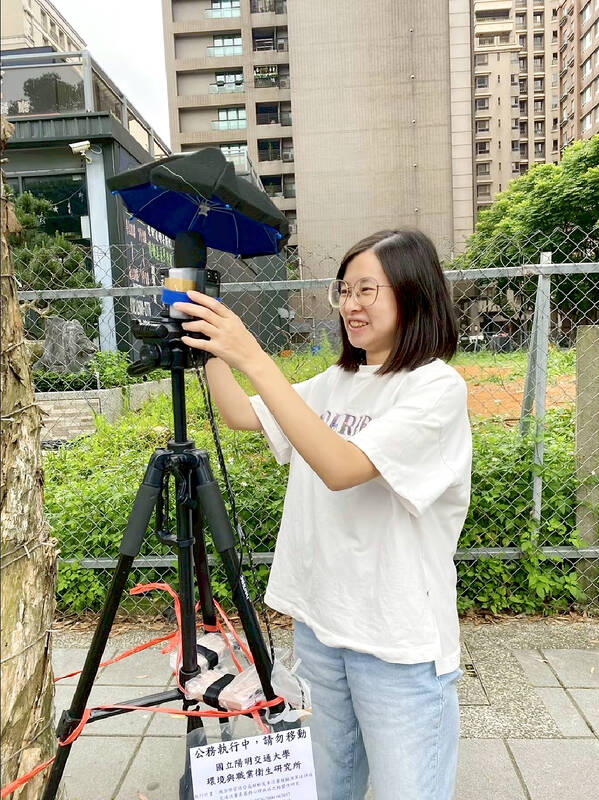
Photo courtesy of the National Yang Ming Chiao Tung University
To overcome these limitations, the team developed EcoDecibel, a low-cost, compact and highly sensitive sensor module that can be deployed on roadside utility poles or in community public spaces and on school campuses, the researchers said.
Because the sensors are inexpensive and portable — each unit only costs about a few thousand New Taiwan dollars and is powered by a standard mobile battery — multiple units can operate simultaneously across an area, allowing cities to build a “listening network,” they said.
The collected data are transmitted to cloud-computing systems provided by Chunghwa Telecom, with artificial intelligence models analyzing sound patterns and generating visualized maps showing levels at specified places and times, as well as changes in environmental noise throughout the day, or over a longer period, they said.
The system has already been tested in several districts across northern Taiwan, including in New Taipei City’s Sanjhih (三芝) and Linkou (林口) districts, and Taoyuan’s Gueishan (龜山) and Lujhu (蘆竹) districts, they said.
The lightweight sensors are highly accurate, with performance comparable to the Ministry of Environment’s environmental noise monitoring standards, the researchers said.
Many studies have confirmed that prolonged exposure to high-noise environments could increase the risk of sleep disruption, anxiety, mental illness and cardiovascular disease, said Pan Wen-chi (潘文驥), director of NYCU College of Medicine’s Institute of Environmental and Occupational Health Sciences.
It could also affect children’s learning ability, he said.
The ability to continuously record environmental sounds over long periods could provide an important foundation for health studies and environmental governance, Pan said.
Academia Sinica Institute of Information Science research fellow Chen Ling-Jyh (陳伶志), who led the hardware development, said the concept behind the project is similar to the AirBox initiative, which monitors PM2.5, particulate matter with a diameter of 2.5 micrometers or smaller.
The research team aims to transition environmental monitoring from a limited number of fixed monitoring stations to a decentralized sensing network in which the public can participate, he said.
If deployed on a larger scale, the “urban mini-ears” could become important infrastructure for smart cities, helping governments manage noise pollution more accurately and enabling residents to better understand the noise risks in their living environments, the research team said.

FUKUOKA SITUATION: Japanese media reported that the pathogen is expected to be identified by the summer, while the CDC downplayed the idea that it was hMPV A “mysterious cold-like illness” reported in Japan’s Fukuoka Prefecture does not seem to be a new disease, but Japanese authorities have been asked about the situation, the Centers for Disease Control (CDC) said yesterday. The Fukuoka Prefectural Medical Association on Wednesday told a news conference that a “mystery cold” that has become a hot topic on social media is “highly likely to be caused by some kind of viral infection,” Japan’s KBC News reported. “Many people are experiencing symptoms starting with a sore throat, followed by a runny nose, phlegm and a severe cough,” KBC News reported, citing association officials. Health authorities are

Nvidia Corp CEO Jensen Huang (黃仁勳) arrived in Taiwan yesterday ahead of upcoming AI and technology events, saying he plans to meet with clients and Taiwan Semiconductor Manufacturing Co Chairman C.C. Wei (魏哲家) during his visit. After landing at Taipei Songshan Airport, Huang posed for photos with fans and handed out Yakult drinks to reporters and supporters waiting at the scene, saying he has “a lot to do” during the trip. Asked about reports that Nvidia’s planned headquarters site in Taipei’s Beitou Shilin Technology Park could break ground on May 27, Huang said that if the company holds an event, he would

Carrefour Taiwan is to begin using a new name from the start of July, but it cannot divulge the name until then, the chairman of the supermarket chain's parent company said today. President Chain Store Co chairman Lo Chih-hsien (羅智先) was asked by reporters after a shareholders' meeting to confirm whether the company has settled on a new name for the supermarket brand. In March, the government-registered name of two Carrefour Taiwan branches was quietly changed to "Le Chia Kang" (樂家康) in Chinese, raising speculation that has been selected as the name. Lo said that because of local regulations and contractual obligations, the

The Philippines would likely be involved in any conflict over Taiwan due to its proximity to the democracy claimed by China, President Ferdinand Marcos Jr said, reiterating a stance that risks angering Beijing. “In the Philippines, we do not have a choice because Taiwan is so close to the Philippines and we have almost 200,000 Filipino nationals living and working in Taiwan,” Marcos said in an interview with Japanese media in Manila on Monday. The Philippine leader’s comments come ahead of a state visit to Japan next week, where he is to meet with Japanese Prime Minister Sanae Takaichi to discuss security


 RSS
RSS