


US President Donald Trump’s recent remarks that he was “not looking” for Taiwan to declare independence do not represent a change in Washington’s long-standing policy toward Taiwan, the president of the Washington-based Jamestown Foundation said yesterday.
The “most important thing” in Trump’s remarks near the end of his May 13 to 15 state visit to China was that he repeatedly stated US policy toward Taiwan had not changed, foundation president Peter Mattis told a media event in Taipei held by Democratic Progressive Party lawmakers.
“In the Fox News interview, he said, I think, three times a version of ‘US policy has not changed,’” Mattis said, referring to Trump’s interview that aired on May 15 after being taped near the end of his trip to Beijing, where he met Chinese President Xi Jinping (習近平).
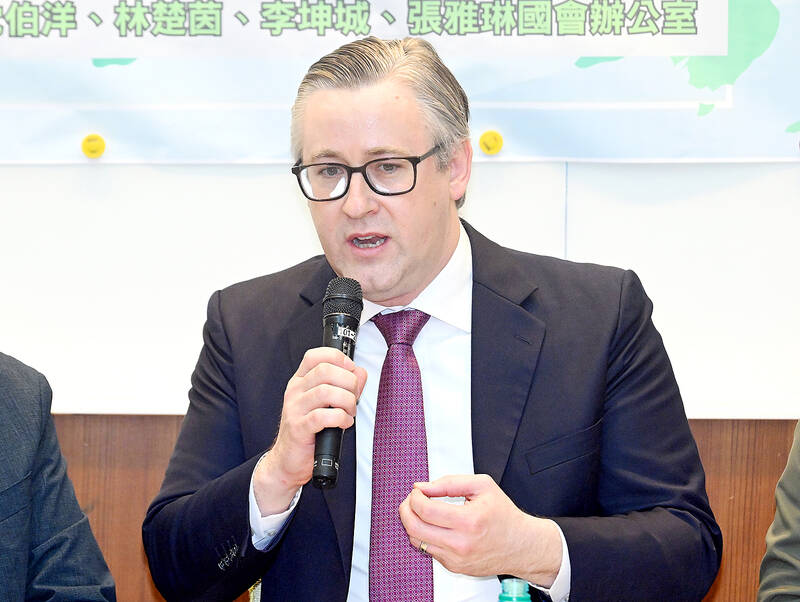
Photo: Liao Chen-huei, Taipei Times
In that interview, Trump said “nothing’s changed” when asked about US policy regarding Taiwan, but added that he was “not looking to have somebody go independent.”
Trump’s remarks “didn’t really change anything” that the US has said about independence or about how Taiwan chooses its future, Mattis said.
“The US policy has been consistent for a very long time that the people on both sides of the Strait have a role in choosing that future, and that that future should be peaceful and it should be free of coercion — Trump hasn’t changed that,” he said.
Trump had not described Taiwan as “a bargaining chip,” nor had he suggested that Washington was prepared to make a deal with Beijing over Taiwan, Mattis said.
“There is no deal that can be made over Taiwan that doesn’t make the US look weak,” he said, adding that Trump is “incredibly sensitive” to the perception that he is presiding over a declining US.
However, Trump did say in the Fox News interview that a pending US$14 billion arms package of missiles, anti-drone equipment and other weapons for Taiwan was a “very good negotiating chip for us ... It’s a lot of weapons.”
That and another comment that the arms sale “depends on China” led to speculation that the arms sale could be delayed.
On Thursday last week, Acting US Secretary of the Navy Hung Cao said at a US Senate hearing that Washington was “doing a pause” on some foreign military sales to Taiwan to ensure it had sufficient munitions for Epic Fury, the US military operation in Iran.
Mattis dismissed suggestions that any potential pause could be linked to US military operations in Iran.
“There’s no way in which FMS that has been decided or notified could be associated with operational inventories or anything else that has taken place” in relation to operations in Iran, he said, using the acronym for foreign Military sales.
FMS is the US government’s security assistance program for selling defense articles and services to foreign countries.
Such comments likely reflected someone “misspeaking” or “not necessarily understanding” the technical details of how US arms sales work, including the packaging and timing of deliveries, Mattis said.
“I think these are separate issues and should be treated that way,” he said.
The day after Cao’s comment, the Presidential Office said that Taipei had not received any formal notification from Washington about any possible adjustment to US arms sales to Taiwan.

FUKUOKA SITUATION: Japanese media reported that the pathogen is expected to be identified by the summer, while the CDC downplayed the idea that it was hMPV A “mysterious cold-like illness” reported in Japan’s Fukuoka Prefecture does not seem to be a new disease, but Japanese authorities have been asked about the situation, the Centers for Disease Control (CDC) said yesterday. The Fukuoka Prefectural Medical Association on Wednesday told a news conference that a “mystery cold” that has become a hot topic on social media is “highly likely to be caused by some kind of viral infection,” Japan’s KBC News reported. “Many people are experiencing symptoms starting with a sore throat, followed by a runny nose, phlegm and a severe cough,” KBC News reported, citing association officials. Health authorities are

Nvidia Corp CEO Jensen Huang (黃仁勳) arrived in Taiwan yesterday ahead of upcoming AI and technology events, saying he plans to meet with clients and Taiwan Semiconductor Manufacturing Co Chairman C.C. Wei (魏哲家) during his visit. After landing at Taipei Songshan Airport, Huang posed for photos with fans and handed out Yakult drinks to reporters and supporters waiting at the scene, saying he has “a lot to do” during the trip. Asked about reports that Nvidia’s planned headquarters site in Taipei’s Beitou Shilin Technology Park could break ground on May 27, Huang said that if the company holds an event, he would

Carrefour Taiwan is to begin using a new name from the start of July, but it cannot divulge the name until then, the chairman of the supermarket chain's parent company said today. President Chain Store Co chairman Lo Chih-hsien (羅智先) was asked by reporters after a shareholders' meeting to confirm whether the company has settled on a new name for the supermarket brand. In March, the government-registered name of two Carrefour Taiwan branches was quietly changed to "Le Chia Kang" (樂家康) in Chinese, raising speculation that has been selected as the name. Lo said that because of local regulations and contractual obligations, the
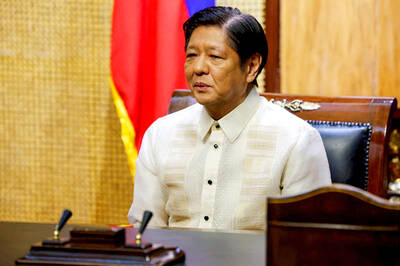
The Philippines would likely be involved in any conflict over Taiwan due to its proximity to the democracy claimed by China, President Ferdinand Marcos Jr said, reiterating a stance that risks angering Beijing. “In the Philippines, we do not have a choice because Taiwan is so close to the Philippines and we have almost 200,000 Filipino nationals living and working in Taiwan,” Marcos said in an interview with Japanese media in Manila on Monday. The Philippine leader’s comments come ahead of a state visit to Japan next week, where he is to meet with Japanese Prime Minister Sanae Takaichi to discuss security


 RSS
RSS