


The Hsinchu District Court on Wednesday last week rejected a NT$1.6 million (US$50,721) defamation claim by a teacher surnamed Chen (陳) who was removed from an unnamed Line group chat after a moderator called him a “one-night stand kind of guy” and said he sent sexually suggestive messages to women in the group.
A woman surnamed Yang (楊) in 2024 said in the group chat that Chen is “widely recognized as a guy who does one-night stands” and “my group is not a tool for you to pick up women,” which Chen claimed was insulting and derogatory.
Yang also posted screenshots of his private conservations with women from the chat, which included personal information such as his marital status, height and weight, profile photo, full-body photo and physical characteristics, Chen said.
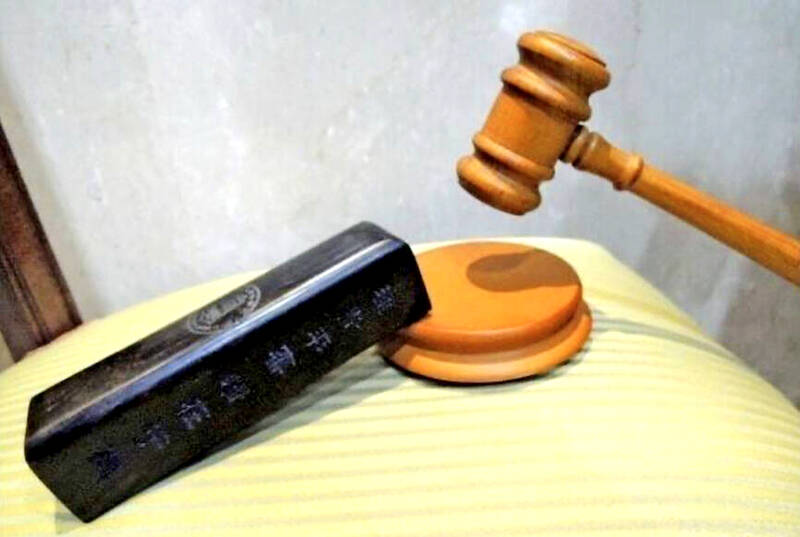
Photo: Taipei Times
Chen said that Yang said: “this is a public trial for everyone to see” and “I am publicly shaming him,” which amounted to intimidation, before she removed him from the group and infringed on his right to social participation.
Chen filed a lawsuit last year seeking NT$1.6 million in damages for emotional distress.
The court said that Chen had sent inappropriate, explicit videos to women in the group chat, and ruled that the comments against him were valid, and removing him from the group chat was to protect other members.
Yang said she made the comments to protect group members due to Chen’s alleged harassment.
Chen engaged in inappropriate behavior by sending explicit messages and videos, and harassing multiple female members, contravening group rules banning pornographic content, sexualized conversations and harassment, Yang said.
His behavior prompted complaints from several members, who later left the group, she added.
Another woman in the group said she was surprised when Chen privately messaged her with inappropriate images, the court said.
The woman said he continued sending such content even after being removed and rejoining the group, including a video titled: “Live to old age, have sex to old age” and a link claiming “12 benefits of sex that can make you younger,” it said.
The group moderator removed him again and blocked him due to repeated complaints, it added.
Yang’s statements about Chen and decision to remove him from the group were based on prior reports from multiple members that he had privately messaged them and sent sexually suggestive messages, images or video links, the court said.
Yang’s actions were grounded in reasonable verification and supporting evidence, and as such did not constitute unlawful defamation, it said.
Her actions were aimed at managing the group and safeguarding other members, the court said, dismissing the case.
While defendants accused of exposing others’ personal information and shaming them online are often found guilty, in this case the court found that Yang’s handling of Chen’s personal data met exemptions under the Personal Data Protection Act (個人資料保護法).
The act stipulates that when non-governmental entities collect or handle personal data, they must have a specific purpose and the data must be voluntarily disclosed, lawfully made public, necessary to promote public interest or obtained from publicly available sources, the court said.
The personal information posted by Yang in the group chat, including Chen’s weight and height, had been voluntarily shared by Chen to other chat members, and it was not sufficient to identity Chen in daily life, it said.
Yang posted Chen’s chat records in the group to protect the rights of other members and prevent him from continuing privately sending sexually suggestive and inappropriate messages to female members, the court ruled.
In addition, the full-body photo Yang posted had been uploaded by Chen himself on the Line platform as his public account background image and could be seen by anyone who viewed his profile, so it was hard to see how Yang had infringed on his privacy rights, it added.

UPGRADE: The Kang Ding-class frigate is replacing its Chaparall missiles with Tien Chien II and Hua Yang VLS, which would provide it with long-range, 360° air defense Taiwan plans to produce 1,200 to 1,376 Hai Chien II missiles (海劍二, Sea Sword II) — also known as TC-2N — to serve as the standard air defense system of the navy’s surface combatant fleet, a source said yesterday. Last week, the Hai Chien II, the naval version of the Tien Kung II missile (天劍二, Sky Sword II), completed a live-fire test in waters off the National Chungshan Institute of Science and Technology’s Jiupeng facility (九鵬) in Pingtung County’s Manjhou Township (滿州). The MIM72 Chaparral and other dated air defense missiles that currently arm Taiwanese ships have inadequate range to combat Chinese

REASONS FOR TRAVEL: An assistant professor said that proposed amendments to penalize drivers if they used drugs overseas would not deter people from traveling People who operate a motor vehicle under the influence of marijuana would have their driver’s license revoked, even if they used the substance while overseas, the Ministry of Transportation and Communications said yesterday, citing proposed amendments to the Road Traffic Management and Penalty Act (道路交通管理處罰條例). The amendments would also authorize the government to revoke the licenses of people determined to have used Category 1 or Category 2 narcotics, even if they were not operating a vehicle while under the influence of drugs, as well as ban them from taking the license test for three years, the ministry said. People aged 18 or
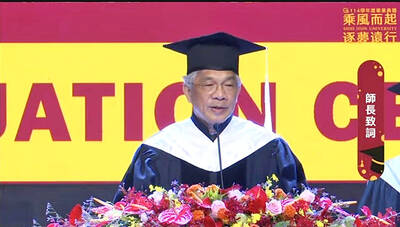
Shih Hsin University President Chen Ching-he (陳清河) yesterday issued a public apology for comments made in his commencement speech last week, stating that he has asked the school to suspend his duties and halt his wages for two months as a show of contrition. At the commencement ceremony on May 30, Chen said, “If you don’t manage your time well, or your own emotions, or your health, then I am telling every one of you — put a quick end to ‘you,’ because the world has no need for ‘you.’” The comments have sparked significant controversy online, and Chen through an open
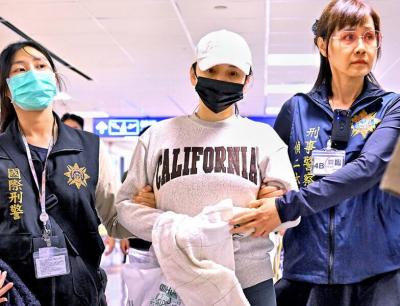
Johanne Liou (劉喬安), a Taiwanese woman who shot to unwanted fame during the Sunflower movement protests in 2014, returned to Taiwan last night after being deported from the US. She is to stand trial in Taiwan for charges involving embezzlement, fraud and drug crimes. The Criminal Investigation Bureau (CIB) said it took her into custody at Taiwan Taoyuan International Airport and would first question her before transferring her to the New Taipei District Prosecutors’ Office. She was arrested upon disembarking a flight from San Francisco that landed shortly before 7pm. Liou absconded to the US in 2019 after jumping bail


 RSS
RSS