


Convenience stores are increasingly employing migrant workers to meet demands among a worsening labor shortage.
As labor shortages continue across industries, convenience store chains have over the past few years turned to foreign students, “new immigrants” and other migrant communities to help staff frontline operations.
7-Eleven has become one of the first convenience store operators in Taiwan to establish training programs aimed at foreign workers and students.

Photo: Yang Ya-min, Taipei Times
The company said it has introduced specialized training classes for foreign university students and established “demonstration stores” in areas with large foreign student populations.
Fourteen such stores have been established nationwide, it said.
It said it hopes referrals and word-of-mouth recommendations from foreign employees would help attract more overseas workers and diversify its workforce.
The company has also introduced several support tools for foreign staff, including foreign-language-friendly name tags, artificial intelligence-powered real-time translation systems, multilingual promotional posters and communication support boards designed to reduce language barriers and help them adapt more quickly to store operations while maintaining customer service standards.
More than 1,000 foreign students and foreign spouses have been hired at 7-Eleven stores in the past few years, according to company statistics.
It said stores in areas with large foreign populations have seen improvements in customer relations and sales after hiring foreign staff.
FamilyMart said it has also recruited diverse talent since 2022, including older workers, foreign nationals and new immigrants for frontline operations. Foreign employees account for about 10 percent of staffing at directly operated stores, including foreign students, vocational students and legally employed new immigrants.
To help foreign employees adapt more quickly, FamilyMart said it has introduced specialized onboarding and training programs covering store operations, service standards and scenario-based communication exercises, alongside multilingual teaching tools and online Mandarin-learning resources.
New employees are also paired with experienced staff mentors during their initial training period, while the company provides regular Chinese-language refresher sessions and multilingual Line support groups to bolster peer support networks.
Foreign employees generally demonstrate high job stability and strong willingness to learn, while bringing diverse cultural perspectives to stores, FamilyMart said.
The main challenges stem from language and cultural differences, the company said.
For example, newly hired foreign employees might not immediately understand localized shorthand expressions used by customers, such as da bing na (大冰拿) — slang for a large iced latte — and often require assistance from experienced staff members until they adapt.
In one case, an Indonesian Muslim employee was uncomfortable handling pork products because of religious beliefs, prompting a store manager to adjust job duties accordingly, the company said.
PX Mart said its stores, fresh food divisions and logistics centers also employ foreign workers, mainly through university-industry cooperation programs.
Foreign nationals account for more than 95 percent of employees in such programs, while about 9.6 percent of part-time student workers are foreign nationals, it said, adding that fewer than 1 percent of regular full-time employees are foreign nationals.
PX Mart said that, to help foreign employees adapt, it has implemented a “new employee passport” mentorship system under which experienced employees guide new workers through at least two weeks of hands-on training and evaluations covering store procedures, retail operations and cashier systems.
The company said it has also established designated “seed stores” staffed by experienced trainers responsible for employee support and instruction. Employees working in fresh food or food safety-related departments receive additional professional training lasting from several weeks to six months, including practical instruction, classroom courses and online learning focused on food hygiene and professional skills.


UPGRADE: The Kang Ding-class frigate is replacing its Chaparall missiles with Tien Chien II and Hua Yang VLS, which would provide it with long-range, 360° air defense Taiwan plans to produce 1,200 to 1,376 Hai Chien II missiles (海劍二, Sea Sword II) — also known as TC-2N — to serve as the standard air defense system of the navy’s surface combatant fleet, a source said yesterday. Last week, the Hai Chien II, the naval version of the Tien Kung II missile (天劍二, Sky Sword II), completed a live-fire test in waters off the National Chungshan Institute of Science and Technology’s Jiupeng facility (九鵬) in Pingtung County’s Manjhou Township (滿州). The MIM72 Chaparral and other dated air defense missiles that currently arm Taiwanese ships have inadequate range to combat Chinese

REASONS FOR TRAVEL: An assistant professor said that proposed amendments to penalize drivers if they used drugs overseas would not deter people from traveling People who operate a motor vehicle under the influence of marijuana would have their driver’s license revoked, even if they used the substance while overseas, the Ministry of Transportation and Communications said yesterday, citing proposed amendments to the Road Traffic Management and Penalty Act (道路交通管理處罰條例). The amendments would also authorize the government to revoke the licenses of people determined to have used Category 1 or Category 2 narcotics, even if they were not operating a vehicle while under the influence of drugs, as well as ban them from taking the license test for three years, the ministry said. People aged 18 or
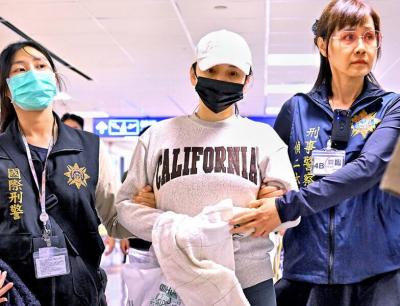
Johanne Liou (劉喬安), a Taiwanese woman who shot to unwanted fame during the Sunflower movement protests in 2014, returned to Taiwan last night after being deported from the US. She is to stand trial in Taiwan for charges involving embezzlement, fraud and drug crimes. The Criminal Investigation Bureau (CIB) said it took her into custody at Taiwan Taoyuan International Airport and would first question her before transferring her to the New Taipei District Prosecutors’ Office. She was arrested upon disembarking a flight from San Francisco that landed shortly before 7pm. Liou absconded to the US in 2019 after jumping bail
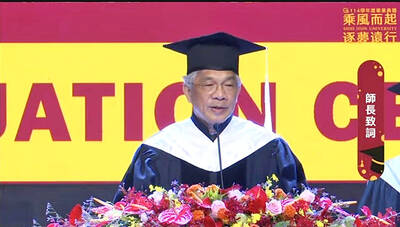
Shih Hsin University President Chen Ching-he (陳清河) yesterday issued a public apology for comments made in his commencement speech last week, stating that he has asked the school to suspend his duties and halt his wages for two months as a show of contrition. At the commencement ceremony on May 30, Chen said, “If you don’t manage your time well, or your own emotions, or your health, then I am telling every one of you — put a quick end to ‘you,’ because the world has no need for ‘you.’” The comments have sparked significant controversy online, and Chen through an open


 RSS
RSS