


As migrant workers, foreign students and new immigrants increasingly rely on convenience stores for daily necessities and services, such chains are focusing on Taiwan’s growing Southeast Asian consumer base.
Retailers have expanded efforts ranging from store layouts and Southeast Asian food offerings to personal financial services to capture rising demand among Taiwan’s foreign residents.
The number of migrant workers in Taiwan has more than doubled over the past 15 years, rising from about 390,000 in 2011 to more than 870,000 this year, Ministry of Labor statistics showed.
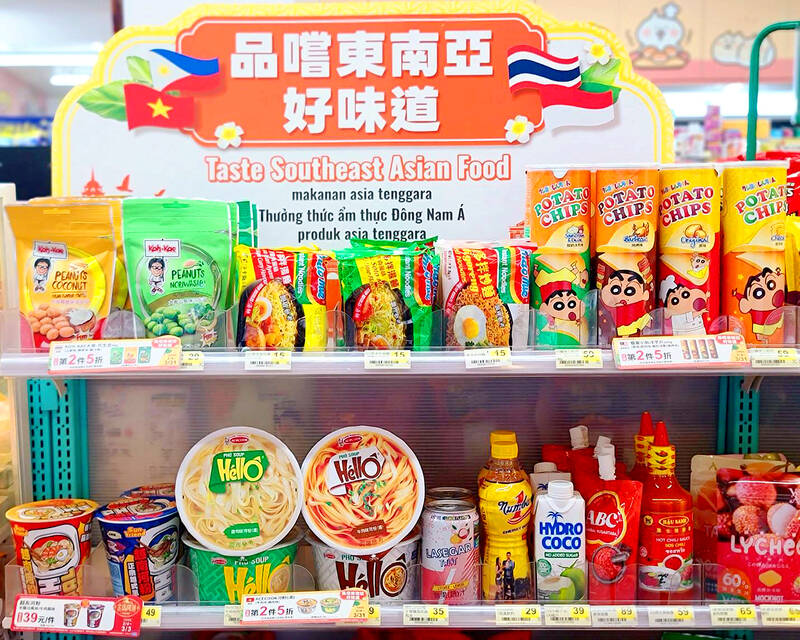
Photo: Yang Ya-min, Taipei Times
If undocumented migrant workers, Southeast Asian spouses of Taiwanese and international students are included, the total is estimated to rise to about 1.2 million.
A nationwide survey conducted by One-Forty, a nonprofit, found that convenience stores have become migrant workers’ “third space” outside factories and dormitories. Migrant workers visit convenience stores on average every two days, with food purchases, international remittances and parcel services ranking as the three most commonly used services.
To meet the growing demand, convenience store chains such as FamilyMart and 7-Eleven have expanded efforts in store operations, product development, service optimization and social engagement to create what they describe as more “diverse and inclusive” shopping environments.
Migrant workers in Taiwan mainly come from Indonesia, Vietnam, the Philippines and Thailand, driving strong demand for Southeast Asian food and lifestyle products, FamilyMart said.
The company said that since 2020, it has introduced Southeast Asian product sections at stores in residential and industrial areas with large migrant worker populations.
The sections feature about 100 products from Indonesia, Vietnam, Thailand and the Philippines, including snacks, beverages, canned foods and seasonings. Price tags also include country-of-origin and halal labels, while product information has been upgraded to Chinese and English, it said.
FamilyMart said it has accelerated expansion of the sections in the past few years, with about 1,200 stores across Taiwan — about 30 percent of all outlets — now featuring Southeast Asian product areas. Sales in the category last year rose about 70 percent from the previous year.
In 2024, the company also launched Taiwan’s first pork-free hot food section for Muslims and consumers with specific dietary needs, offering items such as pork-free hot dogs and steamed buns. The sections have been introduced at about 220 stores in areas frequently visited by migrant workers, including transportation hubs, hospitals, factory districts and tourist destinations, the company said.
FamilyMart has also developed its hot food series featuring Southeast Asian flavors and halal-certified ready-to-eat meals, which are now available at about 700 stores nationwide.
Meanwhile, 7-Eleven has also established Southeast Asian product sections at about 400 stores across Taiwan, mainly in industrial parks, transportation hubs, university districts and hospital areas with large migrant worker and foreign student populations.
Popular products include instant noodles, snacks and seasonings, as well as Indonesian noodles, Philippine dried mangoes, Indonesian shrimp chili sauce, Thai peanuts, hot sauce, energy drinks, coconut water and rice noodles.
PX Mart said migrant workers have also become a sizable and stable consumer group for the chain. In Hsinchu County’s Hukou Industrial Park and surrounding migrant worker communities, about one-fourth of migrant worker customers are considered high-frequency shoppers, visiting the chain more than once per week, while average shoppers visit about two to three times per month, it added.
To meet the demand, PX Mart said it has also introduced Southeast Asian product sections in areas frequented by migrant workers, focusing on four high-demand categories: household goods, instant noodles, fresh produce, and snacks and beverages, while tailoring products to the preferences of different nationalities.
The company said it has expanded vegetable and spice selections for Vietnamese consumers, strengthened hometown-flavor instant noodles and desserts for Filipinos, and introduced Indonesian personal care and household cleaning brands to improve convenience and familiarity for shoppers.
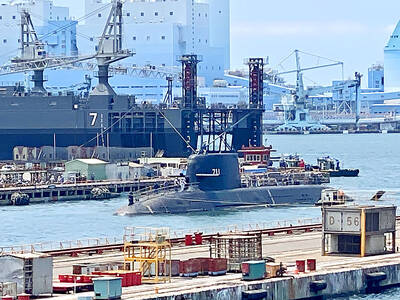
AGING: While Japan has 22 submarines, Taiwan only operates four, two of which were commissioned by the US in 1945 and 1946, and transferred to Taiwan in 1973 Taiwan would need at least 12 submarines to reach modern fleet capabilities, CSBC Corp, Taiwan chairman Chen Cheng-hung (陳政宏) said in an interview broadcast on Friday, citing a US assessment. CSBC is testing the nation’s first indigenous defense submarine, the Hai Kun (海鯤, Narwhal), which is scheduled to be delivered to the navy next month or in July. The Hai Kun has completed torpedo-firing tests and is scheduled to undergo overnight sea trials, Chen said on an SET TV military affairs program. Taiwan would require at least 12 submarines to establish a modern submarine force after assessing the nation’s operational environment and defense

Yangmingshan National Park authorities yesterday urged visitors to respect public spaces and obey the law after a couple was caught on a camera livestream having sex at the park’s Qingtiangang (擎天崗) earlier in the day. The Shilin Police Precinct in Taipei said it has identified a suspect and his vehicle registration number, and would summon him for questioning. The case would be handled in accordance with public indecency charges, it added. The couple entered the park at about 11pm on Thursday and began fooling around by 1am yesterday, the police said, adding that the two were unaware of the park’s all-day live
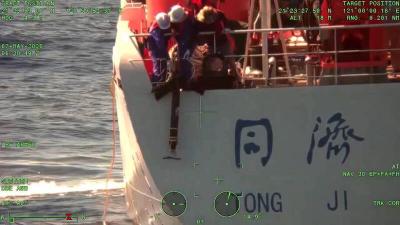
The coast guard today said that it had disrupted "illegal" operations by a Chinese research ship in waters close to the nation and driven it away, part of what Taipei sees a provocative pattern of China's stepped up maritime activities. The coast guard said that it on Thursday last week detected the Chinese ship Tongji (同濟號), which was commissioned only last year, 29 nautical miles (54km) southeast of the southern tip of Taiwan, although just outside restricted waters. The ship was observed lowering ropes into the water, suspected to be the deployment of scientific instruments for "illegal" survey operations, and the coast

A former soldier and an active-duty army officer were yesterday indicted for allegedly selling classified military training materials to a Chinese intelligence operative for a total of NT$79,440. The Taipei District Prosecutors’ Office indicted Chen Tai-yin (陳泰尹) and Lee Chun-ta (李俊達) for contravening the National Security Act (國家安全法) and the Anti-Corruption Act (貪污治罪條例). Chen left the military in September 2013 after serving alongside then-staff sergeant Lee, now an army lieutenant, at the 21st Artillery Command of the army’s Sixth Corps from 2011 to 2013, according to the indictment. Chen met a Chinese intelligence operative identified as “Wang” (王) through a friend in November


 RSS
RSS