


US President Donald Trump has kept China out of decision about arms sales to Taiwan, a Taiwanese national security official said yesterday while highlighting steady US-Taiwan policy signals following Trump’s meeting with Chinese President Xi Jinping (習近平).
Trump on Friday wrapped up his state visit in China during which he met with Xi.
The official, who declined to be named, said that to understand the US policy stance on Taiwan following the Trump-Xi meeting and subsequent remarks by Trump, it is best viewed through a series of coordinated statements from the White House, the Department of State and Trump himself.
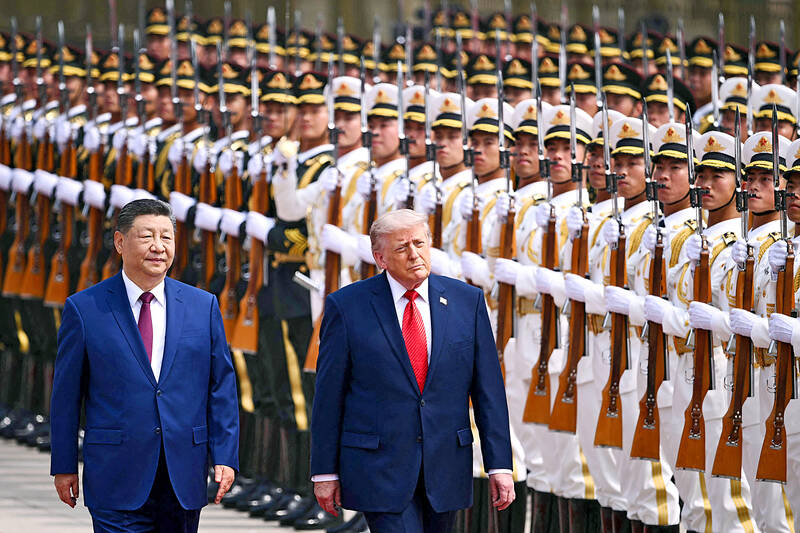
Photo: AFP
Taken together, the messages have remained broadly consistent, which are that there is “no change in US policy toward Taiwan, maintaining the status quo is a priority, and that arms sales are negotiated solely with Taipei,” they said.
Referring to US Secretary of State Marco Rubio’s remarks on Thursday that there has been no change in US policy toward Taiwan, the Taiwanese official said Rubio offered the most direct confirmation from the administration following the meeting.
The official said that the White House also amplified Rubio’s comments on social media, and Trump, in a separate Fox News interview, also said that “nothing has changed.”
With the president and secretary of state making similar statements within 24 hours, the message was unambiguous, the official said.
Trump in media interviews repeatedly referenced Xi raising the issue of Taiwanese independence, prompting some interpretations that he was drawing a red line on Taiwan in line with Beijing’s position, they said.
However, a closer reading of the full context, including Trump’s call for China to “cool down,” suggested that he was less focused on defining Taiwan’s status, and more concerned about avoiding any moves that could disrupt the “status quo”, they said.
Trump’s comments that he does not want to see Taiwan declare independence, or the US “travel 9,500 miles to fight a war,” reflected an effort to avoid being pulled into a conflict that would undermine stability and core US interests, rather than an attempt to define Taiwan’s political status on Beijing’s behalf, the official added.
On arms sales, the official said that when Trump was asked whether he would approve more than US$10 billion in deals, he responded that he “may do it, may not do it,” declining to reveal the key factors behind any decision. Addressing Rubio’s remarks about how arms sales were not a major focus of the meeting and that Trump made it clear that he offered Xi no response or commitments on the matter, in addition to Trump telling the media that he would have to talk to the person that’s “running Taiwan” before making his decision on the arms deals, the Taiwanese official said that in this context, the US response is more of a warning to Beijing not to disrupt the “status quo.”
The official said it has been made clear, including by Trump himself, that despite a range of requests from Xi, there was no response.
“Trump did not allow Xi to negotiate or haggle with him over Taiwan arms sales,” they said.
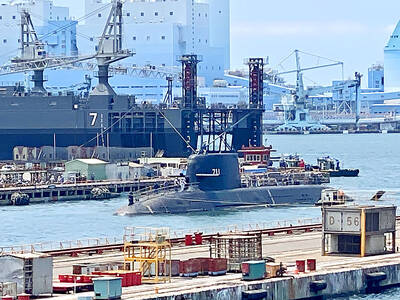
AGING: While Japan has 22 submarines, Taiwan only operates four, two of which were commissioned by the US in 1945 and 1946, and transferred to Taiwan in 1973 Taiwan would need at least 12 submarines to reach modern fleet capabilities, CSBC Corp, Taiwan chairman Chen Cheng-hung (陳政宏) said in an interview broadcast on Friday, citing a US assessment. CSBC is testing the nation’s first indigenous defense submarine, the Hai Kun (海鯤, Narwhal), which is scheduled to be delivered to the navy next month or in July. The Hai Kun has completed torpedo-firing tests and is scheduled to undergo overnight sea trials, Chen said on an SET TV military affairs program. Taiwan would require at least 12 submarines to establish a modern submarine force after assessing the nation’s operational environment and defense
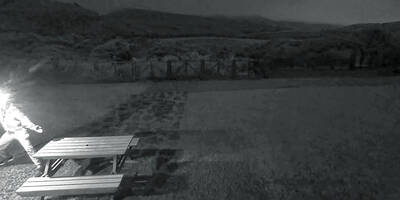
Yangmingshan National Park authorities yesterday urged visitors to respect public spaces and obey the law after a couple was caught on a camera livestream having sex at the park’s Qingtiangang (擎天崗) earlier in the day. The Shilin Police Precinct in Taipei said it has identified a suspect and his vehicle registration number, and would summon him for questioning. The case would be handled in accordance with public indecency charges, it added. The couple entered the park at about 11pm on Thursday and began fooling around by 1am yesterday, the police said, adding that the two were unaware of the park’s all-day live
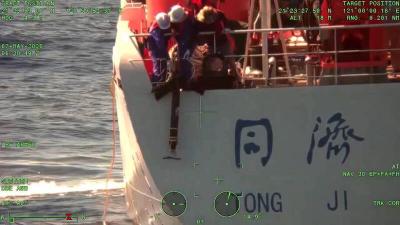
The coast guard today said that it had disrupted "illegal" operations by a Chinese research ship in waters close to the nation and driven it away, part of what Taipei sees a provocative pattern of China's stepped up maritime activities. The coast guard said that it on Thursday last week detected the Chinese ship Tongji (同濟號), which was commissioned only last year, 29 nautical miles (54km) southeast of the southern tip of Taiwan, although just outside restricted waters. The ship was observed lowering ropes into the water, suspected to be the deployment of scientific instruments for "illegal" survey operations, and the coast
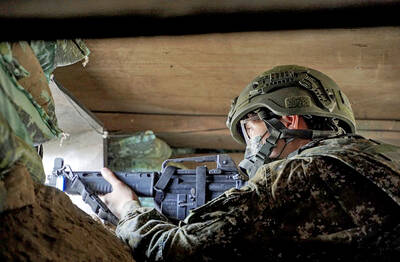
A former soldier and an active-duty army officer were yesterday indicted for allegedly selling classified military training materials to a Chinese intelligence operative for a total of NT$79,440. The Taipei District Prosecutors’ Office indicted Chen Tai-yin (陳泰尹) and Lee Chun-ta (李俊達) for contravening the National Security Act (國家安全法) and the Anti-Corruption Act (貪污治罪條例). Chen left the military in September 2013 after serving alongside then-staff sergeant Lee, now an army lieutenant, at the 21st Artillery Command of the army’s Sixth Corps from 2011 to 2013, according to the indictment. Chen met a Chinese intelligence operative identified as “Wang” (王) through a friend in November


 RSS
RSS