


The Chungshan Institute of Science and Technology (CSIST) has become a qualified supplier of the US Patriot missile system radar element after twice passing the certified third-party assessment required by the US government.
To become a qualified supplier of the US defense supply chain, the US National Defense Authorization Act and US Code of Federal Regulations require defense contractors to pass an assessment conducted by a certified third-party assessment organization under the Cybersecurity Maturity Model Certification (CMMC) program, the institute said.
The institute began participating in the verification process for the Patriot missile system radar antenna element in 2023, and was awarded a CMMC Level 2 certificate in November last year, it said.
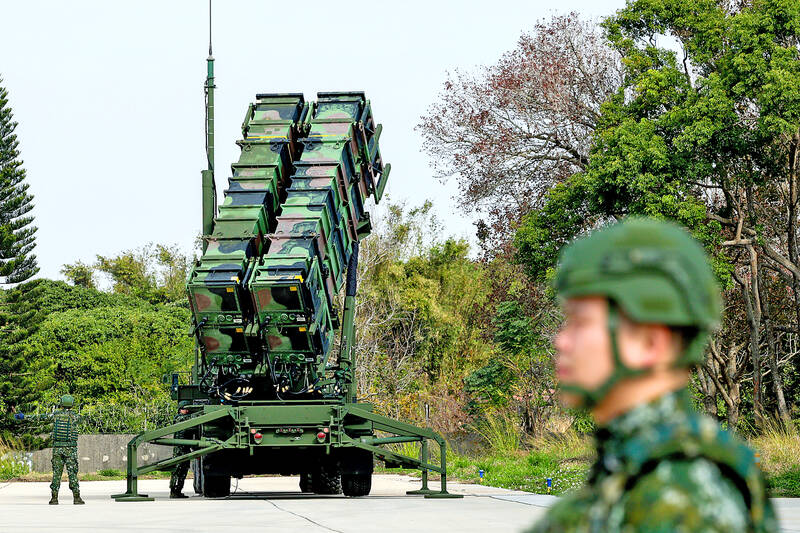
Photo: Ritchie B. Tongo, EPA
The CMMC certification is divided into three levels, it said. A Level 1 certificate covers basic cybersecurity practices, while Level 2 is the formal certification level required to protect sensitive defense information. A Level 3 certificate is designed for advanced cybersecurity protection approaching national-level defense requirements, it said.
With increasingly crucial application of drone technology in defense projects, data related to flight control and communications are considered controlled unclassified information subject to protection of stricter cybersecurity measures, it said.
The institute reapplied for a second third-party assessment in July 2024.
To pass the assessment, the institute said it used the SP800-171 standards set by US National Institute of Standard and Technology to evaluate its 110 cybersecurity management measures.
Internal inspections and employee training were regularly conducted to ensure the measures are fully implemented, the institute said, adding that it carried out multiple rounds of simulated assessments and drills.
The institute secured the Level 2 certificate for the second time following a one-and-half-year assessment, and it has been listed as a certified supplier on the US Department of Defense Industrial Base Web site.
“The certificates show that CSIST are capable of handling advanced defense projects from the US and meeting international standards,” the institute said, adding that it would continue pursuing international certifications for other critical technologies and development programs involving uncrewed systems, missiles and ordnance.
The institute is the first in Taiwan to proactively apply for certification and pass the Level 2 assessment since the US adopted the CMMC regulations.
“We will also assist defense contractors in enhancing their cybersecurity maturity, comprehensively strengthening the protection of trade secrets, core technologies and the overall supply chain,” it said, adding that it would collaborate with industry partners to establish a secure, trustworthy and sustainable defense ecosystem.

REASONS FOR TRAVEL: An assistant professor said that proposed amendments to penalize drivers if they used drugs overseas would not deter people from traveling People who operate a motor vehicle under the influence of marijuana would have their driver’s license revoked, even if they used the substance while overseas, the Ministry of Transportation and Communications said yesterday, citing proposed amendments to the Road Traffic Management and Penalty Act (道路交通管理處罰條例). The amendments would also authorize the government to revoke the licenses of people determined to have used Category 1 or Category 2 narcotics, even if they were not operating a vehicle while under the influence of drugs, as well as ban them from taking the license test for three years, the ministry said. People aged 18 or

GLOBALGIVING: ‘ Caving to external pressure is not acceptable for an organization that has cultivated justice reform and human rights for 30 years,’ one NGO said A slew of non-government organizations (NGOs) have withdrawn from the GlobalGiving fundraising platform after it announced it would use “Chinese Taipei” instead of “Taiwan” from next month. The Taiwan Good Rice Association wrote on Facebook on Friday that it was informed on April 28 via a teleconference call of the change, which was made because the platform wanted to operate in China. Taiwan Good Rice is to terminate all cooperative relationships with GlobalGiving in response to the platform’s “unilateral and non-negotiable” decision to remove references to Taiwan, the NGO said. “Taiwan is in the official name of Taiwan Good Rice Association and the

HEAVY WEATHER: Typhoon Jangmi is due to crash straight into the Ryukyus as airlines look to shift flights to larger aircraft or cancel flights to Okinawa entirely Taiwan’s international air carriers announced flight adjustments over the weekend as Typhoon Jangmi is forecast to hit the Ryukyu Islands today and tomorrow. The Central Weather Administration (CWA) upgraded Jangmi from a tropical storm to a typhoon at 8am yesterday, with the eye located 580km south of Naha city. It was moving north at 19kph. Today, China Airlines’ CI-120, CI-121, CI-122 and CI-123 flights between Taoyuan and Naha, Okinawa, have been canceled as well as CI-132 and CI-133 between Kaohsiung and Naha. EVA Air’s BR-112, BR-113, BR-186 and BR-185 flights between Taoyuan and Naha are also canceled. Low-cost carrier Tigerair Taiwan canceled IT-230,

UPGRADE: The Kang Ding-class frigate is replacing its Chaparall missiles with Tien Chien II and Hua Yang VLS, which would provide it with long-range, 360° air defense Taiwan plans to produce 1,200 to 1,376 Hai Chien II missiles (海劍二, Sea Sword II) — also known as TC-2N — to serve as the standard air defense system of the navy’s surface combatant fleet, a source said yesterday. Last week, the Hai Chien II, the naval version of the Tien Kung II missile (天劍二, Sky Sword II), completed a live-fire test in waters off the National Chungshan Institute of Science and Technology’s Jiupeng facility (九鵬) in Pingtung County’s Manjhou Township (滿州). The MIM72 Chaparral and other dated air defense missiles that currently arm Taiwanese ships have inadequate range to combat Chinese


 RSS
RSS