


The legislature on Friday approved a scaled-down defense budget, a move analysts viewed as a “positive first step,” despite concerns that delays to local defense programs could hurt Taiwan’s long-term military buildup.
The opposition-backed bill has a spending cap of NT$780 billion (US$24.82 billion), lower than the Cabinet’s NT$1.25 trillion proposal. It includes two key funding provisions for US weapons systems: NT$300 billion for sales approved by the US for Taiwan on Dec. 17 last year, and NT$480 billion earmarked for future arms packages expected to be announced by Washington.
Under the bill, approved and future arms sales would need legislative approval before funding could be disbursed.
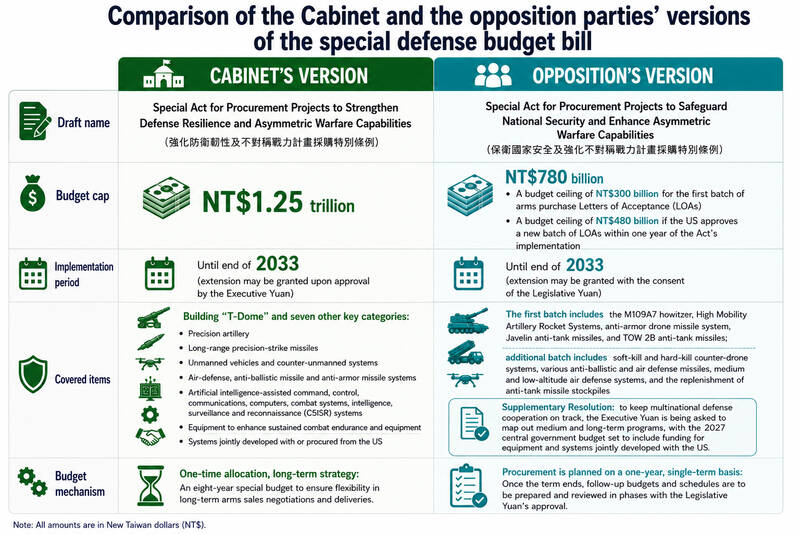
Source: Executive Yuan and Legislative Yuan
Su Tzu-yun (蘇紫雲), director of the Institute for National Defense and Security Research’s Defense Strategy and Resources Division, described the passage of the bill as a “good start.”
The defense bill reflected the broader power struggle between China and the US, he said.
“Beijing hoped to portray Taiwan as reluctant to strengthen its self-defense capabilities in an effort to convince the US to halt future arms sales,” Su said. “Meanwhile, the US wanted Taiwan to demonstrate its commitment to self-defense through concrete actions, not just slogans.”
Amid the US-China rivalry, Taiwan has assumed the role of a “chess player” rather than a “chess piece” by demonstrating its willingness to support its self-defense despite intense partisan wrangling over the bill, Su said.
Su said he hoped the ruling and opposition parties would also support the local defense industry, preferably through supplementary defense budgets.
“This is not for the government’s own convenience, but to offer manufacturers greater stability when investing in research and development, equipment, and raw materials,” he said.
Without stable financing, Taiwan’s efforts to achieve “defense autonomy” could be hampered, he said, citing as an example the F-CK-1 “Ching Kuo” fighter jet program, which he said suffered from sporadic funding.
The rejection of the Cabinet’s bill eliminated supplementary budget funding for major local defense industry initiatives, including plans to expand Taiwan’s drone production capacity.
National security expert Chen Wen-chia (陳文甲) said the version passed by the Legislative Yuan was more than just a reduction in funding, as it underscores a divergence in strategic thinking between a broader push for comprehensive defense transformation and a more limited approach focused on incremental military upgrades.
The Cabinet’s plan emphasized long-term, full-spectrum deterrence, while the Legislative Yuan’s version favors more constrained and tightly controlled defense spending, he said.
The Cabinet’s proposal focused on the “T-Dome,” bolstering defense resilience, and developing new capabilities such as artificial intelligence (AI) and drones as part of a more system-wide, integrated defense framework, Chen said.
It also showed the dependence of drones on AI, semiconductors, batteries, communications and sensors supply chains, and warned that insufficient domestic demand could slow defense industry development and cause Taiwan to miss opportunities in the reshaping of Indo-Pacific supply chains, he added.
The version passed by the Legislative Yuan concentrates on US arms procurement, including High Mobility Artillery Rocket Systems, self-propelled artillery, and Javelin and tube-launched, optically tracked, wire-guided missiles, he said, adding that it reflected a preference for conventional firepower upgrades and near-term readiness.
The opposition-backed version also tightened legislative oversight, requiring budgets approval from the legislature before funding is disbursed, Chen said.
The move reflected opposition concerns over fiscal burden, procurement efficiency and the scope of delegated authority, Chen added.

The Ministry of Finance this afternoon announced the winning numbers for the March-April uniform invoice lottery. The winning number for the NT$10 million (US$318,060) special prize is 19531471, and the winning number for the NT$2 million grand prize is 85941329. Three numbers were drawn for the NT$200,000 first prize: 07225810, 20231230 and 83518781. Those with receipts matching the last seven digits of any of the first-prize numbers will win the NT$40,000 second prize, while those matching the last six digits will win the NT$10,000 third prize. Those whose receipts match the last five digits of the first-prize numbers can claim the NT$4,000 fourth prize,

SIX SUBSIDIES: The monthly allowance for older farmers is to increase to NT$10,000, and NT$5,000 is to be given to homemakers under the national pension system, Lai said The government is to implement major welfare policies for disadvantaged groups, including raising the monthly allowance for older farmers to NT$10,000 and providing homemakers with NT$5,000 per month, President William Lai (賴清德) said yesterday. Lai made the remarks during a visit to Wangling Temple in Chiayi County, saying that the planned increases were being introduced amid economic growth and an increase in tax revenue. Touting a policy, in which the government plans to provide a monthly allowance of NT$5,000 for every child under the age of 18 in a bid to address Taiwan’s low birthrate, Lai said that if received for the
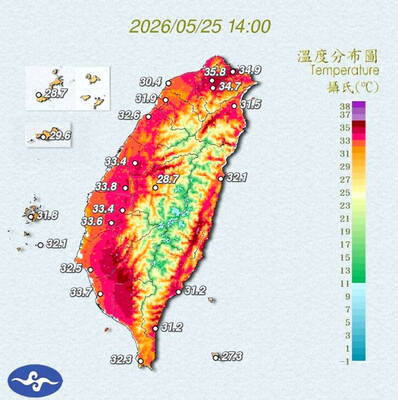
STAY COOL: The HPA recommended that people stay hydrated, use air-conditioning or fans while indoors, wear loose-fitting clothes and walk in the shade while outdoors Employers must implement measures such as installing cooling equipment, and providing drinking water and rest breaks for outdoor workers starting from Monday next week, the Taipei Department of Labor said on Sunday. Employers who fail to comply could face fines of NT$30,000 to NT$300,000 under the Occupational Safety and Health Act (職業安全衛生法), the department said. Businesses in Taipei employing fewer than 100 workers, as well as registered self-employed workers with labor insurance coverage, could receive on-site assessments and guidance from occupational safety consultants to help them apply for central government subsidies to implement or improve heat-protection measures, it said. Under the Ministry of

NATIONAL SECURITY: Authorities are working to confirm the identities of the military personnel involved and investigating possible illegal conduct and regulatory violations Authorities are probing possible national security implications after Kinmen police and immigration officers on Sunday found a Chinese woman allegedly posing as a tourist while engaging in prostitution involving more than 10 military personnel. The woman, surnamed Chen (陳), has since been deported, authorities said, adding that investigators are still working to confirm the identities of those implicated, as the records only listed code names and aliases. The case stemmed from a report received by the Kinmen District Prosecutors’ Office on Friday last week from the Jinhu Precinct of the Kinmen County Police Bureau. On Sunday, police, along with the National Immigration


 RSS
RSS