


The Mainland Affairs Council (MAC) yesterday said that it is considering possible retaliatory measures after a Taiwanese working in China was forced to leave his job for being a relative of Minister of the Interior Liu Shyh-fang (劉世芳), whom China has listed as a die-hard supporter of Taiwan independence.
Liu’s nephew, Yen Wen-chun (顏文群), worked for China-based Taiwanese firm Long Time Technology Co (榮炭科技).
The firm issued a statement saying that Yen had been dismissed from his position, and employees at the firm are banned from supporting Taiwan independence in any means and must adhere to the “one China” principle.
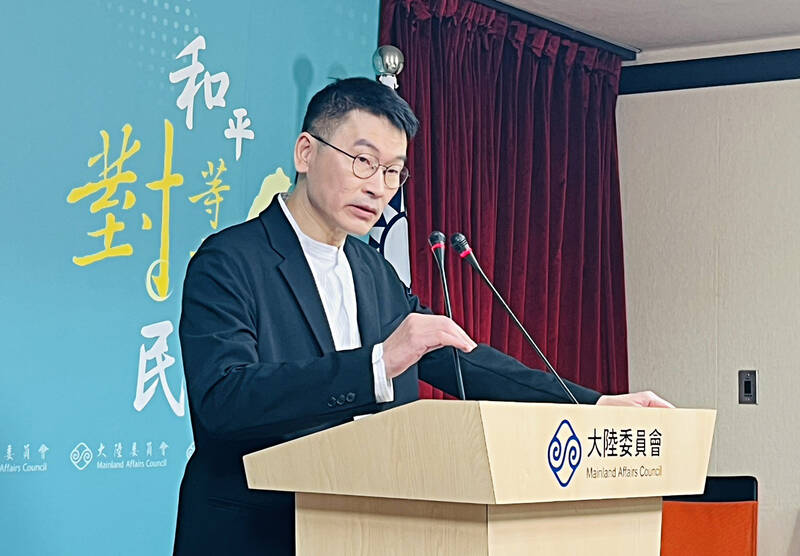
Photo: Chen Yu-fu, Taipei Times
“We are taking this case very seriously. China has used multiple measures to force Long Time to give in, such as prohibiting the company’s suppliers and clients from doing businesses with it,” MAC Deputy Minister Liang Wen-chieh (梁文傑) told a news conference in Taipei.
The company’s bank account was frozen for about a month, leaving it without funds to pay workers and operational costs, Liang said.
Yen was also found to have made small donations to two Democratic Progressive Party candidates running in local elections, he said.
The purpose of all these measures is to force the company to write an affidavit supporting the “one China” principle, he added.
Yen voluntarily left the job to avoid inconveniencing the firm, Liang said.
The measures, which were executed by officials in China’s Jiangxi Province, must be ordered by the senior leadership of the Chinese Communist Party (CCP), he said.
“As more cases similar to Yen’s are sure to happen, we are studying relevant policies to help Taiwanese and companies to counter China’s oppressive practices,” Liang said.
The council is also studying how some of Chinese laws — such as Anti-Foreign Sanctions Law and Regulations on Countering Unjustified Extraterritorial Application of Foreign Legislation and Other Measures — would affect Taiwanese, he said.
Meanwhile, the council advised civil servants, including those at lower levels, to avoid traveling to China after receiving more reports of Taiwanese going missing, being interrogated and having their personal freedom restricted.
As of last month, a total of 343 Taiwanese nationals had gone missing, been detained for questioning or had their personal freedom restricted while traveling to China, council data showed.
Of the 13 people added to the list last month, seven went missing, two were being interrogated and four had their personal freedom restricted, the council said.
Among them were two civil servants working in the National Immigration Agency and Customs Administration, Liang said.
“Instead of being questioned at immigration at the airport, they were questioned in their hotel rooms late at night. Chinese national security officers asked them about their family members, educational and professional background, the purpose of their travel to China and job responsibilities at their employing organizations. They also inspected their mobile phones, including contact lists and WeChat communication records. The questioning lasted about two to four hours,” Liang said, adding that both reported the incident after returning to Taiwan.
Meanwhile, a Chinese student enrolled in a doctoral program at National Chengchi University was reported to have advocated for China’s forcible takeover of Taiwan in articles submitted for publication in international academic journals.
“What he wrote was unacceptable. However, we will deal with him after he finishes his studies in Taiwan. It is a ‘special favor’ that we grant to Chinese students,” Liang said.

FUKUOKA SITUATION: Japanese media reported that the pathogen is expected to be identified by the summer, while the CDC downplayed the idea that it was hMPV A “mysterious cold-like illness” reported in Japan’s Fukuoka Prefecture does not seem to be a new disease, but Japanese authorities have been asked about the situation, the Centers for Disease Control (CDC) said yesterday. The Fukuoka Prefectural Medical Association on Wednesday told a news conference that a “mystery cold” that has become a hot topic on social media is “highly likely to be caused by some kind of viral infection,” Japan’s KBC News reported. “Many people are experiencing symptoms starting with a sore throat, followed by a runny nose, phlegm and a severe cough,” KBC News reported, citing association officials. Health authorities are

Nvidia Corp CEO Jensen Huang (黃仁勳) arrived in Taiwan yesterday ahead of upcoming AI and technology events, saying he plans to meet with clients and Taiwan Semiconductor Manufacturing Co Chairman C.C. Wei (魏哲家) during his visit. After landing at Taipei Songshan Airport, Huang posed for photos with fans and handed out Yakult drinks to reporters and supporters waiting at the scene, saying he has “a lot to do” during the trip. Asked about reports that Nvidia’s planned headquarters site in Taipei’s Beitou Shilin Technology Park could break ground on May 27, Huang said that if the company holds an event, he would

The Ministry of Finance this afternoon announced the winning numbers for the March-April uniform invoice lottery. The winning number for the NT$10 million (US$318,060) special prize is 19531471, and the winning number for the NT$2 million grand prize is 85941329. Three numbers were drawn for the NT$200,000 first prize: 07225810, 20231230 and 83518781. Those with receipts matching the last seven digits of any of the first-prize numbers will win the NT$40,000 second prize, while those matching the last six digits will win the NT$10,000 third prize. Those whose receipts match the last five digits of the first-prize numbers can claim the NT$4,000 fourth prize,

SIX SUBSIDIES: The monthly allowance for older farmers is to increase to NT$10,000, and NT$5,000 is to be given to homemakers under the national pension system, Lai said The government is to implement major welfare policies for disadvantaged groups, including raising the monthly allowance for older farmers to NT$10,000 and providing homemakers with NT$5,000 per month, President William Lai (賴清德) said yesterday. Lai made the remarks during a visit to Wangling Temple in Chiayi County, saying that the planned increases were being introduced amid economic growth and an increase in tax revenue. Touting a policy, in which the government plans to provide a monthly allowance of NT$5,000 for every child under the age of 18 in a bid to address Taiwan’s low birthrate, Lai said that if received for the


 RSS
RSS