


The Legislative Yuan’s Internal Administration Committee today passed an initial review of draft amendments that would lower the voting age from 20 to 18.
The committee reviewed draft amendments to the Civil Servants Election and Recall Act (公職人員選舉罷免法) and Presidential and Vice Presidential Election and Recall Act (總統副總統選舉罷免法).
As the amendments could first require a constitutional interpretation by the Constitutional Court, the committee adopted a supplementary resolution urging the legislature’s Constitutional Amendment Committee to simultaneously begin reviewing relevant amendments to the Constitution.
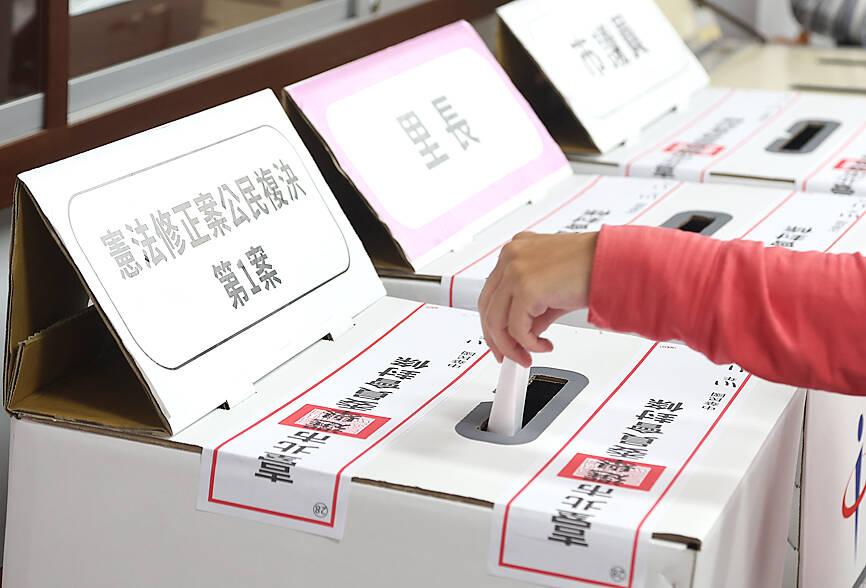
Photo: CNA
Lowering the voting age to 18 is a global trend and there is cross-partisan consensus in the legislature, the resolution stated.
Article 130 of the Constitution states that citizens must be at least 20 years of age to vote, and the high threshold for passing constitutional amendments has blocked efforts to lower the voting age over the past decade.
Since the drafting of the Constitution, the Civil Code has been amended to lower the age of adulthood from 20 to 18, though voting rights have yet to follow suit.
The Constitution also sets 23 as the minimum age to be elected as a public official.
Minister of the Interior Liu Shyh-fang (劉世芳) today reported to the Internal Administration Committee.
As of the end of February, Taiwan had 411,731 citizens aged 18 to 20, she said.
If the voting age were to be lowered, 70 percent of new voters would be registered within the six special municipalities, she added.
The changes could raise concerns over the next election cycle, which cannot be resolved by administrative interpretation alone, and could ultimately need judicial clarification, she said.
The Executive Yuan is not the authoritative body on constitutional interpretations, she added.
The amendments would increase the voting population by an estimated 410,000 people, said Wang Hsiao-lin (王曉麟), head of the Central Election Commission’s Department of Electoral Affairs.
It would involve considerable extra work to change to polling booths and electoral registers before the local elections on Nov. 28, he said.
If the amendments are not passed before the election notice is released on Aug. 20, the old system would remain in place, he added.
The draft amendments must first undergo party caucus negotiations before being submitted to the plenary session for discussion, Internal Administration Committee convenor and Chinese Nationalist Party (KMT) Legislator Liao Hsien-hsiang (廖先翔) said.

NATIONAL SECURITY: Authorities are working to confirm the identities of the military personnel involved and investigating possible illegal conduct and regulatory violations Authorities are probing possible national security implications after Kinmen police and immigration officers on Sunday found a Chinese woman allegedly posing as a tourist while engaging in prostitution involving more than 10 military personnel. The woman, surnamed Chen (陳), has since been deported, authorities said, adding that investigators are still working to confirm the identities of those implicated, as the records only listed code names and aliases. The case stemmed from a report received by the Kinmen District Prosecutors’ Office on Friday last week from the Jinhu Precinct of the Kinmen County Police Bureau. On Sunday, police, along with the National Immigration

GLOBALGIVING: ‘ Caving to external pressure is not acceptable for an organization that has cultivated justice reform and human rights for 30 years,’ one NGO said A slew of non-government organizations (NGOs) have withdrawn from the GlobalGiving fundraising platform after it announced it would use “Chinese Taipei” instead of “Taiwan” from next month. The Taiwan Good Rice Association wrote on Facebook on Friday that it was informed on April 28 via a teleconference call of the change, which was made because the platform wanted to operate in China. Taiwan Good Rice is to terminate all cooperative relationships with GlobalGiving in response to the platform’s “unilateral and non-negotiable” decision to remove references to Taiwan, the NGO said. “Taiwan is in the official name of Taiwan Good Rice Association and the

HEAVY WEATHER: Typhoon Jangmi is due to crash straight into the Ryukyus as airlines look to shift flights to larger aircraft or cancel flights to Okinawa entirely Taiwan’s international air carriers announced flight adjustments over the weekend as Typhoon Jangmi is forecast to hit the Ryukyu Islands today and tomorrow. The Central Weather Administration (CWA) upgraded Jangmi from a tropical storm to a typhoon at 8am yesterday, with the eye located 580km south of Naha city. It was moving north at 19kph. Today, China Airlines’ CI-120, CI-121, CI-122 and CI-123 flights between Taoyuan and Naha, Okinawa, have been canceled as well as CI-132 and CI-133 between Kaohsiung and Naha. EVA Air’s BR-112, BR-113, BR-186 and BR-185 flights between Taoyuan and Naha are also canceled. Low-cost carrier Tigerair Taiwan canceled IT-230,

Chinese Nationalist Party (KMT) Chairwoman Cheng Li-wun (鄭麗文) yesterday briefed her party’s Central Standing Committee regarding her scheduled visit to the US between Monday next week and June 16, saying that her purpose would be to persuade the US that the Republic of China (ROC) Constitution was a “one China” constitution that would foster stable and peaceful cross-strait relations. The ROC Constitution is the most important defense for all Taiwanese citizens, as it upholds our democracy and has contributed to our robust economy, which aligns with international and US interests, she said. “We would not be troublemakers and drag the US under,”


 RSS
RSS