


When US President Donald Trump travels to Beijing this month, Chinese President Xi Jinping (習近平) has made clear that Taiwan is to sit at the top of his agenda, a stark departure from their South Korea meeting last year, when he deliberately set the issue aside.
Taipei will be watching for any sign that Trump, who has unnerved partners with his transactional approach to alliances, could soften or reframe longstanding US policy on Taiwan in return for China buying US aircraft or farm goods and easing economic pressures.
“Regarding Taiwan, the logic is simple: If the US does not want to fight a major war with China over Taiwan, it should not support Taiwan independence,” said Wu Xinbo (吳心伯), dean of Fudan University’s Institute of International Studies, who serves on the policy advisory board of the Chinese Ministry of Foreign Affairs.
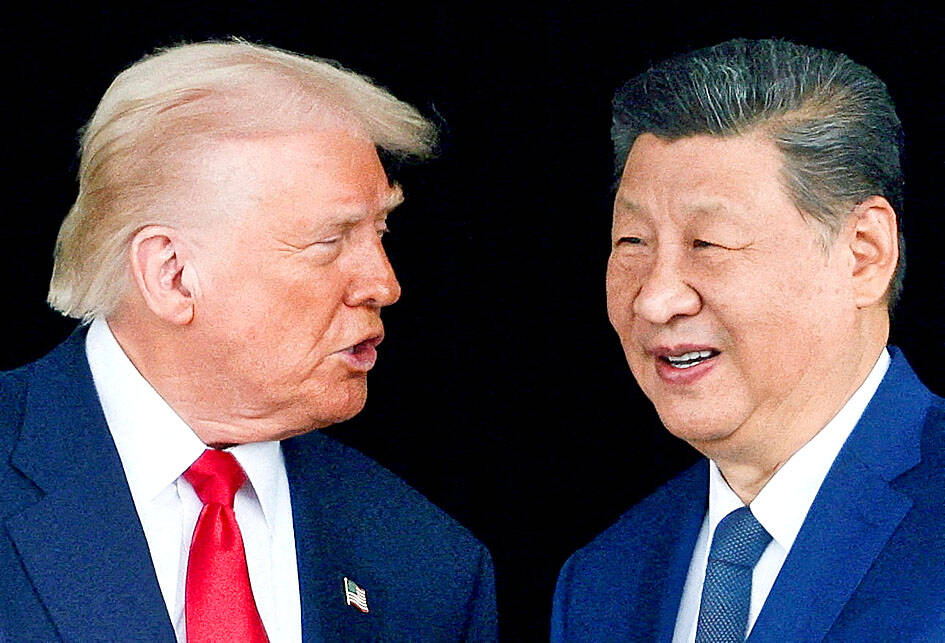
Photo: Reuters
“Trump has no interest in going to war with China. To avoid a major conflict that involves the US, he should make it clear that he won’t support independence or take actions that encourage a separatist political agenda,” he said.
The Chinese foreign ministry said in a statement that Taiwan is China’s “core of core interests” and the “basis of the political basis of China-US relations.”
“’Taiwan independence’ and peace in the Taiwan Strait are as incompatible as fire and water,” it said, adding that China and the US remain in communication about Trump’s trip.
The US Department of State did not respond to requests for comment.
Taiwan sits at the heart of the military balance in the western Pacific, so even a nuanced change in US wording could affect Beijing’s assessment of US resolve to continue its support to the nation, experts say.
Trump administration officials have repeatedly said there has been no change on Taiwan policy, and have routinely condemned China for its pressure against Taiwan.
Privately, they stress that Trump has approved considerably more in weapons sales to Taiwan in just over a year in his second term than his predecessor, Joe Biden, did throughout his presidency.
At a summit with Biden in 2024, Xi asked him to change US language on Taiwan to “we oppose Taiwan independence,” from the current version.
The US has declined to make the change.
People involved in the preparations for Trump’s trip say privately that China has been constantly sending similar signals at a working level ahead of the summit, but declined to discuss the details, citing confidentiality of the talks.
Officials in Taiwan are on high alert.
“We will be watching whether the US makes any changes to its position on Taiwan Strait issues as a result of that meeting,” Mainland Affairs Council Deputy Minister Shen Yu-chung (沈有忠) said. “We will use the remaining time to intensify policy communications with the US.”
Ministry of Foreign Affairs spokesman Hsiao Kuang-wei (蕭光偉) said this week that since Trump took office, his administration “has continuously reaffirmed its support for Taiwan.”
China has used the carrot and the stick in the run-up to the meeting.
It has offered “benefits” for Taiwan in trade and tourism. Then, last week, Taipei accused China of pressuring three African countries to block overflight rights for President William Lai’s (賴清德) trip to Eswatini, causing it to be canceled.
The US strongly criticized China’s actions.
American Institute in Taiwan Director Raymond Greene has been offering public reassurances in the run-up to the meeting that US commitments, including under the Taiwan Relations Act which mandates arms sales, remain “rock solid.”
Former Trump adviser Robert O’Brien said he would not become “the first American president to lose Taiwan. That would not be a Donald Trump goal to have in mind. That’s not the legacy he wants.”
The stakes for the US are high, too, given Taiwan’s strategic location as the site where Washington discreetly makes use of the nation’s advanced radar stations and listening posts high up in Taiwan’s mountains that are pointed at China, security sources said.
“Does the United States really want to lose one of its best locations for gathering intelligence on China?” a Western security source said, speaking on condition of anonymity due to the sensitivity of discussing security matters.

The military has spotted two Chinese warships operating in waters near Penghu County in the Taiwan Strait and sent its own naval and air forces to monitor the vessels, the Ministry of National Defense (MND) said. Beijing sends warships and warplanes into the waters and skies around Taiwan on an almost daily basis, drawing condemnation from Taipei. While the ministry offers daily updates on the locations of Chinese military aircraft, it only rarely gives details of where Chinese warships are operating, generally only when it detects aircraft carriers, as happened last week. A Chinese destroyer and a frigate entered waters to the southwest

A magnitude 6.1 earthquake struck off the coast of Yilan County at 8:39pm tonight, the Central Weather Administration (CWA) said, with no immediate reports of damage or injuries. The epicenter was 38.7km east-northeast of Yilan County Hall at a focal depth of 98.3km, the CWA’s Seismological Center said. The quake’s maximum intensity, which gauges the actual physical effect of a seismic event, was a level 4 on Taiwan’s 7-tier intensity scale, the center said. That intensity level was recorded in Yilan County’s Nanao Township (南澳), Hsinchu County’s Guansi Township (關西), Nantou County’s Hehuanshan (合歡山) and Hualien County’s Yanliao (鹽寮). An intensity of 3 was

Japanese Prime Minister Sanae Takaichi’s comment last year on Tokyo’s potential reaction to a Taiwan-China conflict has forced Beijing to rewrite its invasion plans, a retired Japanese general said. Takaichi told the Diet on Nov. 7 last year that a Chinese naval blockade or military attack on Taiwan could constitute a “survival-threatening situation” for Japan, potentially allowing Tokyo to exercise its right to collective self-defense. Former Japan Ground Self-Defense Force general Kiyofumi Ogawa said in a recent speech that the remark has been interpreted as meaning Japan could intervene in the early stages of a Taiwan Strait conflict, undermining China’s previous assumptions
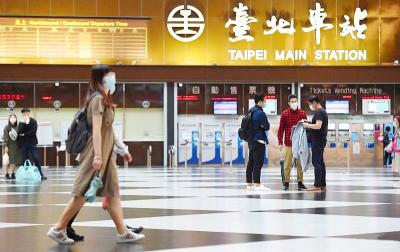
Taiwan Railways Corp (TRC) today announced that Shin Kong Mitsukoshi has been selected as the preferred bidder to operate the Taipei Railway Station shopping mall, replacing the current operator, Breeze Development Co Ltd. Among eight qualified firms that delivered presentations and were evaluated by a review committee, Shin Kong Mitsukoshi was ranked first, while Breeze was named the runner-up, the rail company said in a statement. Contract negotiations are to proceed in accordance with regulations, it said, adding that if negotiations with the top bidder fail, it could invite the second-ranked applicant to enter talks. Breeze in a statement today expressed doubts over


 RSS
RSS