


China likely coerced Zambia into canceling RightsCon — the world’s largest human rights and technology conference — to stop Taiwanese representatives from attending, Human Rights Watch (HRW) said yesterday.
The 14th edition of RightsCon was to be held in Zambia’s capital of Lusaka from Tuesday to Friday next week.
On Wednesday, Zambian Minister of Technology and Science Felix Mutati said in a news release that the event had been postponed to “ensure full alignment with Zambia’s national values, policy priorities and broader public interest considerations.”
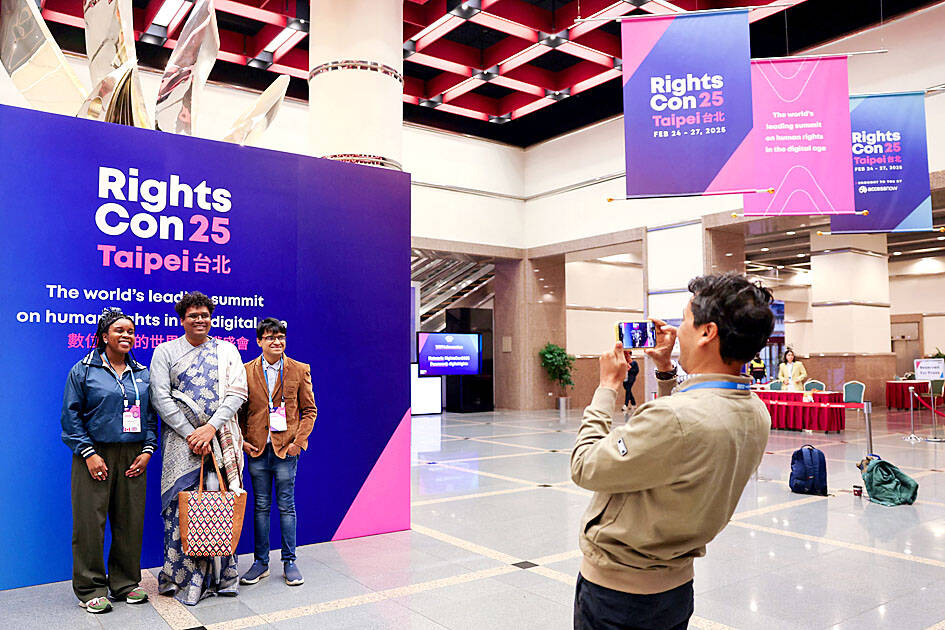
Photo: Ann Wang, Reuters
In a news release, HRW said Zambia’s cancelation of the event raised doubts about that government’s commitment to rights and transparency.
Citing an unnamed activist involved in organizing RightsCon, the group said the Chinese government had expressed its displeasure to Zambia about inviting Taiwanese to the event.
Zambian-based media reported that the real reason for the cancelation was that “the program involves Taiwanese delegates who would potentially speak against China at a venue donated by the Chinese government,” citing multiple “well-placed” sources.
The Mulungushi International Convention Center, which was to host the event, was renovated in 2020 with about US$60 million in funds from Beijing, HRW said.
Lusaka at the time called the project a “gift” from China with “no strings attached.”
The group said that it could not independently verify whether Beijing had a role in Zambia’s decision.
The Zambian government and the Chinese embassy in Lusaka did not immediately respond to a request for comment.
China is a major investor in Zambia, which is a part of Beijing’s Belt and Road initiative, HRW said.
“Human Rights Watch has long documented abusive health, safety and labor conditions associated with Chinese mining interests, some of which pose harm to residents,” it said.
“The cancelation of RightsCon underscores the need for such events to be hosted in countries where the government openly embraces debate on human rights and supports fundamental freedoms,” it added.
Taiwan hosted the 13th edition of RightsCon last year.

The military has spotted two Chinese warships operating in waters near Penghu County in the Taiwan Strait and sent its own naval and air forces to monitor the vessels, the Ministry of National Defense (MND) said. Beijing sends warships and warplanes into the waters and skies around Taiwan on an almost daily basis, drawing condemnation from Taipei. While the ministry offers daily updates on the locations of Chinese military aircraft, it only rarely gives details of where Chinese warships are operating, generally only when it detects aircraft carriers, as happened last week. A Chinese destroyer and a frigate entered waters to the southwest
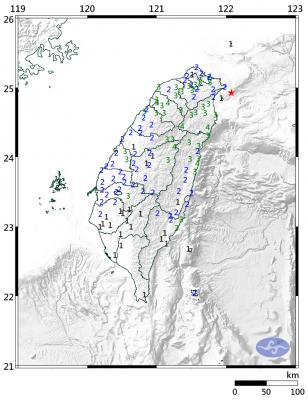
A magnitude 6.1 earthquake struck off the coast of Yilan County at 8:39pm tonight, the Central Weather Administration (CWA) said, with no immediate reports of damage or injuries. The epicenter was 38.7km east-northeast of Yilan County Hall at a focal depth of 98.3km, the CWA’s Seismological Center said. The quake’s maximum intensity, which gauges the actual physical effect of a seismic event, was a level 4 on Taiwan’s 7-tier intensity scale, the center said. That intensity level was recorded in Yilan County’s Nanao Township (南澳), Hsinchu County’s Guansi Township (關西), Nantou County’s Hehuanshan (合歡山) and Hualien County’s Yanliao (鹽寮). An intensity of 3 was

Japanese Prime Minister Sanae Takaichi’s comment last year on Tokyo’s potential reaction to a Taiwan-China conflict has forced Beijing to rewrite its invasion plans, a retired Japanese general said. Takaichi told the Diet on Nov. 7 last year that a Chinese naval blockade or military attack on Taiwan could constitute a “survival-threatening situation” for Japan, potentially allowing Tokyo to exercise its right to collective self-defense. Former Japan Ground Self-Defense Force general Kiyofumi Ogawa said in a recent speech that the remark has been interpreted as meaning Japan could intervene in the early stages of a Taiwan Strait conflict, undermining China’s previous assumptions
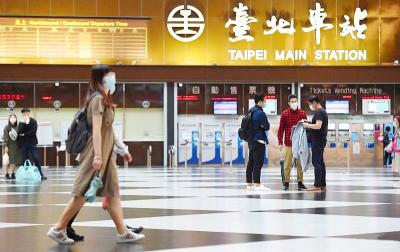
Taiwan Railways Corp (TRC) today announced that Shin Kong Mitsukoshi has been selected as the preferred bidder to operate the Taipei Railway Station shopping mall, replacing the current operator, Breeze Development Co Ltd. Among eight qualified firms that delivered presentations and were evaluated by a review committee, Shin Kong Mitsukoshi was ranked first, while Breeze was named the runner-up, the rail company said in a statement. Contract negotiations are to proceed in accordance with regulations, it said, adding that if negotiations with the top bidder fail, it could invite the second-ranked applicant to enter talks. Breeze in a statement today expressed doubts over


 RSS
RSS