


Taiwan dropped four places to 28th in this year’s World Press Freedom Index compared with a year earlier, as Reporters Without Borders (RSF) said that global press freedom conditions were at a record low.
Taiwan's ranking out of 180 countries and territories declined from 24th last year to 28th this year, with its global score falling from 77.04 to 75.44, according to the index, which was released today.
While Taiwan saw a decline in the index, the country's media environment remained "one of the safest" for journalists, even among democracies, Aleksandra Bielakowska, advocacy manager at RSF's Asia-Pacific Bureau, told a news conference in Taipei.
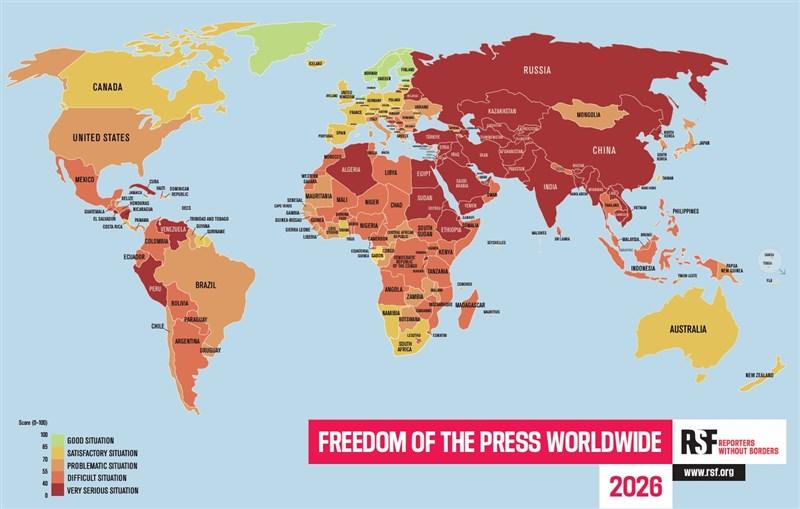
Photo courtesy of Reporters Without Borders
There were no reports of harassment or detentions of journalists by authorities, she added.
Taiwan placed second in the Asia-Pacific region, trailing New Zealand (22nd) but ahead of neighboring countries such as Australia (33rd), South Korea (47th) and Japan (62nd), the index showed.
However, the lack of effective government action over the past decade to improve the quality of news coverage and ensure the public's right to reliable information had become "a major problem" detrimental to Taiwan's democratic system, RSF Asia-Pacific Bureau director Cedric Alviani said.
Taiwan's media outlets continued to face economic challenges, such as a slump in advertising revenue and government funding cuts for public media, Bielakowska said.
Across the Taiwan Strait, Hong Kong ranked 140th and China 178th, with both positions unchanged from last year.
Nevertheless, the gap between Hong Kong and China is "closing quickly," because Hong Kong’s National Security Law — imposed in 2020 by Beijing following mass anti-government protests — continued to erode the territory’s press freedom.
In February, Apple Daily founder Jimmy Lai (黎智英) was sentenced to 20 years in prison — the harshest punishment to date under the law — after being found guilty of conspiring to collude with foreign forces and of publishing seditious articles.
At the same time, RSF also reported that at least 13 foreign journalists had been denied visas or were barred from entering Hong Kong after promulgation of the law.
While there were no new arrests of journalists or raids on newsrooms last year, RSF had learned of several cases of journalists being followed and harassed during their work, Bielakowska said.
Countries worldwide, including democracies, have increasingly used national security policies as "weapons" to target journalists and their reporting, she said.
More than half of the world's countries now fall into the "difficult" or "very serious" categories — the bottom two in the five-tier index, RSF said, adding that the press freedom situation was "at a 25-year low."
When the group first launched the index in 2002, 20 percent of the global population lived in countries where press freedom conditions were categorized as "good," but now less than 1 percent do, RSF said.
Norway ranked first in this year’s index based on surveys with journalists worldwide, for the 10th consecutive year, followed by the Netherlands and Estonia.

NATIONAL SECURITY: Authorities are working to confirm the identities of the military personnel involved and investigating possible illegal conduct and regulatory violations Authorities are probing possible national security implications after Kinmen police and immigration officers on Sunday found a Chinese woman allegedly posing as a tourist while engaging in prostitution involving more than 10 military personnel. The woman, surnamed Chen (陳), has since been deported, authorities said, adding that investigators are still working to confirm the identities of those implicated, as the records only listed code names and aliases. The case stemmed from a report received by the Kinmen District Prosecutors’ Office on Friday last week from the Jinhu Precinct of the Kinmen County Police Bureau. On Sunday, police, along with the National Immigration

GLOBALGIVING: ‘ Caving to external pressure is not acceptable for an organization that has cultivated justice reform and human rights for 30 years,’ one NGO said A slew of non-government organizations (NGOs) have withdrawn from the GlobalGiving fundraising platform after it announced it would use “Chinese Taipei” instead of “Taiwan” from next month. The Taiwan Good Rice Association wrote on Facebook on Friday that it was informed on April 28 via a teleconference call of the change, which was made because the platform wanted to operate in China. Taiwan Good Rice is to terminate all cooperative relationships with GlobalGiving in response to the platform’s “unilateral and non-negotiable” decision to remove references to Taiwan, the NGO said. “Taiwan is in the official name of Taiwan Good Rice Association and the
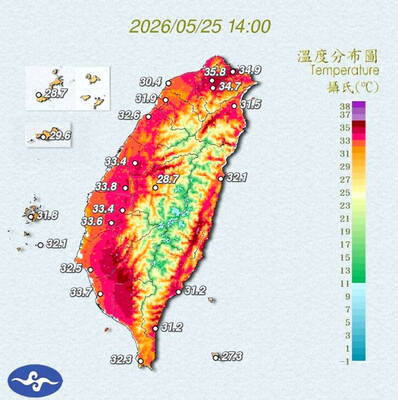
STAY COOL: The HPA recommended that people stay hydrated, use air-conditioning or fans while indoors, wear loose-fitting clothes and walk in the shade while outdoors Employers must implement measures such as installing cooling equipment, and providing drinking water and rest breaks for outdoor workers starting from Monday next week, the Taipei Department of Labor said on Sunday. Employers who fail to comply could face fines of NT$30,000 to NT$300,000 under the Occupational Safety and Health Act (職業安全衛生法), the department said. Businesses in Taipei employing fewer than 100 workers, as well as registered self-employed workers with labor insurance coverage, could receive on-site assessments and guidance from occupational safety consultants to help them apply for central government subsidies to implement or improve heat-protection measures, it said. Under the Ministry of

Chinese Nationalist Party (KMT) Chairwoman Cheng Li-wun (鄭麗文) yesterday briefed her party’s Central Standing Committee regarding her scheduled visit to the US between Monday next week and June 16, saying that her purpose would be to persuade the US that the Republic of China (ROC) Constitution was a “one China” constitution that would foster stable and peaceful cross-strait relations. The ROC Constitution is the most important defense for all Taiwanese citizens, as it upholds our democracy and has contributed to our robust economy, which aligns with international and US interests, she said. “We would not be troublemakers and drag the US under,”


 RSS
RSS