


Data collected by Chinese navigation app AMap (高德地圖) could potentially be used to analyze not only societal patterns, but also the behaviors of individual users, the Ministry of Digital Affairs (MODA) said yesterday, adding that a cybersecurity risk assessment of the app would be released next month.
During a legislative session focused on artificial intelligence (AI) governance and digital transparency, officials from the ministry, the National Science and Technology Council and Academia Sinica were invited to present reports and answer questions, including those related to AMap.
Under the Cybersecurity Management Act (資通安全管理法), AMap is considered a product that poses a threat to national cybersecurity, so government agencies are prohibited from using it and a cybersecurity assessment has to be conducted, the ministry has said.

Photo: Wang Yi-sung, Taipei Times
Democratic Progressive Party (DPP) Legislator Wu Pei-yi (吳沛億) said AMap relies on China’s BeiDou satellite navigation system and operates under Chinese laws that might require companies to share user data with authorities, which could pose significant risks to national security.
The app’s ability to collect and transmit location data could enable large-scale analysis of societal behavior if widely adopted, Wu said.
She also questioned whether aggregated data from Taiwanese users might be used to map not only general social patterns, but also individual lifestyles.
Deputy Minister of Digital Affairs Hou Yi-hsiu (侯宜秀) said the data collected by the app could potentially be used to analyze collective social trends and detailed personal behavior patterns.
That dual-layered risk — affecting society and individual users — has prompted further scrutiny, Hou added.
Ministry officials confirmed that AMap is undergoing testing by cybersecurity authorities.
The evaluation focuses on several key areas, including whether the app accesses data in real time, whether it exceeds the permissions granted by users and whether it retrieves sensitive information such as health records or private communications, they said.
Officials said they are also examining whether the app assigns identifiers to individual devices, which could allow for long-term tracking or profiling of users.
Such practices, if confirmed, could enable the reconstruction of detailed personal movement patterns, they said.
DPP Legislator Chen Hsiu-pao (陳秀寶) said many products are being labeled as “AI,” but whether they truly have AI functions is questionable.
Chen suggested adopting a certification system similar to energy efficiency labeling.
The ministry said it would discuss and study the issue with relevant government agencies.

The Ministry of Finance this afternoon announced the winning numbers for the March-April uniform invoice lottery. The winning number for the NT$10 million (US$318,060) special prize is 19531471, and the winning number for the NT$2 million grand prize is 85941329. Three numbers were drawn for the NT$200,000 first prize: 07225810, 20231230 and 83518781. Those with receipts matching the last seven digits of any of the first-prize numbers will win the NT$40,000 second prize, while those matching the last six digits will win the NT$10,000 third prize. Those whose receipts match the last five digits of the first-prize numbers can claim the NT$4,000 fourth prize,

SIX SUBSIDIES: The monthly allowance for older farmers is to increase to NT$10,000, and NT$5,000 is to be given to homemakers under the national pension system, Lai said The government is to implement major welfare policies for disadvantaged groups, including raising the monthly allowance for older farmers to NT$10,000 and providing homemakers with NT$5,000 per month, President William Lai (賴清德) said yesterday. Lai made the remarks during a visit to Wangling Temple in Chiayi County, saying that the planned increases were being introduced amid economic growth and an increase in tax revenue. Touting a policy, in which the government plans to provide a monthly allowance of NT$5,000 for every child under the age of 18 in a bid to address Taiwan’s low birthrate, Lai said that if received for the
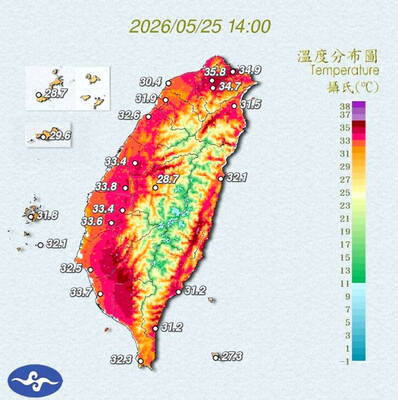
STAY COOL: The HPA recommended that people stay hydrated, use air-conditioning or fans while indoors, wear loose-fitting clothes and walk in the shade while outdoors Employers must implement measures such as installing cooling equipment, and providing drinking water and rest breaks for outdoor workers starting from Monday next week, the Taipei Department of Labor said on Sunday. Employers who fail to comply could face fines of NT$30,000 to NT$300,000 under the Occupational Safety and Health Act (職業安全衛生法), the department said. Businesses in Taipei employing fewer than 100 workers, as well as registered self-employed workers with labor insurance coverage, could receive on-site assessments and guidance from occupational safety consultants to help them apply for central government subsidies to implement or improve heat-protection measures, it said. Under the Ministry of

NATIONAL SECURITY: Authorities are working to confirm the identities of the military personnel involved and investigating possible illegal conduct and regulatory violations Authorities are probing possible national security implications after Kinmen police and immigration officers on Sunday found a Chinese woman allegedly posing as a tourist while engaging in prostitution involving more than 10 military personnel. The woman, surnamed Chen (陳), has since been deported, authorities said, adding that investigators are still working to confirm the identities of those implicated, as the records only listed code names and aliases. The case stemmed from a report received by the Kinmen District Prosecutors’ Office on Friday last week from the Jinhu Precinct of the Kinmen County Police Bureau. On Sunday, police, along with the National Immigration


 RSS
RSS