


Safeguarding the 15 percent non-stacking tariff deal Taiwan struck with the US is the government’s top priority amid a US Section 301 investigation, Premier Cho Jung-tai (卓榮泰) said yesterday.
Cho made the remarks during a question-and-answer session at the Legislative Yuan in Taipei.
Taiwan and the US in February signed the Taiwan-US Reciprocal Trade Agreement (ART), under which the US agreed to reduce tariffs on Taiwanese goods from 20 percent to 15 percent, without stacking them on existing most-favored-nation (MFN) rates.
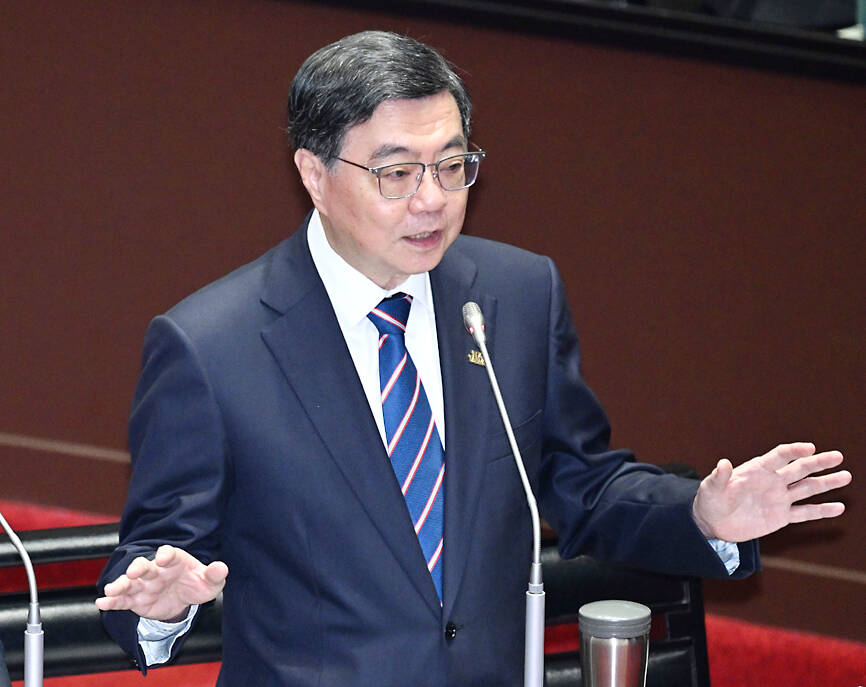
Photo: Liao Chen-huei, Taipei Times
US President Donald Trump last year invoked the US International Emergency Economic Powers Act to impose tariffs on Taiwan and many other nations. However, the US Supreme Court on Feb. 20 ruled that the act does not grant the president authority to impose tariffs.
Trump then turned to Section 122 of the Trade Act of 1974 to impose a uniform 10 percent tariff globally, stacked on existing MFN rates, for a maximum of 150 days, while also initiating a Section 301 investigation under the Trade Act.
The Office of the US Trade Representative last month launched investigations into multiple nations, including Taiwan, over potential issues of “overcapacity” and “forced labor.”
Democratic Progressive Party Legislator Wu Ping-jui (吳秉叡) asked Cho when the tariff arrangements between Taiwan and the US would be finalized.
Cho said the US was yesterday expected to hold public hearings on “overcapacity” and on Tuesday next week on “forced labor,” adding that about a week after the hearings conclude, if the US raises any concerns regarding Taiwan, the government would respond with explanations.
As the investigation covers multiple countries, a final outcome is tentatively expected in about July, pending developments, he said.
Wu said that businesses are feeling the strain of high tariffs, but uncertainty is also a major concern.
For example, in the auto sector, companies are waiting for clarity on tariff policy, with hopes that US duties on vehicles could be lowered, but ambiguity over the levies has contributed to a slowdown in the auto market, adding pressure on the industry, he said.
The government’s top priority is to reach an early resolution so businesses can gain greater certainty and stability, while aiming to ensure that the original terms of the ART are preserved, along with the preferential treatment Taiwan secured, Cho said.
The previously negotiated 15 percent non-stacking tariff arrangement helped bolster Taiwan’s competitiveness, but after the ART was set aside and Section 122 was put in place, some product categories that had been granted exemptions have not been maintained, he said.
The government believes returning to the ART framework would provide the most comprehensive protection for industrial competitiveness and national interests, and it is working toward that goal, Cho said.

FUKUOKA SITUATION: Japanese media reported that the pathogen is expected to be identified by the summer, while the CDC downplayed the idea that it was hMPV A “mysterious cold-like illness” reported in Japan’s Fukuoka Prefecture does not seem to be a new disease, but Japanese authorities have been asked about the situation, the Centers for Disease Control (CDC) said yesterday. The Fukuoka Prefectural Medical Association on Wednesday told a news conference that a “mystery cold” that has become a hot topic on social media is “highly likely to be caused by some kind of viral infection,” Japan’s KBC News reported. “Many people are experiencing symptoms starting with a sore throat, followed by a runny nose, phlegm and a severe cough,” KBC News reported, citing association officials. Health authorities are

Nvidia Corp CEO Jensen Huang (黃仁勳) arrived in Taiwan yesterday ahead of upcoming AI and technology events, saying he plans to meet with clients and Taiwan Semiconductor Manufacturing Co Chairman C.C. Wei (魏哲家) during his visit. After landing at Taipei Songshan Airport, Huang posed for photos with fans and handed out Yakult drinks to reporters and supporters waiting at the scene, saying he has “a lot to do” during the trip. Asked about reports that Nvidia’s planned headquarters site in Taipei’s Beitou Shilin Technology Park could break ground on May 27, Huang said that if the company holds an event, he would

The Ministry of Finance this afternoon announced the winning numbers for the March-April uniform invoice lottery. The winning number for the NT$10 million (US$318,060) special prize is 19531471, and the winning number for the NT$2 million grand prize is 85941329. Three numbers were drawn for the NT$200,000 first prize: 07225810, 20231230 and 83518781. Those with receipts matching the last seven digits of any of the first-prize numbers will win the NT$40,000 second prize, while those matching the last six digits will win the NT$10,000 third prize. Those whose receipts match the last five digits of the first-prize numbers can claim the NT$4,000 fourth prize,
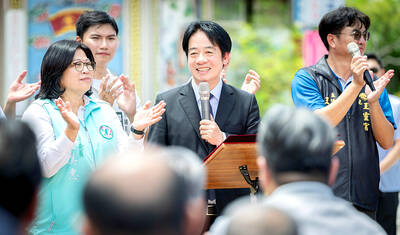
SIX SUBSIDIES: The monthly allowance for older farmers is to increase to NT$10,000, and NT$5,000 is to be given to homemakers under the national pension system, Lai said The government is to implement major welfare policies for disadvantaged groups, including raising the monthly allowance for older farmers to NT$10,000 and providing homemakers with NT$5,000 per month, President William Lai (賴清德) said yesterday. Lai made the remarks during a visit to Wangling Temple in Chiayi County, saying that the planned increases were being introduced amid economic growth and an increase in tax revenue. Touting a policy, in which the government plans to provide a monthly allowance of NT$5,000 for every child under the age of 18 in a bid to address Taiwan’s low birthrate, Lai said that if received for the


 RSS
RSS