


Members of several state-owned enterprises and public institutions’ labor unions yesterday protested in front of the Executive Yuan in Taipei, demanding a minimum salary increase of NT$6,000 for all ranks and overtime pay calculated based on their total monthly wage.
Union members performed a skit to criticize government agencies for having too many what they called “zombie duties” — outdated or redundant tasks — and labor issues including low wages, staff shortages and excessive workloads.
The protesters, including representatives of state-owned enterprise unions, civil service associations, public hospital unions and public sector workers, chanted slogans such as “refuse low-wage state employment” and “overtime pay should be calculated based on full salary,” while a few others threw black ball-like props over the Executive Yuan fence, prompting police to briefly hold up warning signs.
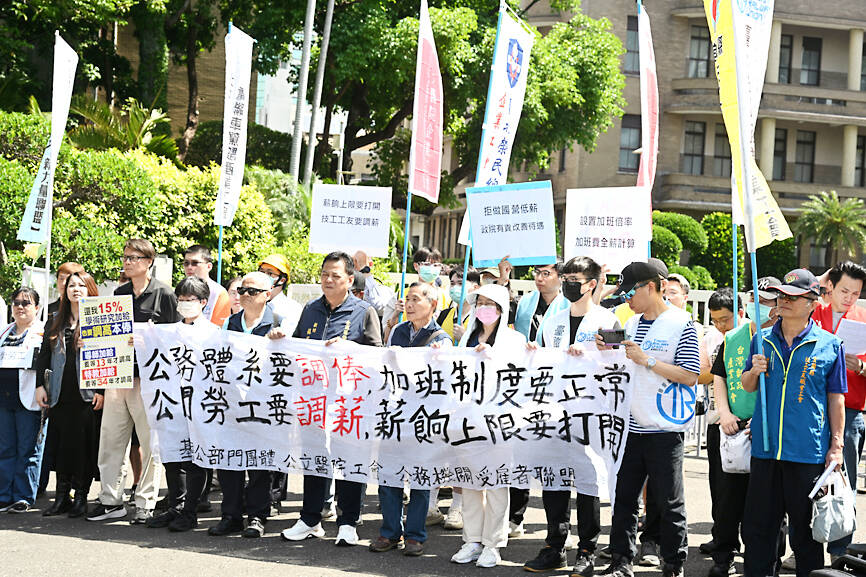
Photo: Lin Cheng-kun, Taipei Times
Citing the Directorate-General of Personnel Administration’s (DGPA) reported plan to raise the “professional allowance” for the public sector in the second half of the year, Taiwan Railway Industries Workers’ Union secretary-general Chu Chih-yu (朱智宇) said the public sector has long faced “ever-increasing workloads and excessive responsibilities,” and more than a professional allowance adjustment needed, adding that pay scales in state-owned enterprises also need to be improved.
The protesters presented four key demands, including a minimum salary increase of NT$6,000 for all ranks and amending the Regulations for Overtime Pay of Government Agencies (各機關加班費支給辦法) to ensure overtime pay is calculated based on full salary.
They also called for guaranteeing that any salary increase for civil servants is applied equally across the entire public sector and reviewing pay for technical workers and janitors — increasing their maximum pay scale to 230 points and re-evaluating the calculation basis for their retirement pensions.
Coalition of Taiwan Civil Service Reform Drivers chairman Hung Jui-hao (洪瑞壕) said rank-and-file civil servants generally expect the DGPA to increase base salaries, not only professional allowances.
Labor unions have reached a consensus that the Executive Yuan should consider a minimum salary raise of 6.67 percent — based on projected adjustments for this year and next year — which would be at least NT$6,000, he said.
Only increasing the “professional allowance” but not the “base salary,” and lacking a proper mechanism to curb unnecessary tasks, means the policy ultimately would not be “deeply felt” by workers, National Federation of Education Unions deputy chairman Wu Ming-yu (吳明玉) said.
For a large portion of contract medical personnel, professional allowances make up only about 10 percent of their total salary, so increasing the allowance alone amounts to a limited raise that barely keeps up with inflation, NTU Cancer Center Union executive board member Pan Hung-fu (潘泓甫) said.
Taiwan Postal Industry Union chairman Liao Nai-chen (廖迺辰) urged Chunghwa Post to address wage gaps among staff, increase salaries and benefits for rank-and-file employees, provide additional allowances for field drivers, and establish hazard and high-temperature allowances for field personnel.
A DGPA senior specialist said the policy is still under discussion and, following a comprehensive assessment and coordination with the general budget schedule, a meeting would be convened to decide the final policy, which would then be submitted to the Executive Yuan for review and approval.

Actor Darren Wang (王大陸) was sentenced to six months in prison, commutable to a fine, by the New Taipei District Court today for contravening the Personal Data Protection Act (個人資料保護法) in a case linked to an alleged draft-dodging scheme. Wang allegedly paid NT$3.6 million (US$114,380) to an illegal group to help him evade mandatory military service through falsified medical documents, prosecutors said. He transferred the funds to Chen Chih-ming (陳志明), the alleged mastermind of a draft-evasion ring, although he lost contact with him as he was already in detention on fraud charges, they said. Chen is accused of helping a

SECURITY: Starlink owner Elon Musk has taken pro-Beijing positions, and allowing pro-China companies to control Taiwan’s critical infrastructure is risky, a legislator said Starlink was reluctant to offer services in Taiwan because of the nation’s extremely high penetration rates in 4G and 5G services, the Ministry of Digital Affairs said yesterday. The ministry made the comments at a meeting of the legislature’s Transportation Committee, which reviewed amendments to Article 36 of the Telecommunications Management Act (電信管理法). Article 36 bans foreigners from holding more than 49 percent of shares in public telecommunications networks, while shares foreigners directly and indirectly hold are also capped at 60 percent of the total, unless specified otherwise by law. The amendments, sponsored by Chinese Nationalist Party (KMT) Legislator Ko
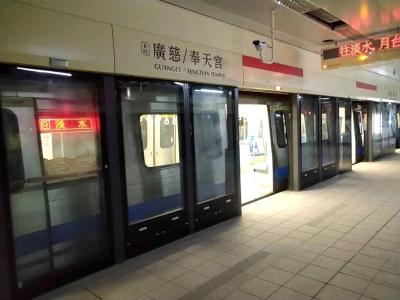
The eastern extension of the Taipei MRT Red Line could begin operations as early as late June, the Taipei Department of Rapid Transit Systems said yesterday. Taipei Rapid Transit Corp said it is considering offering one month of free rides on the new section to mark its opening. Construction progress on the 1.4km extension, which is to run from the current terminal Xiangshan Station to a new eastern terminal, Guangci/Fengtian Temple Station, was 90.6 percent complete by the end of last month, the department said in a report to the Taipei City Council's Transportation Committee. While construction began in October 2016 with an
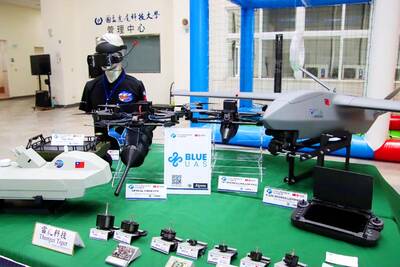
NON-RED SUPPLY: Boosting the nation’s drone industry is becoming increasingly urgent as China’s UAV dominance could become an issue in a crisis, an analyst said Taiwan’s drone exports to Europe grew 41.7-fold from 2024 to last year, with demand from Ukraine’s fight against Russian aggression the most likely driver of growth, a study showed. The Institute for Democracy, Society and Emerging Technology (DSET) in a statement on Wednesday said it found that many of Taiwan’s uncrewed aerial vehicle (UAV) sales were from Poland and the Czech Republic. These countries likely transferred the drones to Ukraine to aid it in its fight against the Russian invasion that started in 2022, it said. Despite the gains, Taiwan is not the dominant drone exporter to these markets, ranking second and fourth


 RSS
RSS