


A deadly traffic accident in January last year involving an electric vehicle near Yangmei Service Area on the National Sun Yat-sen Freeway (National Freeway No. 1) occurred due to speeding and inaccurate use of the advanced driver assistance systems (ADAS), the Taiwan Transportation Safety Board said.
The electric vehicle caught fire after hitting a median island on the road leading to the Yangmei Service Area, killing four people and severely injuring four.
The board has concluded the investigation and published a report. It said the vehicle entered the junction at about 100kph, and the driver did not step on the brake until two seconds before hitting the median island.
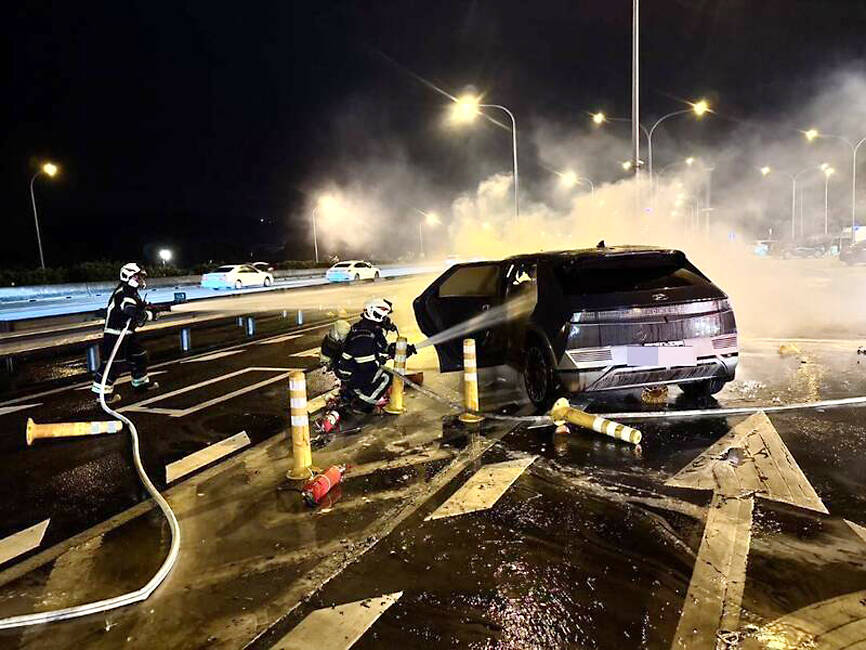
Photo courtesy of the Taoyuan Fire Department
The driver was likely to have activated the ADAS, as the information obtained by investigators showed that they had used the system when driving on freeways in the past, it said, adding that investigators also conducted experiments to verify the hypothesis.
“The ADAS failed to detect the lane markings in time and deactivated automatically, causing the vehicle to deviate from the lane. The speed limit at the location was 60kph, but the vehicle was traveling at approximately 100kph at the time of the incident. The driver did not promptly recognize the situation or take corrective actions, including steering adjustment, decelerating and braking, which resulted in the vehicle crashing into the median island,” it said.
The driver should have paid attention to road conditions, observed the speed limit and kept their hands on the steering wheel at all times, regardless of whether the ADAS was activated, it said.
The driver, who was speeding, was required to observe a dense array of traffic signs and pavement markings within a short time, while simultaneously making decisions regarding the driving path, which might have increased cognitive workload, the board said.
“When drivers are speeding, overly relying on the ADAS or experiencing fatigue, their reaction time might be short and could lead to further rightward lane deviation,” it said.
The overall geometric design of the roadway is unfavorable for vehicle control, and the traffic engineering facilities were unable to mitigate the associated risk, it added.
The board also found that the vehicle was carrying more occupants than the permitted capacity.
Even though the vehicle’s safety gear was activated during the collision, it failed to provide adequate protection for passengers on board, it said.
The vehicle was not equipped with child safety seats, which affects survival rates for children, it said.
The Ministry of Transportation and Communications failed to introduce regulations stipulating that rental car service providers must remind renters about the accurate use of the ADAS, the board said, adding that without the right information, renters could falsely depend on the system.
The board also issued recommendations to the ministry, the Freeway Bureau and the Highway Bureau following the completion of its investigation.

Actor Darren Wang (王大陸) was sentenced to six months in prison, commutable to a fine, by the New Taipei District Court today for contravening the Personal Data Protection Act (個人資料保護法) in a case linked to an alleged draft-dodging scheme. Wang allegedly paid NT$3.6 million (US$114,380) to an illegal group to help him evade mandatory military service through falsified medical documents, prosecutors said. He transferred the funds to Chen Chih-ming (陳志明), the alleged mastermind of a draft-evasion ring, although he lost contact with him as he was already in detention on fraud charges, they said. Chen is accused of helping a

SECURITY: Starlink owner Elon Musk has taken pro-Beijing positions, and allowing pro-China companies to control Taiwan’s critical infrastructure is risky, a legislator said Starlink was reluctant to offer services in Taiwan because of the nation’s extremely high penetration rates in 4G and 5G services, the Ministry of Digital Affairs said yesterday. The ministry made the comments at a meeting of the legislature’s Transportation Committee, which reviewed amendments to Article 36 of the Telecommunications Management Act (電信管理法). Article 36 bans foreigners from holding more than 49 percent of shares in public telecommunications networks, while shares foreigners directly and indirectly hold are also capped at 60 percent of the total, unless specified otherwise by law. The amendments, sponsored by Chinese Nationalist Party (KMT) Legislator Ko

The eastern extension of the Taipei MRT Red Line could begin operations as early as late June, the Taipei Department of Rapid Transit Systems said yesterday. Taipei Rapid Transit Corp said it is considering offering one month of free rides on the new section to mark its opening. Construction progress on the 1.4km extension, which is to run from the current terminal Xiangshan Station to a new eastern terminal, Guangci/Fengtian Temple Station, was 90.6 percent complete by the end of last month, the department said in a report to the Taipei City Council's Transportation Committee. While construction began in October 2016 with an
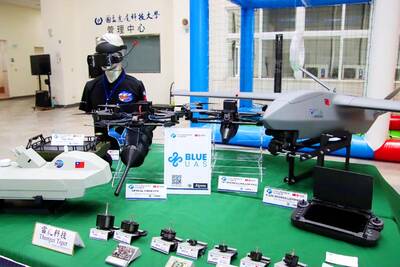
NON-RED SUPPLY: Boosting the nation’s drone industry is becoming increasingly urgent as China’s UAV dominance could become an issue in a crisis, an analyst said Taiwan’s drone exports to Europe grew 41.7-fold from 2024 to last year, with demand from Ukraine’s fight against Russian aggression the most likely driver of growth, a study showed. The Institute for Democracy, Society and Emerging Technology (DSET) in a statement on Wednesday said it found that many of Taiwan’s uncrewed aerial vehicle (UAV) sales were from Poland and the Czech Republic. These countries likely transferred the drones to Ukraine to aid it in its fight against the Russian invasion that started in 2022, it said. Despite the gains, Taiwan is not the dominant drone exporter to these markets, ranking second and fourth


 RSS
RSS