


The Central Election Commission (CEC) faces six major challenges, including Chinese election interference, newly inducted Chairman Michael You (游盈隆) said yesterday, calling for heightened vigilance ahead of the year-end local elections.
Speaking at the handover ceremony, You said that his two priorities during his tenure are: the nine-in-one local elections in November, and the presidential and legislative elections in 2028.
You also detailed the six challenges facing the CEC: simultaneously holding referendums and elections, absentee voting, handling referendum proposals, Chinese spouses’ political rights, artificial intelligence (AI)-driven deepfakes, and Chinese interference in Taiwan’s elections.
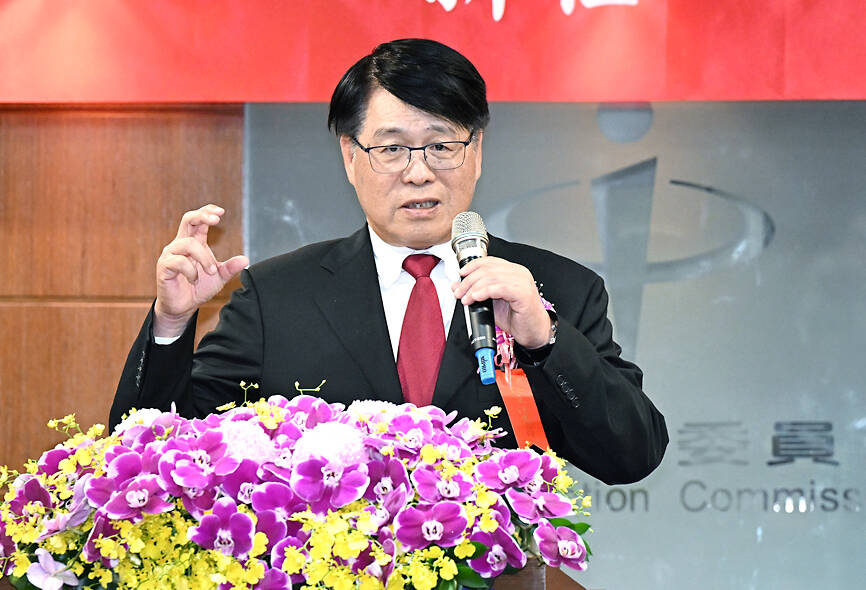
Photo: Liao Chen-huei, Taipei Times
In the age of AI and the Internet, the impact of deepfake misinformation on elections is a serious concern, he said, adding that effectively countering such hard-to-prevent deepfakes, which can influence elections and undermine their fairness, must not be underestimated.
Regarding Chinese interference, You said it is not an exaggeration to say that Chinese Communist Party (CCP) interference in Taiwan’s elections has long been a constant rather than a variable.
This year, Chinese authorities have also, in an unprecedented and openly explicit move, established a task force dedicated to Taiwan’s local elections under the guidance of the CCP Central Leading Group for Taiwan Affairs, he said.
Against this backdrop of evolving cross-strait dynamics, the CEC must remain highly vigilant and cannot afford complacency, he said.
On referendums, You said the Legislative Yuan on Nov. 21 passed amendments to Article 23 of the Referendum Act (公民投票法) officially tying referendums to elections.
While mainstream public opinion toward the change is positive, some are worried that this could complicate elections, he said, adding that properly conducting elections under the new system would be challenging.
While he personally considers absentee voting progressive thinking, You said more comprehensive, rational discussion is required to reach a public consensus and bring such mechanisms into practice.
The CEC’s handling of referendum issues proposed by the legislature would be another tough challenge, You said.
The commission in May last year vetoed the legislature’s proposed referendum on opposing the abolition of the death penalty, while approving a proposed referendum on restarting the Ma-anshan Nuclear Power Plant, You said.
Whether the CEC, as an independent body, has the authority to reject referendum proposals put forward by the Legislative Yuan remains a highly contested and unresolved issue, he said.
How to properly handle such proposals — while ensuring the CEC does not become a mere rubber stamp — poses a significant challenge, he said.
Regarding Chinese spouses’ politic rights, You said the controversy surrounding former legislator-at-large Li Zhenxiu (李貞秀), a Chinese spouse, has subsided after she was expelled from the Taiwan People’s Party and lost her seat in the legislature.
However, Li would not be the last such case, he said.
Cross-strait relations have their own particular complexity, and using the Nationality Act (國籍法) at this stage to address the political rights of spouses from China is arguably forced and highly controversial, he said.
From another perspective, the Li case highlights gaps in Taiwan’s constitutional and legal framework, which also represents a major challenge going forward, he said.

FUKUOKA SITUATION: Japanese media reported that the pathogen is expected to be identified by the summer, while the CDC downplayed the idea that it was hMPV A “mysterious cold-like illness” reported in Japan’s Fukuoka Prefecture does not seem to be a new disease, but Japanese authorities have been asked about the situation, the Centers for Disease Control (CDC) said yesterday. The Fukuoka Prefectural Medical Association on Wednesday told a news conference that a “mystery cold” that has become a hot topic on social media is “highly likely to be caused by some kind of viral infection,” Japan’s KBC News reported. “Many people are experiencing symptoms starting with a sore throat, followed by a runny nose, phlegm and a severe cough,” KBC News reported, citing association officials. Health authorities are

Nvidia Corp CEO Jensen Huang (黃仁勳) arrived in Taiwan yesterday ahead of upcoming AI and technology events, saying he plans to meet with clients and Taiwan Semiconductor Manufacturing Co Chairman C.C. Wei (魏哲家) during his visit. After landing at Taipei Songshan Airport, Huang posed for photos with fans and handed out Yakult drinks to reporters and supporters waiting at the scene, saying he has “a lot to do” during the trip. Asked about reports that Nvidia’s planned headquarters site in Taipei’s Beitou Shilin Technology Park could break ground on May 27, Huang said that if the company holds an event, he would

Carrefour Taiwan is to begin using a new name from the start of July, but it cannot divulge the name until then, the chairman of the supermarket chain's parent company said today. President Chain Store Co chairman Lo Chih-hsien (羅智先) was asked by reporters after a shareholders' meeting to confirm whether the company has settled on a new name for the supermarket brand. In March, the government-registered name of two Carrefour Taiwan branches was quietly changed to "Le Chia Kang" (樂家康) in Chinese, raising speculation that has been selected as the name. Lo said that because of local regulations and contractual obligations, the

The Philippines would likely be involved in any conflict over Taiwan due to its proximity to the democracy claimed by China, President Ferdinand Marcos Jr said, reiterating a stance that risks angering Beijing. “In the Philippines, we do not have a choice because Taiwan is so close to the Philippines and we have almost 200,000 Filipino nationals living and working in Taiwan,” Marcos said in an interview with Japanese media in Manila on Monday. The Philippine leader’s comments come ahead of a state visit to Japan next week, where he is to meet with Japanese Prime Minister Sanae Takaichi to discuss security


 RSS
RSS