


No concrete consensus was reached during cross-caucus negotiations over a proposed special defense budget at the Legislative Yuan yesterday as Chinese Nationalist Party (KMT) lawmakers clashed over the budget cap.
The meeting ended after just 70 minutes, and caucus leaders agreed to hold a fourth round of negotiations on May 6.
Lawmakers remain divided over the scale of the proposed package. The Cabinet is seeking NT$1.25 trillion (US$39.72 billion) over eight years, while the KMT has proposed “NT$380 billion plus N.” The KMT said the “plus N” portion of the proposal means waiting until the US issues letters of acceptance for arms sales to propose relevant budgets, subject to legislative approval.
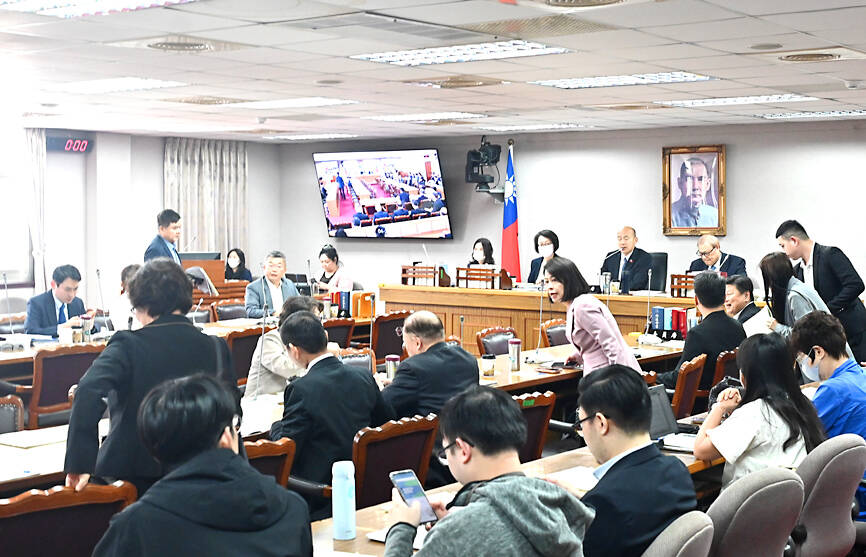
Photo: Wang Yi-sung, Taipei Times
The Taiwan People’s Party’s (TPP) version sets a ceiling of NT$400 billion.
After failing to reach a consensus on April 15, Legislative Speaker Han Kuo-yu (韓國瑜) convened another round of negotiations on Thursday to discuss the draft special defense budget, during which the caucuses reached a consensus on provisions such as budget execution rules and the implementation period, but they still disagreed on key articles, including procurement items and allocated amounts, which led to the third round of negotiations yesterday.
Sources said KMT Legislator Hsu Chiao-hsin (徐巧芯) yesterday proposed raising the budget from the KMT caucus’ proposed “NT$380 billion plus N” to NT$800 billion.

Photo: Ann Wang, Reuters
However, KMT caucus whip Fu Kun-chi (傅?萁) opposed the increase and insisted on sticking to the original proposal.
TPP caucus whip Jacky Chen (陳清龍) said his party caucus needed to further discuss the figure.
Following coordination, Han announced that negotiations would resume on Wednesday next week once the KMT and TPP caucuses have reached internal consensus, and adjourned the meeting.
Democratic Progressive Party caucus whip Tsai Chi-chang (蔡其昌) said after the meeting that while the DPP does not object to the KMT and TPP taking time to communicate internally, military procurement is vital to the nation’s security.
Separately yesterday, American Institute in Taiwan (AIT) Director Raymond Greene urged lawmakers to approve a “comprehensive” defense budget.
In a Facebook post summarizing his interview with the Chinese-language China Times, Greene said it was “vital for Taiwan to pass a comprehensive budget package,” calling it a critical signal to the international community and essential to ensuring Taiwan acquires the full range of defense capabilities it has requested.
He added that Taiwan’s Ministry of National Defense is also seeking funding for integrated air and missile defense systems, as well as uncrewed vehicles and drones.
“As evidenced on the battlefields of the Middle East and Ukraine, these systems are not only critically important, but are also in extremely high demand worldwide,” he said.
Greene added that passing the budget swiftly would create a “positive atmosphere” ahead of KMT Chairwoman Cheng Li-wun’s (鄭麗文) planned Washington visit.

Actor Darren Wang (王大陸) was sentenced to six months in prison, commutable to a fine, by the New Taipei District Court today for contravening the Personal Data Protection Act (個人資料保護法) in a case linked to an alleged draft-dodging scheme. Wang allegedly paid NT$3.6 million (US$114,380) to an illegal group to help him evade mandatory military service through falsified medical documents, prosecutors said. He transferred the funds to Chen Chih-ming (陳志明), the alleged mastermind of a draft-evasion ring, although he lost contact with him as he was already in detention on fraud charges, they said. Chen is accused of helping a

SECURITY: Starlink owner Elon Musk has taken pro-Beijing positions, and allowing pro-China companies to control Taiwan’s critical infrastructure is risky, a legislator said Starlink was reluctant to offer services in Taiwan because of the nation’s extremely high penetration rates in 4G and 5G services, the Ministry of Digital Affairs said yesterday. The ministry made the comments at a meeting of the legislature’s Transportation Committee, which reviewed amendments to Article 36 of the Telecommunications Management Act (電信管理法). Article 36 bans foreigners from holding more than 49 percent of shares in public telecommunications networks, while shares foreigners directly and indirectly hold are also capped at 60 percent of the total, unless specified otherwise by law. The amendments, sponsored by Chinese Nationalist Party (KMT) Legislator Ko
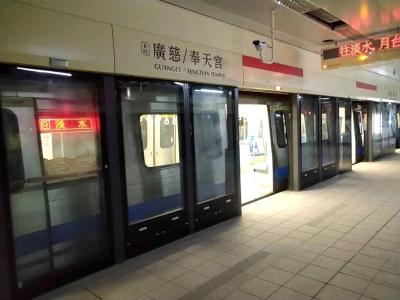
The eastern extension of the Taipei MRT Red Line could begin operations as early as late June, the Taipei Department of Rapid Transit Systems said yesterday. Taipei Rapid Transit Corp said it is considering offering one month of free rides on the new section to mark its opening. Construction progress on the 1.4km extension, which is to run from the current terminal Xiangshan Station to a new eastern terminal, Guangci/Fengtian Temple Station, was 90.6 percent complete by the end of last month, the department said in a report to the Taipei City Council's Transportation Committee. While construction began in October 2016 with an
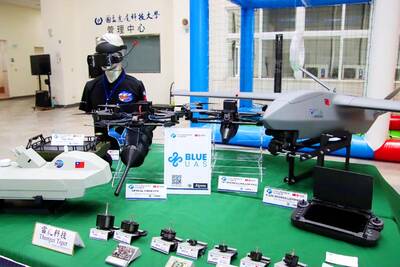
NON-RED SUPPLY: Boosting the nation’s drone industry is becoming increasingly urgent as China’s UAV dominance could become an issue in a crisis, an analyst said Taiwan’s drone exports to Europe grew 41.7-fold from 2024 to last year, with demand from Ukraine’s fight against Russian aggression the most likely driver of growth, a study showed. The Institute for Democracy, Society and Emerging Technology (DSET) in a statement on Wednesday said it found that many of Taiwan’s uncrewed aerial vehicle (UAV) sales were from Poland and the Czech Republic. These countries likely transferred the drones to Ukraine to aid it in its fight against the Russian invasion that started in 2022, it said. Despite the gains, Taiwan is not the dominant drone exporter to these markets, ranking second and fourth


 RSS
RSS