


President William Lai (賴清德) yesterday expressed hope that the 14th Global Taiwan National Affairs Symposium would help buttress a sense of national identity and foster a resilient Taiwan through international cooperation.
In a congratulatory message read by senior presidential adviser Yao Chia-wen (姚嘉文), Lai said he hoped the event would rally Taiwanese around the nation’s consciousness, defend democratic values and strengthen partnerships with global allies.
Vice President Hsiao Bi-khim (蕭美琴) in a separate message said the platform has helped strengthen solidarity among Taiwanese at home and abroad, amplify Taiwan’s voice in the international community and contribute significantly to resisting authoritarian expansion and consolidating democratic gains.
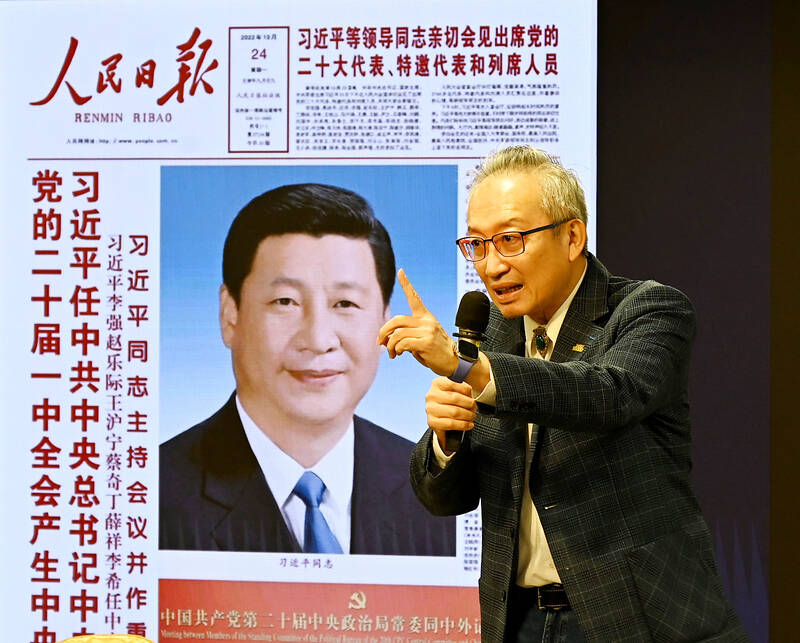
Photo: Wang Yi-sung, Taipei Times
The symposium in Taipei yesterday was co-organized by the World Taiwanese Congress and the Taiwan Nation Alliance in Taipei, with this year’s edition themed “Normalizing the State: New Prospects for Taiwan-Japan-US Relations.”
Yao said the annual conference serves as an important platform for communication among Taiwanese worldwide.
While Taiwan faces many challenges and criticism of the government persists, such as assertions that the ruling Democratic Progressive Party has left many problems unsolved despite being in power for years, he said that internal divisions would only weaken the country.
Taiwan Nation Alliance convener Kuo Chung-kuo (郭重國) said the ultimate goal is the rectification of Taiwan’s name and drafting a new constitution.
The conference’s mission is to forge a collective consensus among Taiwanese, he said, adding that only by equipping themselves with knowledge can people effectively counter China’s “united front” infiltration and cognitive warfare, strengthening internal cohesion and resilience.
“There is no issue of unification or reunification between Taiwan and China — only one of invasion and aggression,” Deputy Minister of Foreign Affairs Francois Wu (吳志中) said in his keynote speech.
If cross-strait affairs are framed as a unification or reunification issue, that is the same as framing Taiwan as a Chinese internal affair, he said.
Once cross-strait affairs become an invasion issue, there would be a “status quo” to safeguard, he said, adding that Taiwan has never been as prosperous as it is today.
Taiwan is a unique country, sui generis, and possesses the attributes of a sovereign state, performing better economically than 95 percent of countries worldwide, he said.
The nation has achieved astounding progress in areas such as the economy, politics, freedom, gender equality and international image, he said, adding that the more distance Taiwan keeps from China, the better it becomes.
Taiwan was internationally seen as a “trouble maker” 20 years ago, but that label has shifted to China, he said, accusing Beijing of obstructing freedom of navigation and overflight in the Taiwan Strait, blocking Taiwan’s presidential visits abroad and limiting the nation’s international participation.
Saying the slogan of “normalizing Taiwan as a state” has been promoted for years, Taiwanese academics at the event yesterday called for a more gradual, pragmatic approach, such as adopting the Gregorian calendar instead of the Republic of China (ROC) calendar.
Taiwan meets all the criteria of a sovereign state, but the ROC is, in legal terms, a republic that calls itself China, said Lo Cheng-chung (羅承宗), a professor at the National Kaohsiung University of Science and Technology’s Graduate Institute of Science and Technology Law.
“Even if you put ‘Taiwan’ in parentheses, it does not resolve the issue. In the Constitution, Taiwan is downgraded to a ‘region,’ and some people even engage in daily self-denial of its national status,” he said.
He urged a gradual approach for normalization, saying local governments could rename streets that still carry China-related names.
Citing polls, Soochow University associate professor Chen Fang-yu (陳方隅) said more than 80 percent of Taiwanese believe the ROC and the People’s Republic of China are not subordinate to each other, while about 75 percent agree that “Taiwan is a sovereign independent country called the ROC.”
While more people are becoming receptive to constitutional reform and name change, political concerns remain, especially over ever-present Chinese threats, he said.
As for how to normalize the state, he described the ROC as “using a borrowed shell for a new business.”
The shell should not be the subject, he said, adding the government should eventually discard the “one China” principle entirely to avoid ambiguity over state sovereignty and encourage the international community to form diplomatic policies that separate Taiwan from China.

The Ministry of Finance this afternoon announced the winning numbers for the March-April uniform invoice lottery. The winning number for the NT$10 million (US$318,060) special prize is 19531471, and the winning number for the NT$2 million grand prize is 85941329. Three numbers were drawn for the NT$200,000 first prize: 07225810, 20231230 and 83518781. Those with receipts matching the last seven digits of any of the first-prize numbers will win the NT$40,000 second prize, while those matching the last six digits will win the NT$10,000 third prize. Those whose receipts match the last five digits of the first-prize numbers can claim the NT$4,000 fourth prize,

SIX SUBSIDIES: The monthly allowance for older farmers is to increase to NT$10,000, and NT$5,000 is to be given to homemakers under the national pension system, Lai said The government is to implement major welfare policies for disadvantaged groups, including raising the monthly allowance for older farmers to NT$10,000 and providing homemakers with NT$5,000 per month, President William Lai (賴清德) said yesterday. Lai made the remarks during a visit to Wangling Temple in Chiayi County, saying that the planned increases were being introduced amid economic growth and an increase in tax revenue. Touting a policy, in which the government plans to provide a monthly allowance of NT$5,000 for every child under the age of 18 in a bid to address Taiwan’s low birthrate, Lai said that if received for the
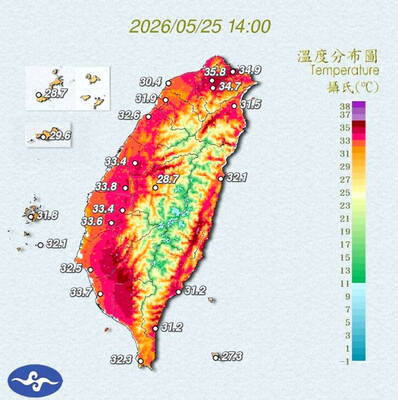
STAY COOL: The HPA recommended that people stay hydrated, use air-conditioning or fans while indoors, wear loose-fitting clothes and walk in the shade while outdoors Employers must implement measures such as installing cooling equipment, and providing drinking water and rest breaks for outdoor workers starting from Monday next week, the Taipei Department of Labor said on Sunday. Employers who fail to comply could face fines of NT$30,000 to NT$300,000 under the Occupational Safety and Health Act (職業安全衛生法), the department said. Businesses in Taipei employing fewer than 100 workers, as well as registered self-employed workers with labor insurance coverage, could receive on-site assessments and guidance from occupational safety consultants to help them apply for central government subsidies to implement or improve heat-protection measures, it said. Under the Ministry of

NATIONAL SECURITY: Authorities are working to confirm the identities of the military personnel involved and investigating possible illegal conduct and regulatory violations Authorities are probing possible national security implications after Kinmen police and immigration officers on Sunday found a Chinese woman allegedly posing as a tourist while engaging in prostitution involving more than 10 military personnel. The woman, surnamed Chen (陳), has since been deported, authorities said, adding that investigators are still working to confirm the identities of those implicated, as the records only listed code names and aliases. The case stemmed from a report received by the Kinmen District Prosecutors’ Office on Friday last week from the Jinhu Precinct of the Kinmen County Police Bureau. On Sunday, police, along with the National Immigration


 RSS
RSS