


With about 80 percent of hospice care cases taking place in hospitals, the Ministry of Health and Welfare (MOHW) has increased the payment for home hospice care medical teams by up to 30 percent to encourage a dignified death at home, Minister of Health and Welfare Shih Chung-liang (石崇良) said yesterday.
Shih made the remarks on the sidelines of a conference on end-of-life care and ethics held by the Taiwan Academy of Hospice Palliative Medicine (TAHPM) in Taipei.
Having promoted hospice care for many years, Taiwan ranks high in the quality of death for terminally ill patients globally, but there is still room for improvement, especially in home hospice care, he said.
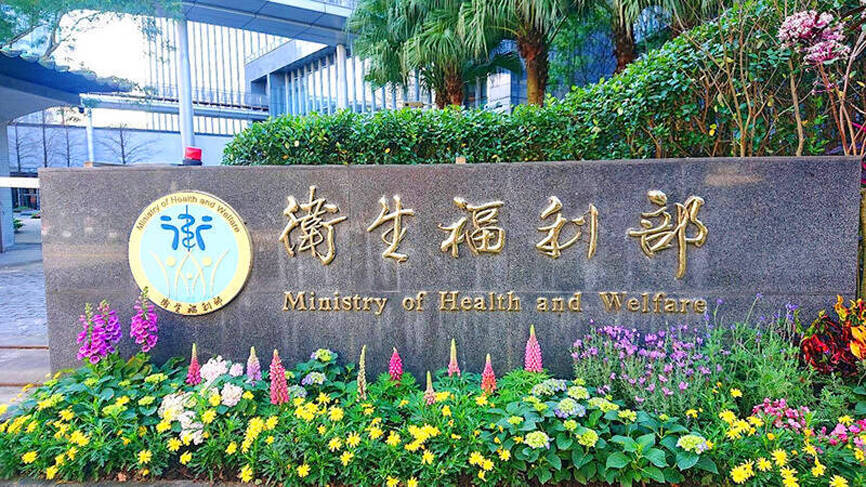
Photo: CNA
Shih said National Health Insurance (NHI) data shows that there were about 100,000 cases of hospice care each year, with 80 percent in hospitals, and while about 65 percent of cancer patients went into hospice care at the terminal stage, only about 35 percent of terminally ill non-cancer patients do the same.
A “good death at home” is based on the idea that a critically ill person stays in their familiar home environment, accompanied by their loved ones at the end of life, avoiding aggressive medical intervention, he said, adding that Taiwan has been promoting NHI-covered hospice care since 1996 to improve patients’ quality of life while reducing the strain on healthcare resources.
Currently, hospice care is categorized into three types — inpatient hospice care, hospice shared care and home hospice care — with the former two taking place in the hospital, accounting for about 80 percent of cases, he said.
The pay-for-performance model was introduced to hospice care to encourage better quality of care, Shih said, adding that, starting from this year, hospitals with home hospice care services would be scored across three tiers — good, excellent and outstanding.
An increased payment of 10 to 30 percent would be offered to medical teams according to their performance score, with a requirement that 60 percent of the added reward payment being designated to frontline healthcare providers, he added.
National Health Insurance Administration Chief Secretary Liu Lin-i (劉林義) said the incentive reward program was announced last year, and about 100 hospitals have applied so far, while the Joint Commission of Taiwan (JCT) has been commissioned to conduct the evaluations for this program.
On-site evaluations of home hospice care quality performance are scheduled to take place between next month and October, with a final review meeting at the end of the year to determine their scores and corresponding rewards, he added.
Regarding the long-standing controversy surrounding euthanasia, Shih said it is not merely a medical issue but also involves complex legal and ethical issues as well as societal values, and although Taiwan’s society is increasingly open to the topic, significant division remains.
Assisting in suicide is a crime under the Criminal Code, and active euthanasia involves physicians performing procedures to end a life, which presents ethical conflict with core medical values, and therefore most medical associations have a conservative stance on this issue, he said.
Therefore, the government has instead been promoting making advance medical decisions and palliative and hospice care under the Hospice Palliative Care Act (安寧緩和醫療條例) and the Patient Right to Autonomy Act (病人自主權利法), to achieve a dignified and peaceful death at home, he said.

The Ministry of Finance this afternoon announced the winning numbers for the March-April uniform invoice lottery. The winning number for the NT$10 million (US$318,060) special prize is 19531471, and the winning number for the NT$2 million grand prize is 85941329. Three numbers were drawn for the NT$200,000 first prize: 07225810, 20231230 and 83518781. Those with receipts matching the last seven digits of any of the first-prize numbers will win the NT$40,000 second prize, while those matching the last six digits will win the NT$10,000 third prize. Those whose receipts match the last five digits of the first-prize numbers can claim the NT$4,000 fourth prize,

SIX SUBSIDIES: The monthly allowance for older farmers is to increase to NT$10,000, and NT$5,000 is to be given to homemakers under the national pension system, Lai said The government is to implement major welfare policies for disadvantaged groups, including raising the monthly allowance for older farmers to NT$10,000 and providing homemakers with NT$5,000 per month, President William Lai (賴清德) said yesterday. Lai made the remarks during a visit to Wangling Temple in Chiayi County, saying that the planned increases were being introduced amid economic growth and an increase in tax revenue. Touting a policy, in which the government plans to provide a monthly allowance of NT$5,000 for every child under the age of 18 in a bid to address Taiwan’s low birthrate, Lai said that if received for the
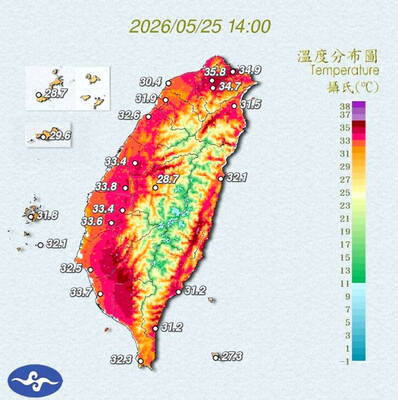
STAY COOL: The HPA recommended that people stay hydrated, use air-conditioning or fans while indoors, wear loose-fitting clothes and walk in the shade while outdoors Employers must implement measures such as installing cooling equipment, and providing drinking water and rest breaks for outdoor workers starting from Monday next week, the Taipei Department of Labor said on Sunday. Employers who fail to comply could face fines of NT$30,000 to NT$300,000 under the Occupational Safety and Health Act (職業安全衛生法), the department said. Businesses in Taipei employing fewer than 100 workers, as well as registered self-employed workers with labor insurance coverage, could receive on-site assessments and guidance from occupational safety consultants to help them apply for central government subsidies to implement or improve heat-protection measures, it said. Under the Ministry of
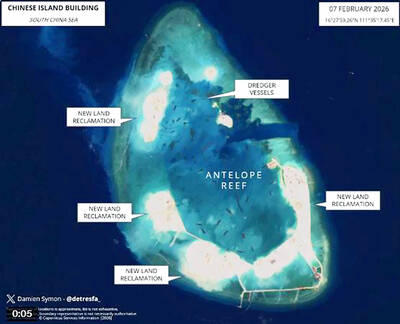
ISOLATION: The outposts would serve as support and backup bases, forcing US forces to either face China head-on or reroute, increasing travel time and operational costs China’s outposts in the South China Sea could be used to delay and constrain foreign forces during a conflict in the Taiwan Strait, giving Beijing a critical window to carry out amphibious landing and blockade operations, a report said. The Chinese Communist Party’s (CCP) forward operating bases on islands and reclaimed features in the South China Sea could delay foreign forces long enough for the Chinese People’s Liberation Army (PLA) to secure a key 48-to-72-hour window in the Taiwan Strait, a report commissioned by the Mainland Affairs Council found. The report, conducted by the Institute for National Defense and Security Research, examined


 RSS
RSS