


A survey released by the Taiwan Fund for Children and Families yesterday found that online “traps” remain widespread, with 15.91 percent of children and adolescents who added strangers as friends saying they would be willing to exchange their intimate photos for “free limited-edition items.”
The foundation’s latest Children and Adolescent Digital Safety Survey found that in a gaming scenario where they could get “free limited-edition items,” 31.35 percent of children and adolescents who engage with a stranger said they would add the person on Line.
Asked regarding the exchange of intimate photos using statements such as “everyone is doing it” or “it is a rare free opportunity,” 15.91 percent said they would send their own photos, the foundation said.

Photo courtesy of the foundation
The results highlight gaps in young people’s ability to recognize digital risks and set clear boundaries, it added.
About 70 percent of child and adolescent sexual exploitation cases over the past five years involved online crimes, the foundation said, adding that the number of victims rose from 1,691 in 2020 to 3,582 in 2024, or an increase of more than 111 percent.
Child online safety expert Liu Yu-chun (劉昱均) said digital sexual exploitation has transformed from simple cases of covert filming and image leaks to more complex forms of “digital blackmail.”
Offenders now often lure victims into nude video chats and secretly record them, and make children afraid of seeking help, she said.
Victims often say they did not think that would happen and ask whether there is a way to stop the images from spreading, Liu said.
“With the widespread use of digital platforms and tools, online sexual exploitation of minors has become an immediate and tangible risk for children,” she warned.
Hualien Hope Garden director Wu Chih-hsien (吳芝嫻) shared a case involving a young person called Hsiao-an (小安) as an example.
Due to a dysfunctional family environment, Hsiao-an sought affection online, but was unfortunately targeted by an online predator, who lured her into sending intimate images, Wu said.
When Hsiao-an tried to end the relationship, the perpetrator threatened to distribute the images, Wu said, adding that with the support of a social worker, the child reported the case to the police, and thanks to their intervention, the images were not circulated further.
Wu urged parents to make sure their children feel safe instead of blaming them in such scenarios, so they know they can seek help by reporting the crime to authorities or requesting digital takedowns.
She also encouraged young people to join clubs or explore interests to reduce reliance on the Internet.
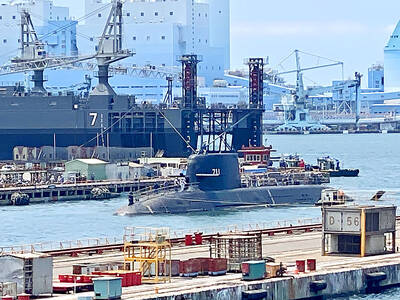
AGING: While Japan has 22 submarines, Taiwan only operates four, two of which were commissioned by the US in 1945 and 1946, and transferred to Taiwan in 1973 Taiwan would need at least 12 submarines to reach modern fleet capabilities, CSBC Corp, Taiwan chairman Chen Cheng-hung (陳政宏) said in an interview broadcast on Friday, citing a US assessment. CSBC is testing the nation’s first indigenous defense submarine, the Hai Kun (海鯤, Narwhal), which is scheduled to be delivered to the navy next month or in July. The Hai Kun has completed torpedo-firing tests and is scheduled to undergo overnight sea trials, Chen said on an SET TV military affairs program. Taiwan would require at least 12 submarines to establish a modern submarine force after assessing the nation’s operational environment and defense

Yangmingshan National Park authorities yesterday urged visitors to respect public spaces and obey the law after a couple was caught on a camera livestream having sex at the park’s Qingtiangang (擎天崗) earlier in the day. The Shilin Police Precinct in Taipei said it has identified a suspect and his vehicle registration number, and would summon him for questioning. The case would be handled in accordance with public indecency charges, it added. The couple entered the park at about 11pm on Thursday and began fooling around by 1am yesterday, the police said, adding that the two were unaware of the park’s all-day live
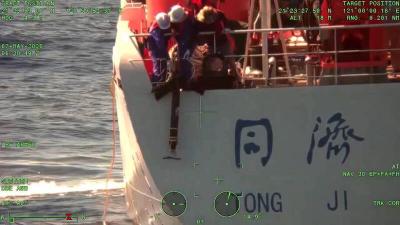
The coast guard today said that it had disrupted "illegal" operations by a Chinese research ship in waters close to the nation and driven it away, part of what Taipei sees a provocative pattern of China's stepped up maritime activities. The coast guard said that it on Thursday last week detected the Chinese ship Tongji (同濟號), which was commissioned only last year, 29 nautical miles (54km) southeast of the southern tip of Taiwan, although just outside restricted waters. The ship was observed lowering ropes into the water, suspected to be the deployment of scientific instruments for "illegal" survey operations, and the coast

A former soldier and an active-duty army officer were yesterday indicted for allegedly selling classified military training materials to a Chinese intelligence operative for a total of NT$79,440. The Taipei District Prosecutors’ Office indicted Chen Tai-yin (陳泰尹) and Lee Chun-ta (李俊達) for contravening the National Security Act (國家安全法) and the Anti-Corruption Act (貪污治罪條例). Chen left the military in September 2013 after serving alongside then-staff sergeant Lee, now an army lieutenant, at the 21st Artillery Command of the army’s Sixth Corps from 2011 to 2013, according to the indictment. Chen met a Chinese intelligence operative identified as “Wang” (王) through a friend in November


 RSS
RSS