


The number of shunting accidents during Taiwan Railway Corp (TRC) operations was relatively high in the past few years, mostly attributable to human factors, the Taiwan Transportation Safety Board (TTSB) said yesterday.
A shunting accident refers to an incident that occurs during rail yard operations, when trains or railcars are being moved and rearranged.
The issue was discussed at the legislature’s Transportation Committee, where the board was scheduled to brief the lawmakers about its operation.
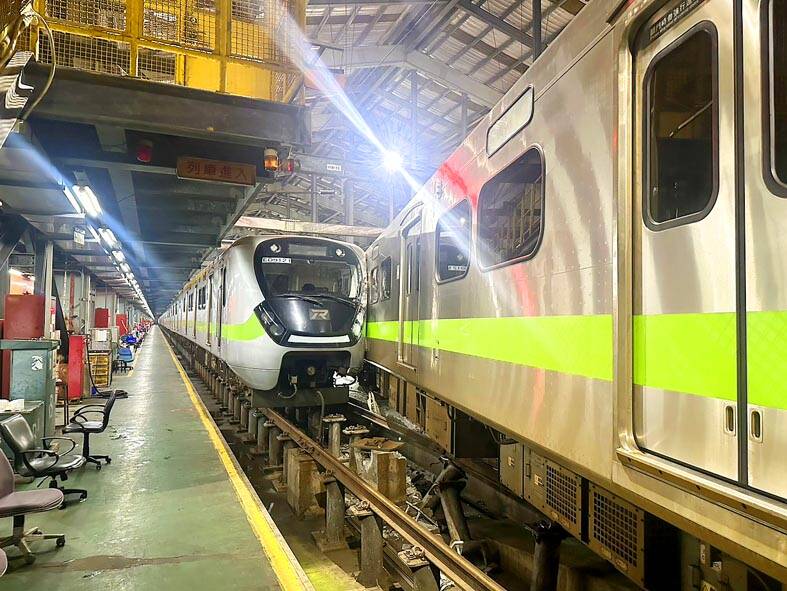
Photo courtesy of a member of the public via CNA
The number of shunting accidents did not decrease after the railway operator was converted into a state-owned corporation in 2024 from a state-run railway service, Chinese Nationalist Party (KMT) Legislator Hung Meng-kai (洪孟楷) said.
There were 14 incidents in 2022, 16 in 2023, and 20 in 2024 and last year, he said, adding that there were also some injuries.
A total of 76 shunting accidents have occurred since the TTSB was established in August 2019 and those incidents were caused mainly by human factors, TTSB Chairman Lin Shinn-der (林信得) said.
The three main types of shunting accidents were derailment (28 cases), switching errors (26) and collisions (13), Lin said.
Most shunting accidents occurred at a railway depot in Keelung’s Cidu District (七堵) and Hualien Locomotive Depot, he added.
The railway firm cannot simply say that they would work hard to address the problem without taking any actions, Hung said.
“If accidents happen frequently in these two depots because of personnel shortage or inadequate training, the company needs to tackle these issues instead of naming the problems every time an incident happens,” Hung said.
Five shunting accidents occurred from January to last month, Democratic Progressive Party Legislator Lee Kun-tse (李昆澤) said, adding that improvements should focus on the shunting route, the operating procedures of route planners, leadership during operations, the division of responsibilities in communication protocols, and the maintenance and management of yard signaling systems.
A factual report of two shunting accidents, which were related to collisions of rail cars, would be published in September following extensive interviews with the depot staff and an analysis of standardized operating procedures, Lin said.
Separately, Hung said that motorcycle lanes on the soon-to-open Danjiang Bridge (淡江大橋) in New Taipei City are too narrow, adding that a single collision could easily cause congestion.
Ambulances would struggle reaching accident spots on the bridge, he said.
Rather than designated specific lanes for motorcycles, some suggest that the traffic can be managed more efficiently by having mixed traffic lanes, where all vehicles are obligated to observe the same speed limit, Hung said.
Lin said the board could advise the Ministry of Transportation and Communications to consider including not only car lanes but also motorcycle lanes in its road safety audit.
The issue can also be discussed at the board’s annual transport safety seminar, Lin said.
The Highway Bureau is in charge of building and maintaining the Danjiang Bridge and managing the traffic on it.
In a statement issued on Sunday, the bureau said the motorcycle lane is 2.5m wide and meets the highway design criteria.
Experts in a safety consulting group would refine the road conditions before the bridge opens to the public on May 12, it said.
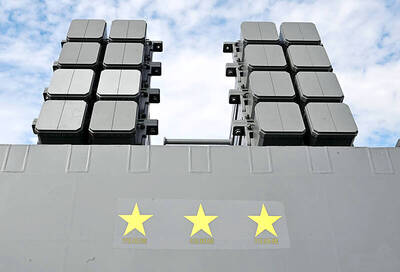
UPGRADE: The Kang Ding-class frigate is replacing its Chaparall missiles with Tien Chien II and Hua Yang VLS, which would provide it with long-range, 360° air defense Taiwan plans to produce 1,200 to 1,376 Hai Chien II missiles (海劍二, Sea Sword II) — also known as TC-2N — to serve as the standard air defense system of the navy’s surface combatant fleet, a source said yesterday. Last week, the Hai Chien II, the naval version of the Tien Kung II missile (天劍二, Sky Sword II), completed a live-fire test in waters off the National Chungshan Institute of Science and Technology’s Jiupeng facility (九鵬) in Pingtung County’s Manjhou Township (滿州). The MIM72 Chaparral and other dated air defense missiles that currently arm Taiwanese ships have inadequate range to combat Chinese

REASONS FOR TRAVEL: An assistant professor said that proposed amendments to penalize drivers if they used drugs overseas would not deter people from traveling People who operate a motor vehicle under the influence of marijuana would have their driver’s license revoked, even if they used the substance while overseas, the Ministry of Transportation and Communications said yesterday, citing proposed amendments to the Road Traffic Management and Penalty Act (道路交通管理處罰條例). The amendments would also authorize the government to revoke the licenses of people determined to have used Category 1 or Category 2 narcotics, even if they were not operating a vehicle while under the influence of drugs, as well as ban them from taking the license test for three years, the ministry said. People aged 18 or

GLOBALGIVING: ‘ Caving to external pressure is not acceptable for an organization that has cultivated justice reform and human rights for 30 years,’ one NGO said A slew of non-government organizations (NGOs) have withdrawn from the GlobalGiving fundraising platform after it announced it would use “Chinese Taipei” instead of “Taiwan” from next month. The Taiwan Good Rice Association wrote on Facebook on Friday that it was informed on April 28 via a teleconference call of the change, which was made because the platform wanted to operate in China. Taiwan Good Rice is to terminate all cooperative relationships with GlobalGiving in response to the platform’s “unilateral and non-negotiable” decision to remove references to Taiwan, the NGO said. “Taiwan is in the official name of Taiwan Good Rice Association and the

HEAVY WEATHER: Typhoon Jangmi is due to crash straight into the Ryukyus as airlines look to shift flights to larger aircraft or cancel flights to Okinawa entirely Taiwan’s international air carriers announced flight adjustments over the weekend as Typhoon Jangmi is forecast to hit the Ryukyu Islands today and tomorrow. The Central Weather Administration (CWA) upgraded Jangmi from a tropical storm to a typhoon at 8am yesterday, with the eye located 580km south of Naha city. It was moving north at 19kph. Today, China Airlines’ CI-120, CI-121, CI-122 and CI-123 flights between Taoyuan and Naha, Okinawa, have been canceled as well as CI-132 and CI-133 between Kaohsiung and Naha. EVA Air’s BR-112, BR-113, BR-186 and BR-185 flights between Taoyuan and Naha are also canceled. Low-cost carrier Tigerair Taiwan canceled IT-230,


 RSS
RSS