


The Food and Drug Administration (FDA) is planning to introduce a traffic light labeling system for packaged foods, allowing consumers to more easily understand if products contain low, medium or high saturated fat, sugar and salt.
Citing the WHO having listed “unhealthy diet” as a leading risk factor for noncommunicable diseases, which cause roughly 75 percent of global deaths, the FDA said that, in a joint effort with the Health Promotion Administration (HPA), the traffic light labeling — to be introduced in the second half of this year — is aimed at allowing people to more intuitively identify food content and choose healthier food.
The HPA’s Nutrition and Health Survey in Taiwan showed that 63 percent of adults exceed the recommended daily limit of salt, and 17.3 percent of adults consume more than the recommended amount of sugar (less than 10 percent of total daily energy intake).
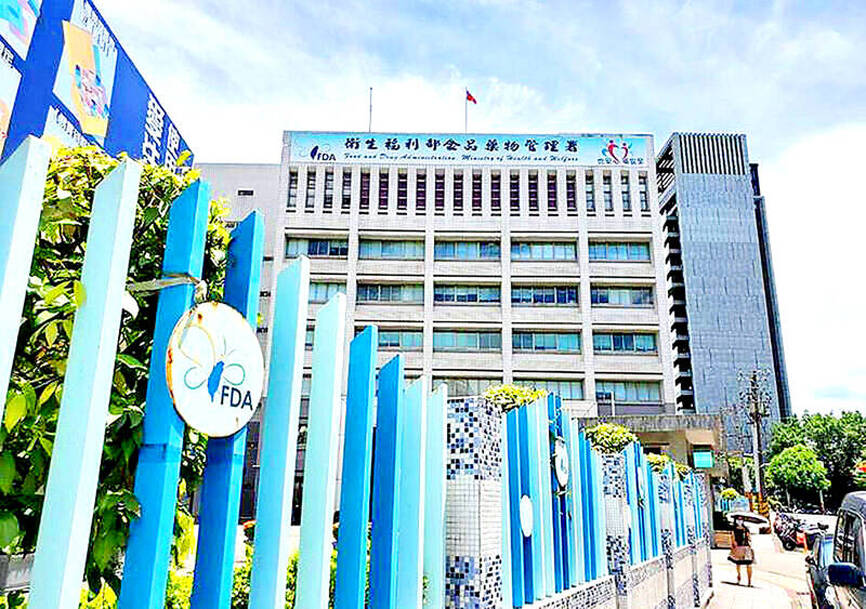
Photo: Chung Li-hua, Taipei Times
“International studies show that using interpretive nutrition labels on the front of food packaging allows consumers to grasp nutritional facts more easily and encourages them to make healthier selections,” the FDA said.
FDA Food Safety Division head Hsu Chao-kai (許朝凱) said the idea of introducing the traffic light labelling was brought up by former Taiwan Dietitian Association president Kuo Su-e (郭素娥) at a Healthy Taiwan National Forum in April last year, and it was supported by President William Lai (賴清德) and Premier Cho Jung-tai (卓榮泰).
Hsu said current food product labeling can be difficult for some consumers to immediately understand, so the FDA and HPA have gathered local and international empirical data and referenced policies in other countries to improve the issue.
After convening several specialist meetings with experts of medicine, nutrition, food science and other relevant fields, a consensus on the design of the new traffic light labeling has been reached, he said.
The draft guideline shows that the front-of-pack nutrition labeling would be based on a standard of per 100g for solids or per 100ml for liquids, and feature a “red-yellow-green” traffic light-color grading system specifically for three nutrients — sugar, sodium and saturated fat.
Food products might be labeled as “green” when their sugar, sodium and saturated fat content falls below the following thresholds: 5g of sugar, 120mg of sodium and 1.5g of saturated fat for solid foods (per 100g); 2.5g of sugar, 120mg of sodium and 0.75g of saturated fat for liquid foods (per 100ml).
They might be labeled as “red” if their content is above the following thresholds: 15g of sugar, 500mg of sodium and 4.5g of saturated fat for solid foods; and 7.5g of sugar, 250mg of sodium and 2.25g of saturated fat for liquid foods.
If the food products’ sugar, sodium and saturated fat are between the two thresholds, they can be labeled as “yellow.”
Hsu said food manufacturers can voluntarily follow the drafted guidelines to print the traffic light labeling on their products, adding that, after a period of policy guidance, the system is scheduled to be formally adopted in the second half of the year.

NATIONAL SECURITY: Authorities are working to confirm the identities of the military personnel involved and investigating possible illegal conduct and regulatory violations Authorities are probing possible national security implications after Kinmen police and immigration officers on Sunday found a Chinese woman allegedly posing as a tourist while engaging in prostitution involving more than 10 military personnel. The woman, surnamed Chen (陳), has since been deported, authorities said, adding that investigators are still working to confirm the identities of those implicated, as the records only listed code names and aliases. The case stemmed from a report received by the Kinmen District Prosecutors’ Office on Friday last week from the Jinhu Precinct of the Kinmen County Police Bureau. On Sunday, police, along with the National Immigration

GLOBALGIVING: ‘ Caving to external pressure is not acceptable for an organization that has cultivated justice reform and human rights for 30 years,’ one NGO said A slew of non-government organizations (NGOs) have withdrawn from the GlobalGiving fundraising platform after it announced it would use “Chinese Taipei” instead of “Taiwan” from next month. The Taiwan Good Rice Association wrote on Facebook on Friday that it was informed on April 28 via a teleconference call of the change, which was made because the platform wanted to operate in China. Taiwan Good Rice is to terminate all cooperative relationships with GlobalGiving in response to the platform’s “unilateral and non-negotiable” decision to remove references to Taiwan, the NGO said. “Taiwan is in the official name of Taiwan Good Rice Association and the

HEAVY WEATHER: Typhoon Jangmi is due to crash straight into the Ryukyus as airlines look to shift flights to larger aircraft or cancel flights to Okinawa entirely Taiwan’s international air carriers announced flight adjustments over the weekend as Typhoon Jangmi is forecast to hit the Ryukyu Islands today and tomorrow. The Central Weather Administration (CWA) upgraded Jangmi from a tropical storm to a typhoon at 8am yesterday, with the eye located 580km south of Naha city. It was moving north at 19kph. Today, China Airlines’ CI-120, CI-121, CI-122 and CI-123 flights between Taoyuan and Naha, Okinawa, have been canceled as well as CI-132 and CI-133 between Kaohsiung and Naha. EVA Air’s BR-112, BR-113, BR-186 and BR-185 flights between Taoyuan and Naha are also canceled. Low-cost carrier Tigerair Taiwan canceled IT-230,

Chinese Nationalist Party (KMT) Chairwoman Cheng Li-wun (鄭麗文) yesterday briefed her party’s Central Standing Committee regarding her scheduled visit to the US between Monday next week and June 16, saying that her purpose would be to persuade the US that the Republic of China (ROC) Constitution was a “one China” constitution that would foster stable and peaceful cross-strait relations. The ROC Constitution is the most important defense for all Taiwanese citizens, as it upholds our democracy and has contributed to our robust economy, which aligns with international and US interests, she said. “We would not be troublemakers and drag the US under,”


 RSS
RSS