


Democratic Progressive Party Legislator Chung Chia-pin (鍾佳濱) yesterday urged the Ministry of Economic Affairs to propose a law requiring land to be set aside for self-generated power in industrial parks, in line with the US Ratepayer Protection Pledge.
Minister of Economic Affairs Kung Ming-hsin (龔明鑫) yesterday at a meeting of the legislature’s Economics Committee unveiled short-term development targets for renewables.
The target for cumulative installed capacity by 2030 has been set at 31 gigawatts (GW) for solar power, 10.9GW for offshore wind power, 2.14GW for hydropower and 200 megawatts for geothermal power, he said.
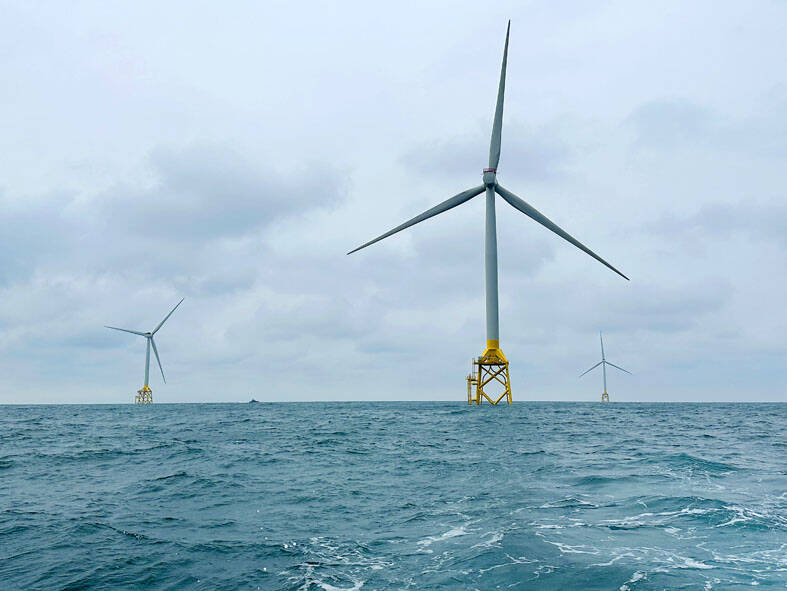
Photo: CNA
As of February, solar power had reached 15.68GW in total installed capacity and offshore wind power hit 13.68GW, while hydropower and geothermal power had a collective capacity of 2.136GW, Kung said.
The ministry continued to survey sea areas applicable for offshore wind power facilities and aimed to reach a cumulative capacity of 40GW or 55GW for offshore wind power by 2050, he said.
The Energy Administration has formulated a small hydropower carbon reduction flagship project, while incentive measures would be enacted to encourage geothermal power development, he added.
Regarding grid resilience, the ministry would continue to implement the Grid Resilience Strengthening Construction Plan approved by the Cabinet on Aug. 19, 2022, with a budget of NT$564.59 billion (US$17.89 billion), Kung said.
About 40.79 percent of the plan had been completed as of last month, ahead of the originally targeted 38.88 percent, he said.
National Development Council Deputy Minister Jan Fang-guan (詹方冠) said Taiwan relies on imports for 94 percent of its energy.
The development of renewables is part of the government’s effort to boost the percentage of domestically produced energy, he said.
However, Chung said that grid resilience should be prioritized over boosting electricity capacity, as centralized power grids are vulnerable to single points of failure.
The lawmaker asked Kung whether the main cause of power outages in Taiwan were shortages or an uneven power grid.
“The power grid is the main problem,” Kung said.
Citing former deputy minister of economic affairs Tseng Wen-sheng (曾文生), Chung said the power outage leading to more than NT$1 billion in losses to Taiwan Semiconductor Manufacturing Co’s Tainan fab in 2021 was not caused by a power shortage.
Taiwan’s power grids are highly centralized in Hsinchu’s Longtan District (龍潭), Nantou County’s Jhongliao Township (中寮) and Tainan’s Longci District (龍崎) — which Tseng considered the main cause of the 2021 power outage, Chung said.
Any single point of failure in one of the three centralized mega-grids would result in grid collapse, he said, adding that grid resilience is more crucial than boosting capacities.
Given that the industrial sector accounts for 55 percent of power consumption nationwide, the ministry should incentivize energy-intensive industries to generate their own electricity, Chung said.
It should also require industrial parks to reserve parcels of land for self-generated power facilities, he said.
Kenting National Park service technician Yang Jien-fon (楊政峰) won a silver award in World Grand Prix Photography Awards Spring Season for his photograph of two male rat snakes intertwined in combat. Yang’s colleagues at Kenting National Park said he is a master of nature photography who has been held back by his job in civil service. The awards accept entries in all four seasons across six categories: architectural and urban photography, black-and-white and fine art photography, commercial and fashion photography, documentary and people photography, nature and experimental photography, and mobile photography. Awards are ranked according to scores and divided into platinum, gold and

More than half of the bamboo vipers captured in Tainan in the past few years were found in the city’s Sinhua District (新化), while other districts had smaller catches or none at all. Every year, Tainan captures about 6,000 snakes which have made their way into people’s homes. Of the six major venomous snakes in Taiwan, the cobra, the many-banded krait, the brown-spotted pit viper and the bamboo viper are the most frequently captured. The high concentration of bamboo vipers captured in Sinhua District is puzzling. Tainan Agriculture Bureau Forestry and Nature Conservation Division head Chu Chien-ming (朱健明) earlier this week said that the

The Chinese Nationalist Party (KMT) caucus yesterday said it opposes the introduction of migrant workers from India until a mechanism is in place to prevent workers from absconding. Minister of Labor Hung Sun-han (洪申翰) on Thursday told the Legislative Yuan that the first group of migrant workers from India could be introduced as early as this year, as part of a government program. The caucus’ opposition to the policy is based on the assessment that “the risk is too high,” KMT caucus secretary-general Lin Pei-hsiang (林沛祥) said. Taiwan has a serious and long-standing problem of migrant workers absconding from their contracts, indicating that

TRADE-OFF: Beijing seeks to trade a bowl of tempura for a Chinese delicacy, an official said, while another said its promises were attempts to interfere in the polls The government must carefully consider the national security implications of building a bridge connecting Kinmen County and Xiamen, China, the Public Construction Commission (PCC) said yesterday. PCC Commissioner Derek Chen (陳金德), who is also a minister without portfolio, made the remarks in a meeting of the legislature’s Transportation Committee, after Democratic Progressive Party Legislator Hsu Fu-kuei (徐富癸) asked about China’s proposal of new infrastructure projects to further connect Kinmen and Lienchiang (Matsu) counties with Xiamen. China unveiled the bridge plan, along with nine other policies for Taiwan, on Sunday, the last day of Chinese Nationalist Party (KMT) Chairwoman Cheng Li-wun’s (鄭麗文) visit


 RSS
RSS