


Minister of Transportation and Communications Chen Shih-kai (陳世凱) yesterday urged China not to politicize tourism, saying that cross-strait travel policies have long fluctuated based on political conditions.
Chen was commenting on Beijing’s latest 10-point “incentive measures” for Taiwan.
China’s decision to limit cross-strait flights to Shanghai and Fujian demonstrates that Chinese authorities continue to restrict outbound travel to Taiwan, he said, adding that tourism has consistently been used as a political tool.
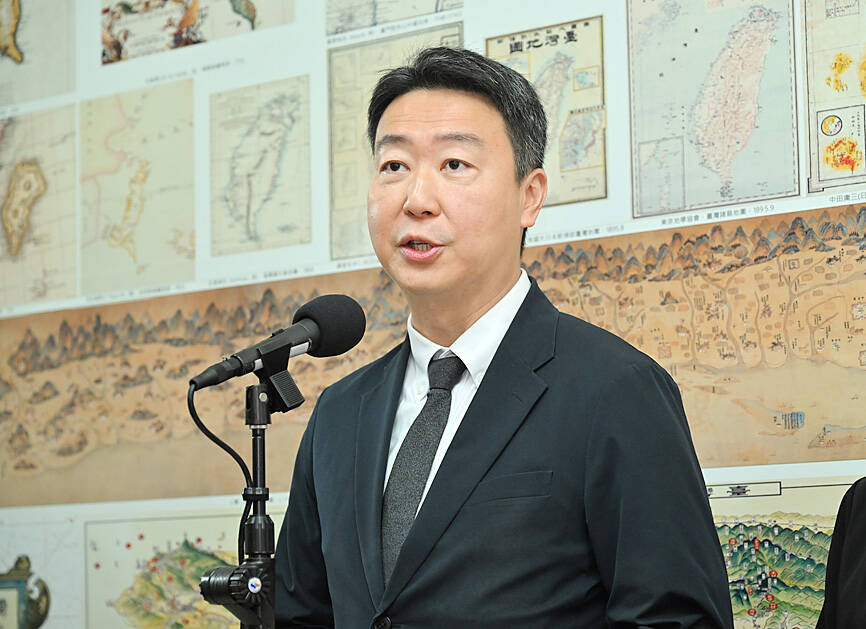
Photo: Tien Yu-hua, Taipei Times
Group tours remain banned on both sides, but Taiwan allows individual travelers to visit China freely, which shows that Taipei imposes comparatively fewer restrictions on travelers, Chen said.
Taiwan’s tourism industry has stabilized and seen steady growth over the past few years, Chen said, adding that while the nation does not intend to return to relying on Chinese tourists, it hoped cross-strait tourism could be addressed constructively.
The nation operates 10 flights to China, with a weekly capacity of about 420 flights, he said.
However, actual cross-strait flights total about 310 per week, indicating that demand remains below expectations, he said, adding that the ministry would adjust the capacity if demand increases.
An additional 13 destinations remain eligible for charter flights, but no applications have been filed, suggesting that there is sufficient capacity, Chen said.
Only about 2 percent of airlines have reduced flights due to the US-Israel conflict with Iran, Chen said, adding that measures to stabilize domestic airfares have helped shield travelers and operators.
In other news, Taiwan from Monday to today participated in the Seatrade Cruise Global exhibition in Miami, promoting combined air-and-cruise tourism packages.
Tourism Administration International Affairs Division Secretary Su You-hsuan (蘇佑萱) said Taiwan’s location, the about 180 direct flights between Taiwan and the US, and the development of maritime ports make the nation well-positioned as a regional cruise hub.
To attract cruise operators, Taiwan offers subsidies of up to US$15,000 for vessels docking for at least 12 hours, while ships with shorter stays remain eligible for up to US$7,500, she said.
Separately, the Tourism Administration on Tuesday launched a talent development program aimed at helping the industry reach its 2030 output target of NT$1 trillion (US$31.60 billion).
Sixty senior professionals from travel, hospitality and leisure sectors would be selected for study visits to Japan and Thailand, as part of a push to bolster industry competitiveness through leadership training, innovation and digital transformation, the agency said.
The talent development program centers on “sustainability and digital innovation,” it said.
Program participants would explore sustainable practices and digital transformation during the overseas study tours, the agency said.
Mid-level courses, held nationwide, would include broader tourism-related sectors, emphasizing cross-industry collaboration, storytelling marketing, hospitality design and artificial intelligence applications, the agency said.
Since its launch in 2015, the program has trained more than 5,000 mid to senior-level professionals, supporting long-term industry resilience and growth, it added.

FUKUOKA SITUATION: Japanese media reported that the pathogen is expected to be identified by the summer, while the CDC downplayed the idea that it was hMPV A “mysterious cold-like illness” reported in Japan’s Fukuoka Prefecture does not seem to be a new disease, but Japanese authorities have been asked about the situation, the Centers for Disease Control (CDC) said yesterday. The Fukuoka Prefectural Medical Association on Wednesday told a news conference that a “mystery cold” that has become a hot topic on social media is “highly likely to be caused by some kind of viral infection,” Japan’s KBC News reported. “Many people are experiencing symptoms starting with a sore throat, followed by a runny nose, phlegm and a severe cough,” KBC News reported, citing association officials. Health authorities are

Nvidia Corp CEO Jensen Huang (黃仁勳) arrived in Taiwan yesterday ahead of upcoming AI and technology events, saying he plans to meet with clients and Taiwan Semiconductor Manufacturing Co Chairman C.C. Wei (魏哲家) during his visit. After landing at Taipei Songshan Airport, Huang posed for photos with fans and handed out Yakult drinks to reporters and supporters waiting at the scene, saying he has “a lot to do” during the trip. Asked about reports that Nvidia’s planned headquarters site in Taipei’s Beitou Shilin Technology Park could break ground on May 27, Huang said that if the company holds an event, he would

Carrefour Taiwan is to begin using a new name from the start of July, but it cannot divulge the name until then, the chairman of the supermarket chain's parent company said today. President Chain Store Co chairman Lo Chih-hsien (羅智先) was asked by reporters after a shareholders' meeting to confirm whether the company has settled on a new name for the supermarket brand. In March, the government-registered name of two Carrefour Taiwan branches was quietly changed to "Le Chia Kang" (樂家康) in Chinese, raising speculation that has been selected as the name. Lo said that because of local regulations and contractual obligations, the

The Philippines would likely be involved in any conflict over Taiwan due to its proximity to the democracy claimed by China, President Ferdinand Marcos Jr said, reiterating a stance that risks angering Beijing. “In the Philippines, we do not have a choice because Taiwan is so close to the Philippines and we have almost 200,000 Filipino nationals living and working in Taiwan,” Marcos said in an interview with Japanese media in Manila on Monday. The Philippine leader’s comments come ahead of a state visit to Japan next week, where he is to meet with Japanese Prime Minister Sanae Takaichi to discuss security


 RSS
RSS