


Taiwanese scientists have linked abnormalities in the olfactory region of mouse brains with behaviors connected to autism spectrum disorder, using a novel artificial intelligence (AI)-based brain mapping technology.
Academic Sinica Institute of Molecular Biology distinguished research fellow Hsueh Yi-Ping (薛一蘋) and Institute of Information Science associate research fellow Wang Chien-yao (王建堯) collaborated in the study, the National Science and Technology Council said in a statement yesterday.
Wang’s team developed a new brain mapping system to image the highly complex “whole-of-brain” neural circuits in mice, which took seven years to complete, the council said.
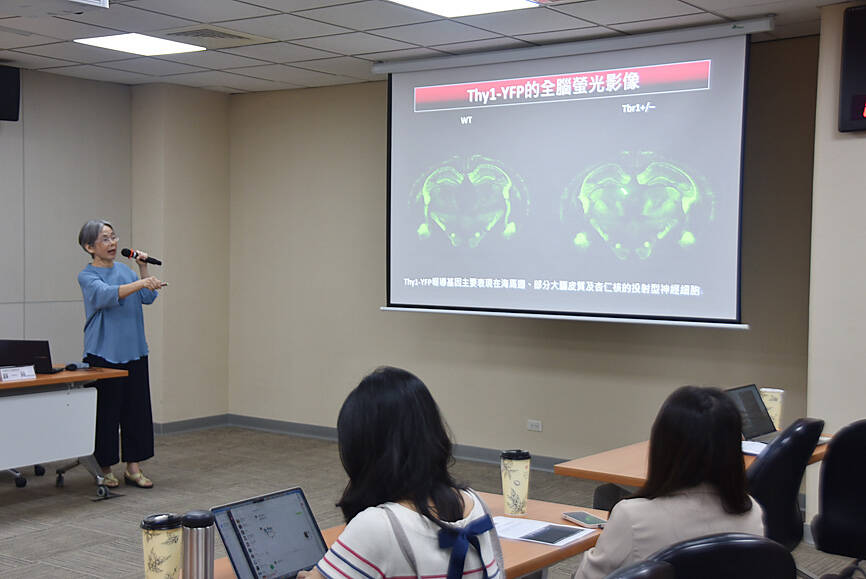
Photo: Wu Po-hsuan, Taipei Times
Hsueh and her team assisted in developing the AI tool by providing raw data based on whole-brain fluorescence imaging, it said.
The joint team incorporated manually collected data accumulated over five years and introduced AI deep learning technology to create the automated brain region identification system, yielding rapid and precise analysis of more than 500 brain regions in mice, it said.
Enabled by the AI tool, Hsueh’s team was able to stimulate three representative autism mouse models, and matched them against data on normal mouse brains drawn from the Allen Institute for Brain Science in the US, the council said.
The researchers discovered that mice fitting the autism model share a common pathology, which is a significant reduction in specific projection neurons in their olfactory cortex, and experiments proved that the mice can detect odors, but cannot tell them apart, it said.
When wild mice were injected with chemicals that inhibited the olfactory cortex functions, they exhibited the same reduced social interactions typical of “autistic” mice, the council said.
In addition, the research team found that autism mouse models have weakened connectivity between brain regions, as stimuli in the olfactory cortex elicited a weaker-than-normal response in other parts of the brain, it said.
This showed that olfactory cortex abnormalities not only affect the sense of smell, but also the information transmission and connectivity between it and other brain regions, opening new avenues of research for neuroscience, the council said.
The study underscored the importance of the olfactory cortex to research in autism spectrum disorders, and proved the brain mapping system’s potential for overcoming bottlenecks in traditional whole-brain image processing, it said.
The National Science and Technology Council and Academia Sinica jointly funded the research project, the council said.
The study suggests olfactory-based sensory therapy might have a place alongside tactile and sensory stimulation utilized for helping people with autism manage their condition, Hsueh said.
The research was published in Nature’s Molecular Psychiatry journal in November last year.
Additional reporting by CNA

NATIONAL SECURITY: Authorities are working to confirm the identities of the military personnel involved and investigating possible illegal conduct and regulatory violations Authorities are probing possible national security implications after Kinmen police and immigration officers on Sunday found a Chinese woman allegedly posing as a tourist while engaging in prostitution involving more than 10 military personnel. The woman, surnamed Chen (陳), has since been deported, authorities said, adding that investigators are still working to confirm the identities of those implicated, as the records only listed code names and aliases. The case stemmed from a report received by the Kinmen District Prosecutors’ Office on Friday last week from the Jinhu Precinct of the Kinmen County Police Bureau. On Sunday, police, along with the National Immigration

GLOBALGIVING: ‘ Caving to external pressure is not acceptable for an organization that has cultivated justice reform and human rights for 30 years,’ one NGO said A slew of non-government organizations (NGOs) have withdrawn from the GlobalGiving fundraising platform after it announced it would use “Chinese Taipei” instead of “Taiwan” from next month. The Taiwan Good Rice Association wrote on Facebook on Friday that it was informed on April 28 via a teleconference call of the change, which was made because the platform wanted to operate in China. Taiwan Good Rice is to terminate all cooperative relationships with GlobalGiving in response to the platform’s “unilateral and non-negotiable” decision to remove references to Taiwan, the NGO said. “Taiwan is in the official name of Taiwan Good Rice Association and the
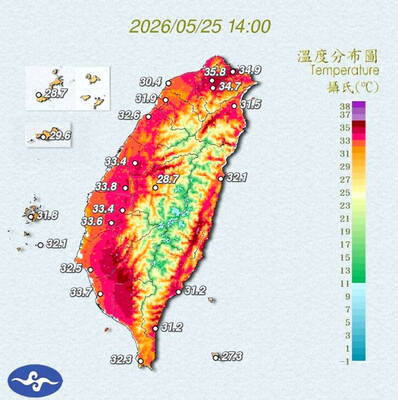
STAY COOL: The HPA recommended that people stay hydrated, use air-conditioning or fans while indoors, wear loose-fitting clothes and walk in the shade while outdoors Employers must implement measures such as installing cooling equipment, and providing drinking water and rest breaks for outdoor workers starting from Monday next week, the Taipei Department of Labor said on Sunday. Employers who fail to comply could face fines of NT$30,000 to NT$300,000 under the Occupational Safety and Health Act (職業安全衛生法), the department said. Businesses in Taipei employing fewer than 100 workers, as well as registered self-employed workers with labor insurance coverage, could receive on-site assessments and guidance from occupational safety consultants to help them apply for central government subsidies to implement or improve heat-protection measures, it said. Under the Ministry of

Chinese Nationalist Party (KMT) Chairwoman Cheng Li-wun (鄭麗文) yesterday briefed her party’s Central Standing Committee regarding her scheduled visit to the US between Monday next week and June 16, saying that her purpose would be to persuade the US that the Republic of China (ROC) Constitution was a “one China” constitution that would foster stable and peaceful cross-strait relations. The ROC Constitution is the most important defense for all Taiwanese citizens, as it upholds our democracy and has contributed to our robust economy, which aligns with international and US interests, she said. “We would not be troublemakers and drag the US under,”


 RSS
RSS