


The High Court today sentenced six active and retired military personnel to four-and-a-half to eight-and-a-half years in prison for espionage and collecting sensitive military information for China.
The ruling can be appealed. The High Prosecutors’ Office said it would consider appealing after receiving the judgement.
The court ruled that Wang Wen-hao (王文豪), Tan Chun-ming (譚俊明), Lu Fang-chi (呂芳契), Chiu Han-lin (邱翰林) and Yang Chien-hui (楊千慧) had contravened Article 7, Paragraph 1 of the National Security Act (國家安全法) by developing an organization for China.
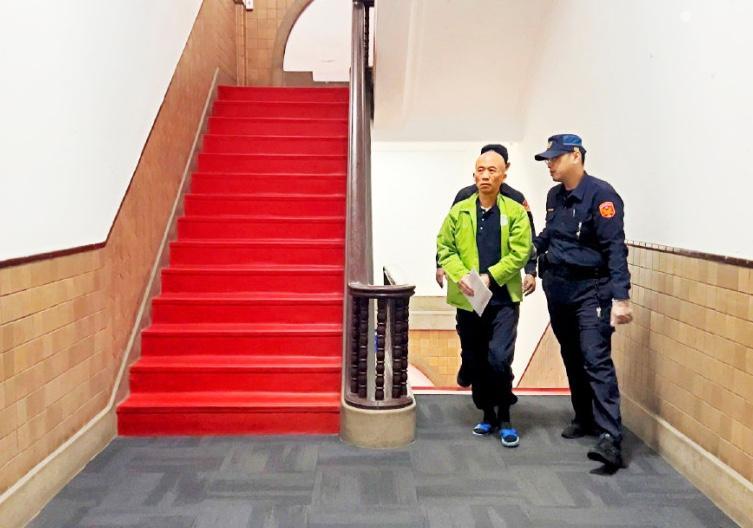
Photo: Chang Wen-chuan, Taipei Times
In addition, it ruled that Yang Po-chih (楊博智) contravened the Criminal Code of the Armed Forces (陸海空軍刑法) by leaking classified information.
The six defendants were sentenced to prison terms ranging from four years and six months to eight years and six months. Illegal gains ranging from NT$80,000 to NT$500,000 (US$2,531 to US$15,818) were confiscated.
The case was opened in 2024 when the Investigation Bureau’s Taipei branch suspected that Hong Kong national Ding Xiaohu (丁小琥) was developing organizations in Taiwan for China and collecting classified information.
The Political Warfare Bureau also found Yang Po-chih’s activities suspicious, gathered evidence and reported it to national security authorities, directing the High Prosecutors’ Office and Taipei District Prosecutors’ Office to investigate.
The investigation found that Ding was instructed by China’s Political Work Department of the Central Military Commission and entered Taiwan multiple times on business and tourist visas to develop an espionage network.
He first recruited retired military officers including Wang, Tan, Chang Chih-wei (張志煒) and Ho Sheng-ying (何聖影), and then used their connections to recruit active and retired personnel, including Lu, Chiu, Yang Chien-hui and Yang Po-chih, investigators said.
In addition to collecting classified information, Ding attempted to influence active-duty military personnel to adopt a passive, non-resistant stance in the event of cross-strait conflict, they said.
Ding and Chang arranged funding for these activities, instructing Chen Chun-an (陳俊安) to funnel more than NT$11.12 million to support the organization, they added.
The High Prosecutors’ Office in November last year indicted Ding and the six people sentenced today for contravening the National Security Act, transferring the case to the High Court for trial.
The court determined that the seven defendants were strongly suspected of contravening the National Security Act and that they were a flight risk, ruling that all seven be detained.
Ding was later granted medical parole due to illness and passed away in February, with the court later ruling not to continue the prosecution.
Yang Po-chih was deemed not to require continued detention, and was released on bail on April 1 and placed under electronic monitoring.
The other five remain in detention.
The Taipei District Prosecutors’ Office in November last year indicted Ding, Wang and Chen for contravening the Banking Act (銀行法) and Money Laundering Control Act (洗錢防制法).
The Taipei District Court ruled not to continue prosecuting Ding following his death, while continuing to prosecute the other two defendants.
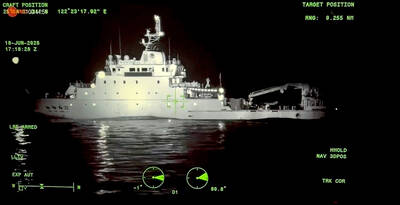
EXCUSES: Beijing is using government and research vessels as a pretext to harass the nation and enter its EEZ, and engage in ‘hegemonic expansion,’ the coast guard said The Coast Guard Administration yesterday said it drove away Chinese oceanographic research vessel Xiang Yang Hong 22 (向陽紅33) from restricted waters after warning it that it was in Taiwan’s exclusive economic zone (EEZ). The Chinese vessel entered restricted waters off the coast of Yilan County’s Suao (蘇澳) at 11:35pm on Thursday, the coast guard said, adding that it dispatched the Lanyu patrol vessel and the boat PP-10077 to shadow the Chinese ship and issue radio warnings ordering it to leave. China has no sovereignty over waters off Taiwan’s east coast, Lanyu’s crew told Xiang Yang Hong 22 over the radio, and demanded

BAIT AND SWITCH: Allowing KMT-run counties to sell to China while the threat of abrupt cancelations hangs overhead is another form of coercion, officials said Beijing is using agricultural purchase offers announced during the Straits Forum to deepen Taiwan’s dependence on the Chinese market, a Taiwanese official said yesterday as they criticized the Taitung County commissioner’s participation in the initiative. During the Straits Forum held in Xiamen on Saturday, Chinese officials announced a sales and purchase agreement for agricultural products from some counties led by the Chinese Nationalist Party (KMT). Taitung County Commissioner Yao Ching-ling (饒慶鈴), who was barred from attending the event in person by the Mainland Affairs Council, participated via video. Under the agreement, China would purchase atemoyas, pomeloes, tea and grouper harvested in Taitung,

SHIFTING FIRE: While the tempo of purely military exercises around Taiwan has gone down somewhat, Beijing is working to isolate Lai diplomatically from support abroad Chinese President Xi Jinping (習近平) is shifting tactics in his campaign to pressure Taiwan, ramping up diplomatic isolation of the nation while dialing down provocative displays of military aggression. Taiwan recorded a daily average of five Chinese military aircraft crossing the Taiwan Strait’s buffer line with China through May this year — half the number logged in the same period last year. In March, Beijing did not send a single fighter jet near Taiwan for seven days, the longest absence on record outside of typhoon season. In comparison, China sent 153 planes near Taiwan during one day at its peak in
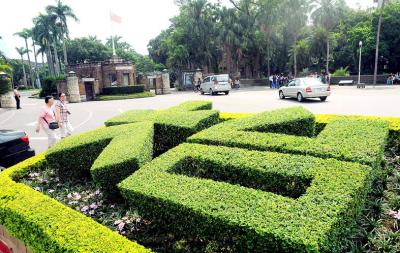
Four Taiwanese universities have been ranked among the world's top 200 institutions in the Quacquarelli Symonds (QS) World University Rankings for next year, the highest Taiwan has ever placed in the category, with National Taiwan University (NTU) achieving its best performance at 54th globally and 17th in Asia. The four Taiwanese institutions in the global top 200 are NTU (54th), National Tsing Hua University (142nd), National Yang Ming Chiao Tung University (177th) and National Cheng Kung University (191st), the rankings showed. All four universities achieved their highest-ever global rankings this year, QS data showed. National Cheng Kung University entered the top 200 for


 RSS
RSS