


The government could help offset the economic impact of the ongoing conflict in the Middle East by passing a special relief budget of about NT$130 billion (US$4.09 billion), Directorate-General of Budget, Accounting and Statistics (DGBAS) Minister Chen Shu-tzu (陳淑姿) said today.
The Legislative Yuan’s Finance Committee invited agencies to report on the medium to long-term impacts of the Middle East conflict on energy, prices, livelihoods, medical supplies and markets.
It also requested a review of the implementation of special budgets to strengthen economic, social and national resilience in response to wider international challenges.

Photo: Fang Pin-chao, Taipei Times
Democratic Progressive Party Legislator Lee Kun-cheng (李坤城) said that the government previously reacted to the fallout of US President Donald Trump’s tariff policies with the Special Act for Strengthening Economic, Social and National Security Resilience in Response to International Circumstances (因應國際情勢強化經濟社會及民生國安韌性特別條例).
The NT$570 billion relief budget included universal cash handouts of NT$10,000, plus funds to support industry.
As the conflict in the Middle East has impacted various sectors and industries across Taiwan, ministries have rolled out support measures including tax reductions, price freezes and subsidies, all of which require funding, Lee said.
While the existing special act includes NT$25.3 billion in reserved flexible funds, they cannot cover these expenses without amendments to the act and additional budgeting, Chen said.
Current budgets are far from sufficient, constrained by the fact that this year’s central government budget has yet to be passed, Chen added.
Chinese Nationalist Party (KMT) Legislator Lo Ming-tsai (羅明才) asked whether it would be possible to allocate an NT$10,000-per-person fuel subsidy.
As with the previous NT$10,000 cash handout, it would require about NT$236 billion and could boost GDP by 0.415 percent, Chen said.
However, the government’s current approach is to first freeze oil prices to avoid generating additional fiscal expenditures, she added.

More than half of the bamboo vipers captured in Tainan in the past few years were found in the city’s Sinhua District (新化), while other districts had smaller catches or none at all. Every year, Tainan captures about 6,000 snakes which have made their way into people’s homes. Of the six major venomous snakes in Taiwan, the cobra, the many-banded krait, the brown-spotted pit viper and the bamboo viper are the most frequently captured. The high concentration of bamboo vipers captured in Sinhua District is puzzling. Tainan Agriculture Bureau Forestry and Nature Conservation Division head Chu Chien-ming (朱健明) earlier this week said that the
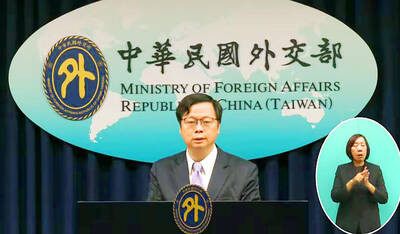
NAMING SPAT: The foreign ministry called on Denmark to propose an acceptable solution to the erroneous nationality used for Taiwanese on residence permits Taiwan has revoked some privileges for Danish diplomatic staff over a Danish permit that lists “Taiwan” as “China,” Eric Huang (黃鈞耀), head of the Ministry of Foreign Affairs’ Department of European Affairs, told a news conference in Taipei yesterday. Reporters asked Huang whether the Danish government had responded to the ministry’s request that it correct the nationality on Danish residence permits of Taiwanese, which has been listed as “China” since 2024. Taiwan’s representative office in Denmark continues to communicate with the Danish government, and the ministry has revoked some privileges previously granted to Danish representatives in Taiwan and would continue to review
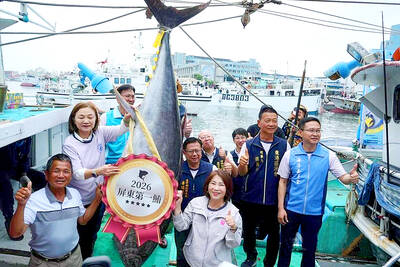
The first bluefin tuna of the season, brought to shore in Pingtung County and weighing 190kg, was yesterday auctioned for NT$10,600 (US$333.5) per kilogram, setting a record high for the local market. The auction was held at the fish market in Donggang Fishing Harbor, where the Siaoliouciou Island-registered fishing vessel Fu Yu Ching No. 2 delivered the “Pingtung First Tuna” it had caught for bidding. Bidding was intense, and the tuna was ultimately jointly purchased by a local restaurant and a local company for NT$10,600 per kilogram — NT$300 ,more than last year — for a total of NT$2.014 million. The 67-year-old skipper
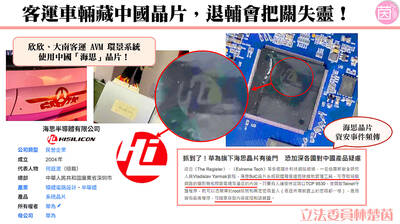
BREACH OF CONTRACT: The bus operators would seek compensation and have demanded that the manufacturer replace the chips with ones that meet regulations Two bus operators found to be using buses with China-made chips are to demand that the original manufacturers replace the systems and provide compensation for breach of contract, the Veterans Affairs Council said yesterday. Democratic Progressive Party Legislator Michelle Lin (林楚茵) yesterday said that Da Nan Bus Co and Shin-Shin Bus Co Ltd have fielded a total of 82 buses that are using Chinese chips. The bus models were made by Tron-E, while the systems provider was CYE Electronics, Lin said. Lin alleged that the buses were using chips manufactured by Huawei subsidiary HiSilicon Co, which presents a national security risk if the


 RSS
RSS