


New Taipei City’s Animal Protection and Health Inspection Office yesterday marked World Hamster Day by advocating for proper care of the pet rodents.
Recently in New Taipei City’s Yingge District (鶯歌), a hamster required veterinary treatment after it accidently ingested a foreign object, the office said.
The hamster was unable to open its eyes and was breathing weakly, and vets found it had an object stuck in its intestines, it said.
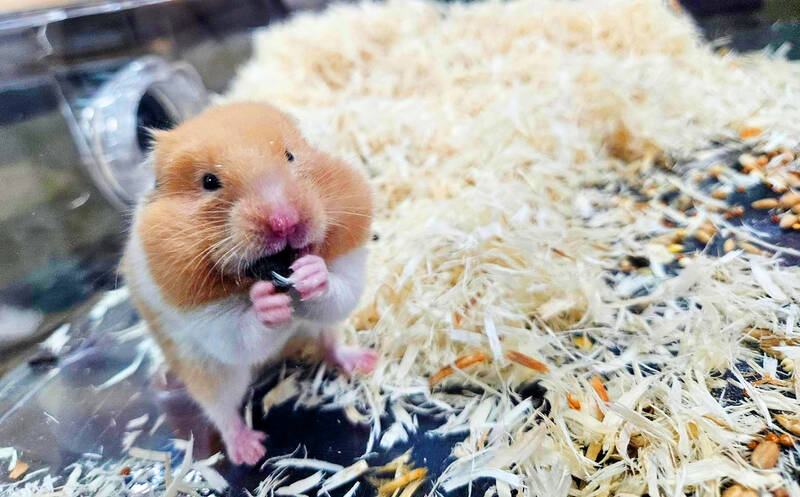
Photo courtesy of the New Taipei City’s Animal Protection and Health Inspection Office
After receiving treatment, the hamster recovered and was put up for adoption, it added.
According to the office, hamsters have an average lifespan of two to three years and are nocturnal omnivores, with a diet consisting mainly of grains, as well as vegetables, fruits and protein.
Hamster owners should follow five key principles, the office said.
First, provide each hamster with an enclosure of at least 60cm by 40cm, as hamsters might fight if kept in an enclosure together.
Second, provide enrichment such as exercise wheels inside the enclosure, as well as a safe substrate that they can dig into and create hiding spaces to reduce stress.
Third, avoid washing hamsters with water to prevent hypothermia and other risks.
Fourth, ensure hamsters maintain a healthy diet and do not ingest unknown foods or objects.
Fifth, regularly check enclosures are secure, as hamsters might chew the cage and attempt to escape.
Hamsters are strictly prohibited from going outdoors alone, with contraventions subject to fines of up to NT$15,000, the office added.
New Taipei City has launched a program to incentivize people to register pets that are not dogs or cats.
Until the end of this year, the first 500 people who register birds, rabbits, snakes, turtles or rodents and download the “New Taipei Life” app would receive NT$300 in New Taipei City vouchers, which can be used at the four major convenience stores, the office said.
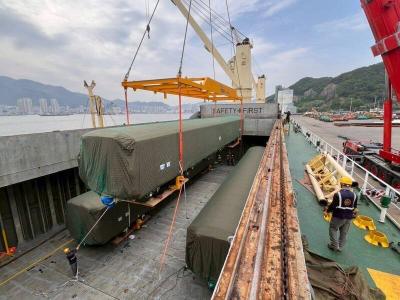
The first of 10 new high-capacity trains purchased from South Korea’s Hyundai Rotem arrived at the Port of Taipei yesterday to meet the demands of an expanding metro network, Taipei Rapid Transit Corp (TRTC) said yesterday. The train completed a three-day, 1,200km voyage from the Port of Masan in South Korea, the company said. Costing NT$590 million (US$18.79 million) each, the new six-carriage trains feature a redesigned interior based on "human-centric" transportation concepts, TRTC said. The design utilizes continuous longitudinal seating to widen the aisles and optimize passenger flow, while also upgrading passenger information displays and driving control systems for a more comfortable

Instead of focusing solely on the threat of a full-scale military invasion, the US and its allies must prepare for a potential Chinese “quarantine” of Taiwan enforced through customs inspections, Stanford University Hoover fellow Eyck Freymann said in a Foreign Affairs article published on Wednesday. China could use various “gray zone” tactics in “reconfiguring the regional and ultimately the global economic order without a war,” said Freymann, who is also a nonresident research fellow at the US Naval War College. China might seize control of Taiwan’s links to the outside world by requiring all flights and ships entering or leaving Taiwan
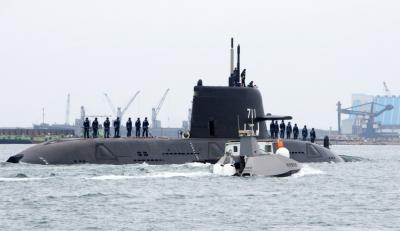
Taiwan's first indigenous defense submarine, the SS-711 Hai Kun (海鯤, or Narwhal), departed for its 13th sea trial at 7am today, marking its seventh submerged test, with delivery to the navy scheduled for July. The outing also marked its first sea deployment since President William Lai (賴清德) boarded the submarine for an inspection on March 19, drawing a crowd of military enthusiasts who gathered to show support. The submarine this morning departed port accompanied by CSBC Corp’s Endeavor Manta (奮進魔鬼魚號) uncrewed surface vessel and a navy M109 assault boat. Amid public interest in key milestones such as torpedo-launching operations and overnight submerged trials,
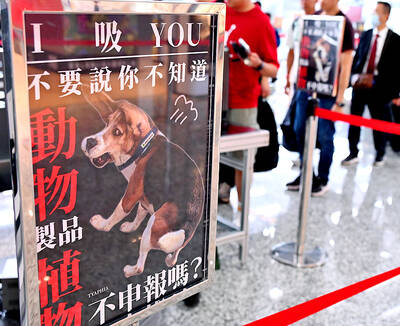
Quarantine awareness posters at Taiwan Taoyuan International Airport have gone viral for their use of wordplay. Issued by the airport branch of the Animal and Plant Health Inspection Agency, the posters feature sniffer dogs making a range of facial expressions, paired with advisory messages built around homophones. “We update the messages for holidays and campaign needs, periodically refreshing materials to attract people’s attention,” quarantine officials said. “The aim is to use the dogs’ appeal to draw focus to quarantine regulations.” A Japanese traveler visiting Taiwan has posted a photo on X of a poster showing a quarantine dog with a


 RSS
RSS