


President William Lai officially opened the National Center for AI Robotics (NCAIR) yesterday, calling it a crucial step toward Taiwan’s goal of becoming a technology-oriented island.
NCAIR, which operates under the National Institutes of Applied Research (NIAR), was created in line with the government’s “Ten AI Initiatives Promotion Plan” to give the nation a competitive edge in the global tech market.
Speaking at the opening ceremony, Lai expressed hope that the AI initiatives plan will benefit 1 million small and medium enterprises through the application of AI.
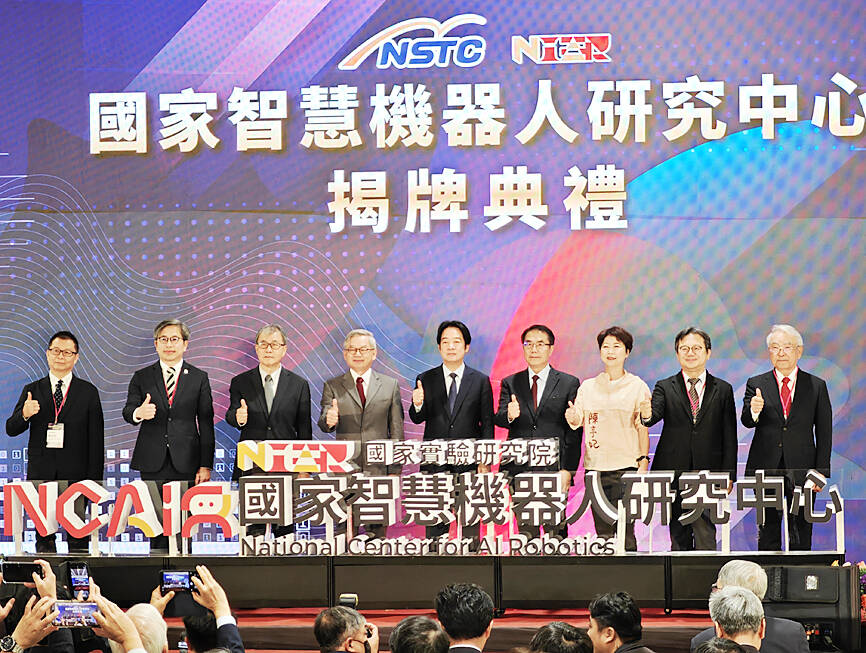
Photo: Wu Chun-feng, Taipei Times
Lai said that robots, the key development focus of NCAIR, not only represent technological advancement but also showcase a nation’s competitiveness.
As Taiwan already has a robust tech industry, such as mature chip production and precision technology development, it has a solid foundation on which to base robotics advancements, Lai added.
Lai said he expects NCAIR to become an engine for local robotics research and development, provide a platform for the nurturing of talents in the field and serve as a bridge between the tech education sector and industry.
NCAIR is located in the Shalun Green Energy Science City (SSGESC) in Tainan.
In addition to research and development into artificial intelligence and robotics, NCAIR will also focus on robot testing and training.
At the event, National Applied Research Laboratories President Tsai Hung-yin (蔡宏營) revealed that a government program promoting the local robotics industry will be launched this year, with plans to invest NT $20 billion (US$629 million) from 2026-2029.
The investment will help create at least three new robotics startups to assist with the development of smart robots and cultivate business, Tsai added.
With the global robotics industry projected to grow rapidly by 2030, Taiwan’s robotics industry will focus primarily on the areas of high-risk occupations, medicine and healthcare, as well as the food and service industry.
Such priorities reflect the global trend of aging societies and the need for service-based robots, Tsai said.
NCAIR Director Su Wen-yu (蘇文鈺) said that the center will focus on home care robots, but also seek to develop robots that can perform less popular jobs that are high-risk.

FUKUOKA SITUATION: Japanese media reported that the pathogen is expected to be identified by the summer, while the CDC downplayed the idea that it was hMPV A “mysterious cold-like illness” reported in Japan’s Fukuoka Prefecture does not seem to be a new disease, but Japanese authorities have been asked about the situation, the Centers for Disease Control (CDC) said yesterday. The Fukuoka Prefectural Medical Association on Wednesday told a news conference that a “mystery cold” that has become a hot topic on social media is “highly likely to be caused by some kind of viral infection,” Japan’s KBC News reported. “Many people are experiencing symptoms starting with a sore throat, followed by a runny nose, phlegm and a severe cough,” KBC News reported, citing association officials. Health authorities are

Nvidia Corp CEO Jensen Huang (黃仁勳) arrived in Taiwan yesterday ahead of upcoming AI and technology events, saying he plans to meet with clients and Taiwan Semiconductor Manufacturing Co Chairman C.C. Wei (魏哲家) during his visit. After landing at Taipei Songshan Airport, Huang posed for photos with fans and handed out Yakult drinks to reporters and supporters waiting at the scene, saying he has “a lot to do” during the trip. Asked about reports that Nvidia’s planned headquarters site in Taipei’s Beitou Shilin Technology Park could break ground on May 27, Huang said that if the company holds an event, he would

Carrefour Taiwan is to begin using a new name from the start of July, but it cannot divulge the name until then, the chairman of the supermarket chain's parent company said today. President Chain Store Co chairman Lo Chih-hsien (羅智先) was asked by reporters after a shareholders' meeting to confirm whether the company has settled on a new name for the supermarket brand. In March, the government-registered name of two Carrefour Taiwan branches was quietly changed to "Le Chia Kang" (樂家康) in Chinese, raising speculation that has been selected as the name. Lo said that because of local regulations and contractual obligations, the

The Philippines would likely be involved in any conflict over Taiwan due to its proximity to the democracy claimed by China, President Ferdinand Marcos Jr said, reiterating a stance that risks angering Beijing. “In the Philippines, we do not have a choice because Taiwan is so close to the Philippines and we have almost 200,000 Filipino nationals living and working in Taiwan,” Marcos said in an interview with Japanese media in Manila on Monday. The Philippine leader’s comments come ahead of a state visit to Japan next week, where he is to meet with Japanese Prime Minister Sanae Takaichi to discuss security


 RSS
RSS