


The National Atomic Research Institute (NARI) this year launched a small modular reactor (SMR) research program focusing on reactors that could cut high-level nuclear waste by more than 70 percent, with Taiwan potentially generating its first SMR power as early as 2035.
Taiwan Power Co on March 27 submitted plans to the Nuclear Safety Commission to restart the decommissioned Ma-anshan Nuclear Power Plant in Pingtung County’s Hengchun Township (恆春).
In addition to evaluating whether to restart nuclear plants, the government would continue to monitor advanced nuclear technologies, including nuclear fusion and SMRs, and would remain open to adopting them as long as conditions are met, President William Lai (賴清德) has said.
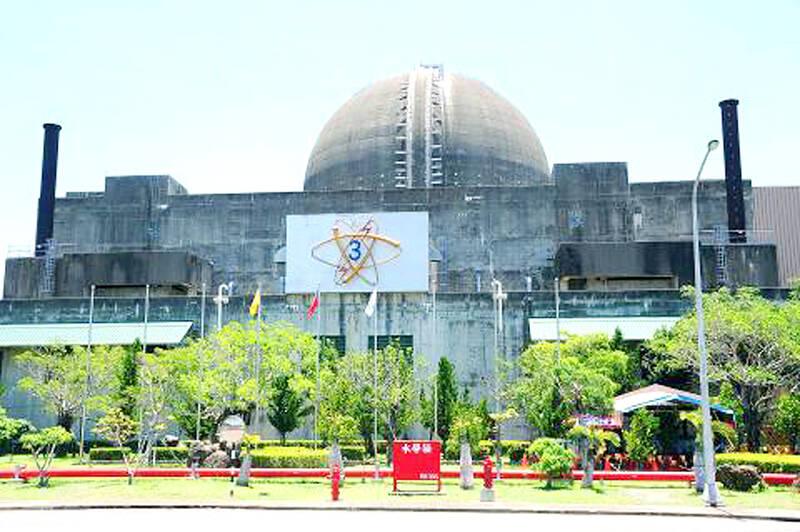
Photo: Tsai Tsung-hsien, Taipei Times
The Nuclear Safety Commission has invested in research on new nuclear energy, including low-carbon, high-energy-density SMR research led by the NARI this year, and is planning a four-year project from next year through 2030.
The four-year project would focus on SMR designs, considering safety and nuclear waste, to inform domestic policy and industries on whether to adopt the technology.
The project requires NT$1 billion (US$31.46 million) in funding and is under review by the National Science and Technology Council.
Some light-water SMRs could have commercial products by 2030 or earlier, with international companies such as Westinghouse Electric and General Electric developing them, NARI president Kao Tsu-mu (高梓木) said.
Taiwan should observe these new designs for two years for any potential safety issues and then, in 2032, evaluate whether to introduce, build or even mass-produce them domestically, Kao said.
As SMRs are smaller, can be produced under foreign licensing and take about three and a half years to build, Taiwan could generate its first SMR electricity in 2035 or 2036, he said.
Taiwan lacks the ability to design core nuclear systems, but if foreign SMR suppliers provided licenses and design blueprints, domestic manufacturers could produce some SMR components, the NARI said.
In addition to licensing negotiations, strict certification and verification would be required before approved equipment can be manufactured and used in SMR power plants, the institute said.
The NARI is researching three kinds of reactors: accelerator driven subcritical reactors (ADS), sodium-cooled fast reactors and thorium molten salt reactors, it said.
These three technologies could reduce high-level radioactive waste by more than 70 percent, shorten storage durations and mitigate the environmental and social effects of nuclear waste, it added.
ADS reactors could shorten the final disposal period of nuclear waste from hundreds of thousands of years to a few hundred to 1,000 years, a solution more in line with social expectations, the institute said.
ADS reactors are designed to reduce high-level nuclear waste, with an estimated cost of about US$2 billion and could be commercially operational within 10 years, it said.
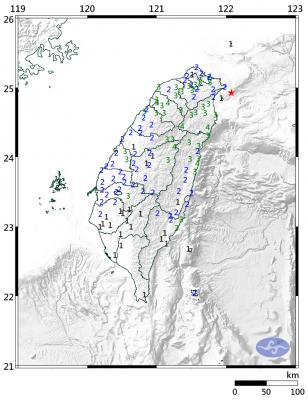
A magnitude 6.1 earthquake struck off the coast of Yilan County at 8:39pm tonight, the Central Weather Administration (CWA) said, with no immediate reports of damage or injuries. The epicenter was 38.7km east-northeast of Yilan County Hall at a focal depth of 98.3km, the CWA’s Seismological Center said. The quake’s maximum intensity, which gauges the actual physical effect of a seismic event, was a level 4 on Taiwan’s 7-tier intensity scale, the center said. That intensity level was recorded in Yilan County’s Nanao Township (南澳), Hsinchu County’s Guansi Township (關西), Nantou County’s Hehuanshan (合歡山) and Hualien County’s Yanliao (鹽寮). An intensity of 3 was
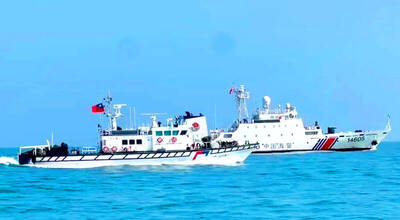
Instead of focusing solely on the threat of a full-scale military invasion, the US and its allies must prepare for a potential Chinese “quarantine” of Taiwan enforced through customs inspections, Stanford University Hoover fellow Eyck Freymann said in a Foreign Affairs article published on Wednesday. China could use various “gray zone” tactics in “reconfiguring the regional and ultimately the global economic order without a war,” said Freymann, who is also a nonresident research fellow at the US Naval War College. China might seize control of Taiwan’s links to the outside world by requiring all flights and ships entering or leaving Taiwan
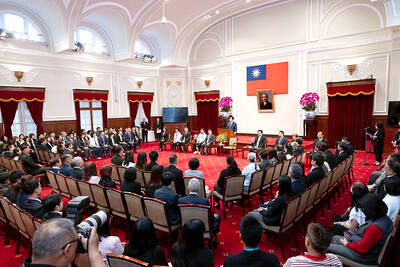
The next minimum wage hike is expected to exceed NT$30,000, President William Lai (賴清德) said yesterday during an award ceremony honoring “model workers,” including migrant workers, at the Presidential Office ahead of Workers’ Day today. Lai said he wished to thank the awardees on behalf of the nation and extend his most sincere respect for their hard work, on which Taiwan’s prosperity has been built. Lai specifically thanked 10 migrant workers selected for the award, saying that although they left their home countries to further their own goals, their efforts have benefited Taiwan as well. The nation’s industrial sector and small businesses lay
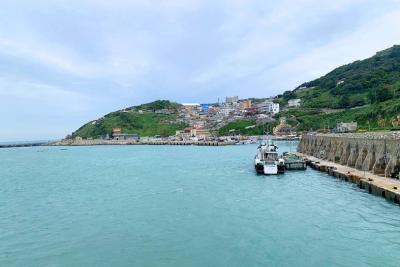
Taiwan has activated backup communications for its northernmost territory, the remote and strategically located island of Dongyin (東引), after poor weather conditions apparently shifted the wreckage of a ship onto an undersea cable causing it to break. The vulnerability of undersea communication cables linking Taiwan with its outlying islands has been a persistent cause of concern for Taipei, whose government has on several occasions blamed Chinese ships for intentionally causing damage. Dongyin, home to about 1,500 people, sits in a strategic position at the top of the Taiwan Strait and the island has a heavy military presence. It does not have an


 RSS
RSS