


Chinese Nationalist Party (KMT) Chairwoman Cheng Li-wun’s (鄭麗文) comments in China have harmed the nation’s legitimacy, government officials and Democratic Progressive Party (DPP) lawmakers said yesterday, as the opposition leader visited the Sun Yat-sen Mausoleum in Nanjing amid fanfare.
Cheng is expected to meet with Chinese President Xi Jinping (習近平) later in her scheduled six-day trip to China, with Taiwan’s special defense budget and government funding hanging in legislative limbo.
DPP caucus chief executive Chuang Jui-hsiung (莊瑞雄) told a news conference at the legislature in Taipei that the KMT has no right to decide the nation’s future behind closed doors with the Chinese Communist Party (CCP).
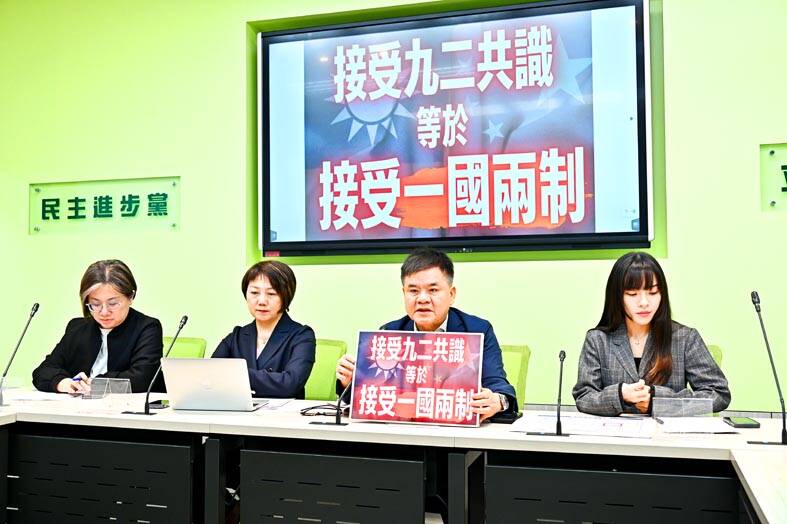
Photo: Tu Chien-jung, Taipei Times
Cheng’s praise for the so-called “1992 consensus” as an enduring document facilitated Beijing’s narrative, as the agreement allegedly reached by the KMT and the CCP is part of China’s blueprint for annexing Taiwan, he said.
The so-called “1992 consensus” — a term that former Mainland Affairs Council chairman Su Chi (蘇起) in 2006 admitted making up in 2000 — refers to a tacit understanding between the KMT and the CCP that both sides of the Taiwan Strait acknowledge that there is “one China,” with each side having its own interpretation of what “China” means.
Chuang said the opposition leader has claimed to represent the majority of Taiwanese, but the latest National Chengchi University poll showed that only 2.5 percent of the public identify themselves as Chinese and 62 percent identified as Taiwanese.
Taiwan’s only path to survival is to fight for its democracy, not relying on a politician who bailed out to her party’s ideological opposite, the totalitarian regime in Beijing, he said.
Citing a Mainland Affairs Council survey, DPP Legislator Fan Yun (范雲) said that 81 percent of Taiwanese are opposed to China’s “one country, two systems” formula for “unifying” Taiwan, and 70 percent want the KMT to pass the government’s special defense budget.
Separately, the Mainland Affairs Council said that Cheng’s homage at Sun’s tomb played into China’s propaganda campaign aimed at negating the legitimacy of the Republic of China (ROC).
The CCP has long portrayed Sun as a forebear to the communist revolution with itself as his legitimate heir, without recognizing the KMT or the ROC, the council said.
“Cheng’s furtive references to the ROC served to only placate a domestic audience in Taiwan and went entirely unnoticed by Chinese media,” it said.
Seperately National Security Bureau Director-General Tsai Ming-yen (蔡明彥) said that the bureau is not at liberty to comment on the activities of political parties, but called attention to China’s “united front” strategy.
Beijing’s main strategy for undermining Taiwan is to use “gray zone” tactics — such as surrounding the nation with jets and warships, and making threatening remarks — to scare Taiwanese into believing that war is imminent, he said.
Simultaneously, China uses cross-strait exchanges with specific people and groups as a pretext to sow division in Taiwan, with the goal of making Taiwanese accept a peace dictated by Beijing, Tsai said.
These targeted exchanges are choreographed to yield certain benefits to promote pro-Beijing political factions and weaken Taiwan, he said.

The Ministry of Finance this afternoon announced the winning numbers for the March-April uniform invoice lottery. The winning number for the NT$10 million (US$318,060) special prize is 19531471, and the winning number for the NT$2 million grand prize is 85941329. Three numbers were drawn for the NT$200,000 first prize: 07225810, 20231230 and 83518781. Those with receipts matching the last seven digits of any of the first-prize numbers will win the NT$40,000 second prize, while those matching the last six digits will win the NT$10,000 third prize. Those whose receipts match the last five digits of the first-prize numbers can claim the NT$4,000 fourth prize,

SIX SUBSIDIES: The monthly allowance for older farmers is to increase to NT$10,000, and NT$5,000 is to be given to homemakers under the national pension system, Lai said The government is to implement major welfare policies for disadvantaged groups, including raising the monthly allowance for older farmers to NT$10,000 and providing homemakers with NT$5,000 per month, President William Lai (賴清德) said yesterday. Lai made the remarks during a visit to Wangling Temple in Chiayi County, saying that the planned increases were being introduced amid economic growth and an increase in tax revenue. Touting a policy, in which the government plans to provide a monthly allowance of NT$5,000 for every child under the age of 18 in a bid to address Taiwan’s low birthrate, Lai said that if received for the
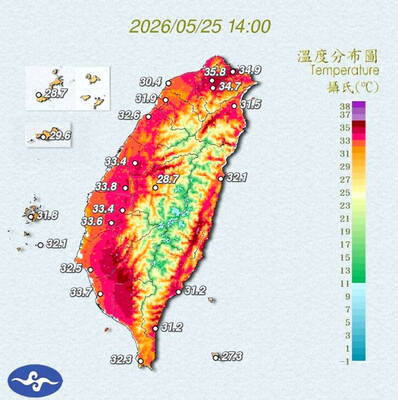
STAY COOL: The HPA recommended that people stay hydrated, use air-conditioning or fans while indoors, wear loose-fitting clothes and walk in the shade while outdoors Employers must implement measures such as installing cooling equipment, and providing drinking water and rest breaks for outdoor workers starting from Monday next week, the Taipei Department of Labor said on Sunday. Employers who fail to comply could face fines of NT$30,000 to NT$300,000 under the Occupational Safety and Health Act (職業安全衛生法), the department said. Businesses in Taipei employing fewer than 100 workers, as well as registered self-employed workers with labor insurance coverage, could receive on-site assessments and guidance from occupational safety consultants to help them apply for central government subsidies to implement or improve heat-protection measures, it said. Under the Ministry of

NATIONAL SECURITY: Authorities are working to confirm the identities of the military personnel involved and investigating possible illegal conduct and regulatory violations Authorities are probing possible national security implications after Kinmen police and immigration officers on Sunday found a Chinese woman allegedly posing as a tourist while engaging in prostitution involving more than 10 military personnel. The woman, surnamed Chen (陳), has since been deported, authorities said, adding that investigators are still working to confirm the identities of those implicated, as the records only listed code names and aliases. The case stemmed from a report received by the Kinmen District Prosecutors’ Office on Friday last week from the Jinhu Precinct of the Kinmen County Police Bureau. On Sunday, police, along with the National Immigration


 RSS
RSS