


Chinese Nationalist Party (KMT) Chairwoman Cheng Li-wun (鄭麗文) yesterday pledged to channel the spirit of her party’s founder, Sun Yat-sen (孫逸仙), and seek reconciliation with China, offering praise at his tomb in China for the nation’s achievements following the communist revolution.
In a moment filled with symbolism on her first full day in China, Cheng laid a wreath at Sun’s mausoleum in Nanjing, also the capital of the KMT-led Republic of China (ROC) government before it fled to Taiwan in 1949 having lost a civil war with Mao Zedong’s (毛澤東) communists.
“The core values of Sun Yat-sen’s ideal that ‘all under heaven are equal’ have always been equality, inclusiveness and unity,” Cheng said in footage carried live on Taiwanese television channels.
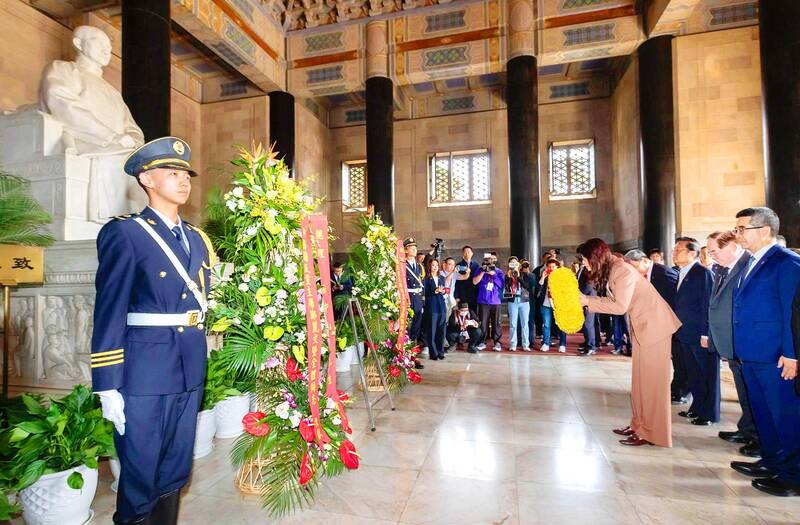
Photo: EPA / Chinese Nationalist Party
“We should work together to promote reconciliation and unity across the [Taiwan] Strait, and create regional prosperity and peace,” she said. “I hope that today we plant the seeds of peace not only for Chinese people on both sides of the Strait, but for all humankind.”
Sun, who founded the ROC in 1912, died of cancer in 1925.
He is still officially venerated in Taiwan as the founder of the ROC, but also in China by the Chinese Communist Party as a national hero.
Mao declared him the “great revolutionary forerunner.”
Cheng said that the KMT had eventually honored Sun’s founding principles, and made Taiwan into a free and democratic society, although she also mentioned the White Terror era during the 38 years of martial law until 1987.
“Likewise, on the mainland, we have also seen and witnessed progress and development that exceeded everyone’s expectations and imagination,” she said.
Security was tight for her visit.
“I think this is very important for peaceful exchanges between the two sides of the Taiwan Strait,” said student Yang Zihang, 19, who went with his classmate to see Cheng’s motorcade.
In a park surrounding the mausoleum, a 74-year-old Nanjing resident surnamed Fen said that he had come to the area after hearing of Cheng’s visit.
“I hope she will contribute to the reunification of the motherland,” he said.
Cheng says she is on a mission of peace and that while she supports defense spending, it has to be balanced with dialogue.
“The two sides of the Taiwan Strait are not doomed to war, as the international community has feared,” Cheng had said in a speech on Tuesday evening after arriving in China.
Cheng is the first KMT chair to visit China in a decade, but her trip — during which she hopes to meet with Chinese President Xi Jinping (習近平) — has sparked debate in Taiwan, and critics, including those within her own party, have accused her of being too pro-Beijing.
China severed high-level contact with Taiwan in 2016 after Tsai Ing-wen (蔡英文) of the Democratic Progressive Party was elected president.
Since then, China has been ramping up military pressure with near daily deployments of fighter jets and warships near Taiwan, and regular large-scale military drills.

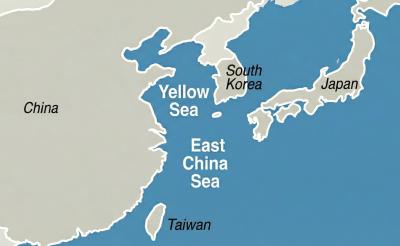
China has reserved offshore airspace in the Yellow Sea and East China Sea from March 27 to May 6, issuing alerts usually used to warn of military exercises, although no such exercises have been announced, the Wall Street Journal (WSJ) reported yesterday. Reserving such a large area for 40 days without explanation is an “unusual step,” as military exercises normally only last a few days, the paper said. These alerts, known as Notice to Air Missions (Notams), “are intended to inform pilots and aviation authorities of temporary airspace hazards or restrictions,” the article said. The airspace reserved in the alert is
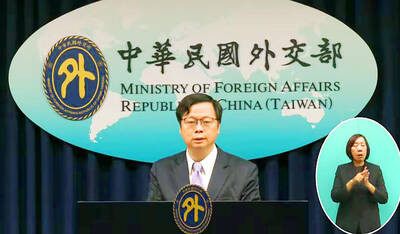
NAMING SPAT: The foreign ministry called on Denmark to propose an acceptable solution to the erroneous nationality used for Taiwanese on residence permits Taiwan has revoked some privileges for Danish diplomatic staff over a Danish permit that lists “Taiwan” as “China,” Eric Huang (黃鈞耀), head of the Ministry of Foreign Affairs’ Department of European Affairs, told a news conference in Taipei yesterday. Reporters asked Huang whether the Danish government had responded to the ministry’s request that it correct the nationality on Danish residence permits of Taiwanese, which has been listed as “China” since 2024. Taiwan’s representative office in Denmark continues to communicate with the Danish government, and the ministry has revoked some privileges previously granted to Danish representatives in Taiwan and would continue to review

More than 6,000 Taiwanese students have participated in exchange programs in China over the past two years, despite the Mainland Affairs Council’s (MAC) “orange light” travel advisory, government records showed. The MAC’s publicly available registry showed that Taiwanese college and university students who went on exchange programs across the Strait numbered 3,592 and 2,966 people respectively. The National Immigration Agency data revealed that 2,296 and 2,551 Chinese students visited Taiwan for study in the same two years. A review of the Web sites of publicly-run universities and colleges showed that Taiwanese higher education institutions continued to recruit students for Chinese educational programs without

A bipartisan group of US senators has introduced a bill to enhance cooperation with Taiwan on drone development and to reduce reliance on supply chains linked to China. The proposed Blue Skies for Taiwan Act of 2026 was introduced by Republican US senators Ted Cruz and John Curtis, and Democratic US senators Jeff Merkley and Andy Kim. The legislation seeks to ease constraints on Taiwan-US cooperation in uncrewed aerial systems (UAS), including dependence on China-sourced components, limited access to capital and regulatory barriers under US export controls, a news release issued by Cruz on Wednesday said. The bill would establish a "Blue UAS


 RSS
RSS