


Rhetoric used by Chinese President Xi Jinping (習近平) during his nine previous meetings with current, former or honorary Chinese Nationalist Party (KMT) chairpersons shows that the Chinese Communist Party (CCP) has no plan to change its policy on Taiwan, an official said today.
KMT Chairwoman Cheng Li-wun (鄭麗文) departed today on a six-day trip to China, where she is expected to meet with Xi in Beijing near the end of her visit.
In February 2013, Xi met with then-KMT honorary chairman Lien Chan (連戰), marking the first time he met with a KMT leader since becoming CCP general secretary in November 2012.
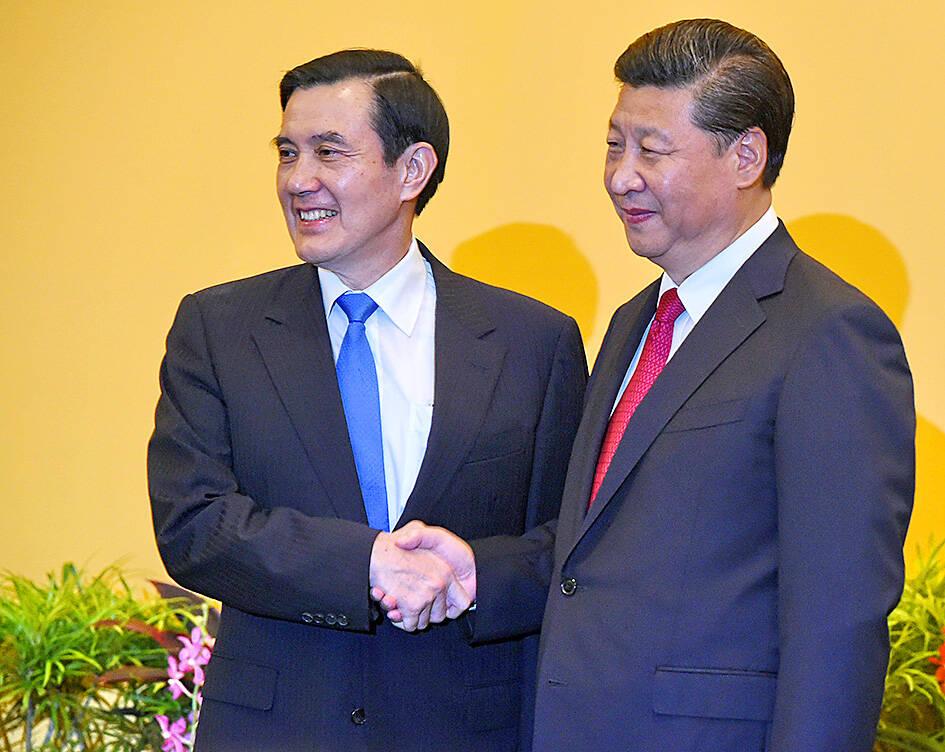
Photo: AFP
During the meeting, Xi declared the need to "promote peaceful unification," while Lien proposed "one China, cross-strait peace."
In June of the same year, Xi met with then-KMT honorary chairman Wu Poh-hsiung (吳伯雄), stating that the CCP and the KMT should adhere to the "one China" principle.
Lien held additional meetings with Xi in 2014, 2015 and 2018, and also attended a CCP military parade in Tiananmen Square in 2015 to mark the 70th anniversary of the end of the Second Sino-Japanese War.
In 2015, then-KMT chairman Eric Chu (朱立倫) met Xi in China, during which the KMT expressed hope to join the Asian Infrastructure Investment Bank based on the so-called "1992 consensus."
The “1992 consensus” refers to a tacit understanding between the KMT and CCP that both sides of the Taiwan Strait acknowledge there is “one China,” with each side having its own interpretation of what “China” means.
Former Mainland Affairs Council chairman Su Chi (蘇起) in 2006 admitted that he made up the term in 2000 to break the cross-strait deadlock and alleviate tension.
In November 2015, Xi met with then-president Ma Ying-jeou (馬英九) in Singapore, where each addressed the other with the honorific "mister," with no mention of the Republic of China (ROC).
During her meeting with Xi in 2016, then-KMT chairwoman Hung Hsiu-chu (洪秀柱) mentioned signing a cross-strait peace agreement and advocated "seeking the common ground of the ‘one China’ principle while reserving differences in its meaning."
During his second meeting with then-former president Ma in April 2024, Xi said that differences in cross-strait systems "cannot change the objective fact that both sides belong to one country and one nation."
An official familiar with the CCP's “united front” tactics said today that Xi's nine meetings with KMT leaders prove that he would not change its Taiwan policy, regardless of which KMT figure he meets.
Most Taiwanese support peace, but the CCP's goal is to eliminate the ROC and annex Taiwan, the official said on condition of anonymity.
The itinerary for Cheng’s current trip to China was entirely orchestrated by China's Taiwan Affairs Office, reducing the KMT to a “united front” tool with no parity or dignity, the official said.
The CCP is still observing Cheng's behavior, and a meeting with Xi would only be finalized if she says things that satisfy Beijing, they added.
If Cheng meets Xi, she should boldly speak the name of the ROC and demand the CCP face the reality of the ROC's existence, the official said.

Actor Darren Wang (王大陸) was sentenced to six months in prison, commutable to a fine, by the New Taipei District Court today for contravening the Personal Data Protection Act (個人資料保護法) in a case linked to an alleged draft-dodging scheme. Wang allegedly paid NT$3.6 million (US$114,380) to an illegal group to help him evade mandatory military service through falsified medical documents, prosecutors said. He transferred the funds to Chen Chih-ming (陳志明), the alleged mastermind of a draft-evasion ring, although he lost contact with him as he was already in detention on fraud charges, they said. Chen is accused of helping a

SECURITY: Starlink owner Elon Musk has taken pro-Beijing positions, and allowing pro-China companies to control Taiwan’s critical infrastructure is risky, a legislator said Starlink was reluctant to offer services in Taiwan because of the nation’s extremely high penetration rates in 4G and 5G services, the Ministry of Digital Affairs said yesterday. The ministry made the comments at a meeting of the legislature’s Transportation Committee, which reviewed amendments to Article 36 of the Telecommunications Management Act (電信管理法). Article 36 bans foreigners from holding more than 49 percent of shares in public telecommunications networks, while shares foreigners directly and indirectly hold are also capped at 60 percent of the total, unless specified otherwise by law. The amendments, sponsored by Chinese Nationalist Party (KMT) Legislator Ko
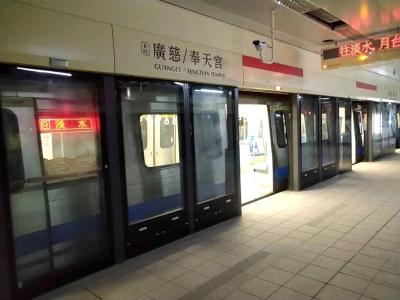
The eastern extension of the Taipei MRT Red Line could begin operations as early as late June, the Taipei Department of Rapid Transit Systems said yesterday. Taipei Rapid Transit Corp said it is considering offering one month of free rides on the new section to mark its opening. Construction progress on the 1.4km extension, which is to run from the current terminal Xiangshan Station to a new eastern terminal, Guangci/Fengtian Temple Station, was 90.6 percent complete by the end of last month, the department said in a report to the Taipei City Council's Transportation Committee. While construction began in October 2016 with an
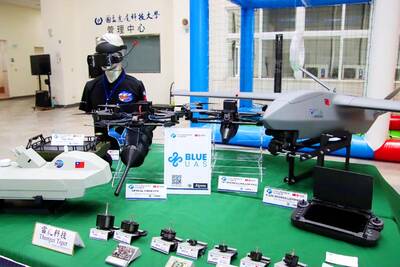
NON-RED SUPPLY: Boosting the nation’s drone industry is becoming increasingly urgent as China’s UAV dominance could become an issue in a crisis, an analyst said Taiwan’s drone exports to Europe grew 41.7-fold from 2024 to last year, with demand from Ukraine’s fight against Russian aggression the most likely driver of growth, a study showed. The Institute for Democracy, Society and Emerging Technology (DSET) in a statement on Wednesday said it found that many of Taiwan’s uncrewed aerial vehicle (UAV) sales were from Poland and the Czech Republic. These countries likely transferred the drones to Ukraine to aid it in its fight against the Russian invasion that started in 2022, it said. Despite the gains, Taiwan is not the dominant drone exporter to these markets, ranking second and fourth


 RSS
RSS