


Taiwan is to increase monthly plastic bag production equivalent to 1.25 billion 600ml bags to address a shortage, the Executive Yuan said yesterday.
A special project would supply ethylene to Formosa Plastics for producing affordable polyethylene, it said.
As instability in the Middle East impacted energy supplies, a “plastic bag crisis” has occurred in Taiwan in the past few weeks, sparking public frustration.
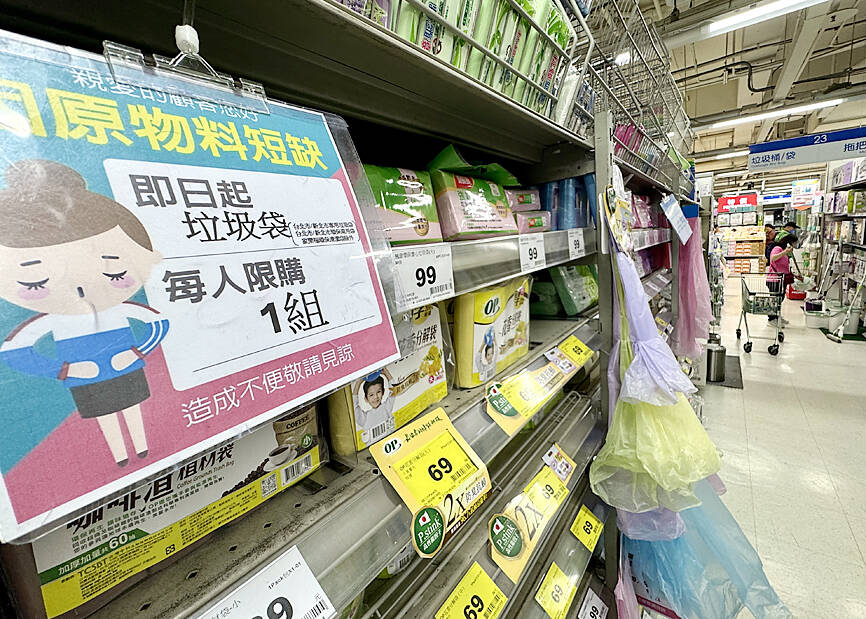
Photo: CNA
The Cabinet at a news conference said the government has coordinated state-owned oil supplier CPC Corp, Taiwan (CPC) to activate the No. 4 naphtha cracker on Wednesday last week to boost ethylene supply.
The nation’s total production of the upstream raw material would increase from 60,000 tonnes last month to 79,000 tonnes this month, and reach 90,000 tonnes next month, with a maximum production expansion of 30,000 tonnes, it said.
The total production of midstream raw material polyethylene would rise from 22,000 tonnes last month to 27,500 tonnes this month with a further increase expected next month, it said.
Minister Without Portfolio Yeh Chun-hsien (葉俊顯), also the minister of the National Development Council, said there are two major market stabilization mechanisms in place to stabilize oil and gas supply, as well as industrial supply chain operations.
Current inventories of oil and gas are above the statutory requirements, and CPC and Formosa Plastics have procured additional crude oil and naphtha shipments from this month to July, rerouting them from the Red Sea for export, Yeh said.
Liquefied natural gas shipments for this month and next month have also been secured, he added.
Fifteen vessels are required for deployment in June, and 11 vessels have already been procured, he said.
Gasoline and diesel prices were originally set to rise by about NT$6.8 and NT$8.8 (US$0.21 and US$0.28) per liter respectively this week, but under a special price stabilization mechanism, the increases would be absorbed by the CPC, Yeh said.
Therefore, natural gas for household use and bottled LPG prices would remain the same this month, and electricity rates would also not change, he said.
CPC’s No. 4 naphtha cracker resumed operations on Wednesday last week to ensure sufficient upstream production for domestic demand, so production can increase by 19,000 tonnes this month and by 30,000 tonnes next month to help stabilize industrial supply chain operations, he said.
Along with Formosa Plastics’ output, the total ethylene production is expected to reach 169,000 tonnes by October, which would be sufficient to meet domestic demand, he added.
CPC has launched a special project to provide 5,000 tonnes of ethylene at stabilized prices to Formosa Plastics to ensure affordable polyethylene production, and 20 plastic processing companies have been coordinated to increase monthly production by 1.25 billion plastic bags, Yeh said.
For businesses facing shortages, dedicated personnel can be assigned to handle specific cases and assist them in resource allocation and supply matching, he added.
Meanwhile, the Food and Drug Administration (FDA) said domestic medical device manufacturers require about 1,138 tonnes of plastic raw materials per month, adding that it has adopted two approaches to ensure a continuous supply of medical materials.
FDA Director-General Chiang Chih-kang (姜至剛) said the agency has established a dedicated contact window on its drug and medical device supply platform, allowing domestic pharmaceutical and medical device providers to report if they encounter shortages in raw materials.
An inventory check showed that about 1,138 tonnes of plastic raw materials are required by domestic medical device manufacturers each month, so the Ministry of Economic Affairs’ Industrial Development Administration (IDA) has coordinated suppliers to prioritize these orders, he said.
Eight pharmaceutical companies and 14 medical device manufacturers had reported potential plastic material shortages, and with the IDA’s assistance, six pharmaceutical and six medical device manufacturers have been matched with raw material and packaging suppliers, Chiang said.
Regarding the rising costs, he said the necessary additional funding would be covered by the NT$20 billion National Health Insurance (NHI) Reserve Fund, and manufacturers can also apply to the NHI Administration for price renegotiations.
If healthcare providers encounter suspected price gouging by manufacturers, they can report such cases to the Ministry of Justice, he added.
Additional reporting by Tseng Yi-ning

The military has spotted two Chinese warships operating in waters near Penghu County in the Taiwan Strait and sent its own naval and air forces to monitor the vessels, the Ministry of National Defense (MND) said. Beijing sends warships and warplanes into the waters and skies around Taiwan on an almost daily basis, drawing condemnation from Taipei. While the ministry offers daily updates on the locations of Chinese military aircraft, it only rarely gives details of where Chinese warships are operating, generally only when it detects aircraft carriers, as happened last week. A Chinese destroyer and a frigate entered waters to the southwest

A magnitude 6.1 earthquake struck off the coast of Yilan County at 8:39pm tonight, the Central Weather Administration (CWA) said, with no immediate reports of damage or injuries. The epicenter was 38.7km east-northeast of Yilan County Hall at a focal depth of 98.3km, the CWA’s Seismological Center said. The quake’s maximum intensity, which gauges the actual physical effect of a seismic event, was a level 4 on Taiwan’s 7-tier intensity scale, the center said. That intensity level was recorded in Yilan County’s Nanao Township (南澳), Hsinchu County’s Guansi Township (關西), Nantou County’s Hehuanshan (合歡山) and Hualien County’s Yanliao (鹽寮). An intensity of 3 was

Japanese Prime Minister Sanae Takaichi’s comment last year on Tokyo’s potential reaction to a Taiwan-China conflict has forced Beijing to rewrite its invasion plans, a retired Japanese general said. Takaichi told the Diet on Nov. 7 last year that a Chinese naval blockade or military attack on Taiwan could constitute a “survival-threatening situation” for Japan, potentially allowing Tokyo to exercise its right to collective self-defense. Former Japan Ground Self-Defense Force general Kiyofumi Ogawa said in a recent speech that the remark has been interpreted as meaning Japan could intervene in the early stages of a Taiwan Strait conflict, undermining China’s previous assumptions
Taiwan Railways Corp (TRC) today announced that Shin Kong Mitsukoshi has been selected as the preferred bidder to operate the Taipei Railway Station shopping mall, replacing the current operator, Breeze Development Co Ltd. Among eight qualified firms that delivered presentations and were evaluated by a review committee, Shin Kong Mitsukoshi was ranked first, while Breeze was named the runner-up, the rail company said in a statement. Contract negotiations are to proceed in accordance with regulations, it said, adding that if negotiations with the top bidder fail, it could invite the second-ranked applicant to enter talks. Breeze in a statement today expressed doubts over


 RSS
RSS